Showing posts with label hf. Show all posts

04 February 2024

So Close, Yet Still Oh So Far

I got bored yesterday and decided to put together yet another one of my ham radio transceiver evaluation spreadsheets. This time I wanted to evaluate QRP and 100 watt HF rigs against the same criteria, but not have them compete in the same space. So I decided to take a look at 100 watt rigs and QRP rigs separately.

My evaluation criteria change around the margins from year-to-year, but there are always a core set of requirements I'm looking for. These are MY requirements, the features and capabilities that matter to me. I also only evaluate rigs I've got personal experience with, or rigs that have caught my eye. For example, as kind of a toss-in to see where the market is today I decided to add the new(ish) Yaesu FT-710 to the evaluation. I have no personal experience with the rig, other than about a 15 minute test session at my local HRO showroom, but felt it deserved to be evaluated against some of its older siblings like the FT-897 and the FT-891.

Some of the radios I evaluate are out of production, so their scores really are not relevant to anyone other than me. But, since they are in my radio arsenal, I figured they would serve a useful purpose to highlight how far current rigs have (or have not) improved in terms of features and capabilities.

Let's talk briefly about the evaluation criteria. As I said, these are features that matter to ME. However, I know from talking to a lot of hams that like to operate outdoors that many of you are interested in these features, too. I also weight the evaluation criteria. For example, I consider the a built-in sound card interface to be critically important, so I give it an evaluation weight of 3, as opposed to having back-lit buttons, which only gets an evaluation weight of 1. While I think back-lit buttons are important, I consider a built-in sound card interface to be three times as important. 

Let's review some of the criteria:

  • Built in panadapter. This implies the radio has a real-time panadapter and waterfall display. Over the years I've found this a very useful feature, particularly when doing digital modes. A panadapter isn't absolutely critical; some high performing rigs on this evaluation, like the KX2, don't have them, but if the radio does have one that's a plus
  • Sound card interface. I've already discussed this above. My feeling is this - with a modern rig of any type, if you are a manufacturer and don't include a sound card interface, you are half-stepping it
  • Ease of digital mode configuration. It's one thing to have a built-in sound card. It's another to have a firmware set that makes it easy to configure for and run sound card digital modes. In my experience, Icom clearly excels at this. While no manufacturer's digital mode configuration settings are exactly 'easy', Icom's configurations are the least confusing and aggravating to set up and troubleshoot. 
  • Internal battery. It used to be only QRP rigs came with internal batteries (and not all of them, at that). I can understand 100 watt rigs not having internal batteries due to cost and technical complexity (although that excuse is becoming harder and harder to swallow, given recent improvements in battery chemistries and charging technologies), but there is NO reason today for a QRP rig to not have replaceable, rechargeable internal batteries or, in the case of rigs like the IC-705 and the Lab599 TX-500, a battery holder that securely attaches to and integrates with the main radio body
  • MARS mod. This is important to me, but likely not to many others. I'm a licensed MARS operator, so the ability to do a wide-band TX mod on any radio I own is important. The good news is that just about any radio can take a MARS modification. The challenge is the cost and difficulty. Most radios need some physical modification - either the removal of diodes or, in the case of some Yaesu rigs, adding a solder bridge across two open pads on a board. But the all-time winner is Elecraft. Their MARS mods are done via software - quick, easy, elegant and reversable
  • Tuners. Most tuners built into 100 watt rigs are anemic, handling (at best) a 4:1 antenna mis-match. They'll tweak up an 'almost resonant' antenna, but choke when the SWR crawls above 5:1. But what if you are dealing with some serious mis-matches under something like disaster response conditions? Spare me the talk about only using resonant antennas. I operate in the real world, where I've got one antenna up, and it's got to work on 10 - 40 meters and, if possible, at reduced power on 80 meters. This is why I want a more robust tuner in my radio. I'm OK with a tuner that can handle a 4:1 mis-match, but if you can give me one that'll handle 10:1, and build it into the radio, you get an extra point in my evaluation
  • IP and MILSTD ratings for water/dust resistance and ruggedness. Every rig fails at this, but I keep it as aspirational evaluation criteria. Both Yaesu and Icom know how to build IPX and MILSTD radios - they do it every day for the military, marine, aviation, commercial and land mobile markets the serve, and they also do it for some of the ham radio UHF/VHF handheld radios they currently make, like the Icom ID-52. There is no reason why they can't put just one HF radio in their lineup that meets these standards
  • Factory ruggedized. This is the most subjective evaluation criteria I have. It is different from IP and MILSTD ratings, but the end goal is the same - a radio that offers improved water and shock resistance for field use. There two radios on my list that manufacturers have either implied or outright stated as built to a higher standard - the Icom IC-7200 (now out of production) and the Lab599 TX-500. I've opened up my IC-7200 several times, and I can tell you that radio is about as water resistant as a submarine with screen hatches. It looks rugged, but it's really just a plastic shell surrounding a huge heat sink. A good radio, yes, but in no way water resistant. Icom should be ashamed of itself for implying in their product literature that the IC-7200 was in some way more water resistant than other radios on the market. The TX-500 is a different story. Lab599 proudly states that the radio is built to offer a higher level of water resistance. While the radio doesn't meet IPX or MILSTD ratings, reports from the field are that the radio really does offer serious water resistance in light rain and snow (it's a Russian design so, yeah, snow). The TX-500 is the only radio I give an extra point to for being truly rugged 

What's not in this evaluation criteria? UHF/VHF capability. Since I'm only interested in HF, I don't take into consideration any UHF/VHF capabilities the radio might have. Both the IC-7100 and the IC-705 offer UHF/VHF, but I simply don't care when it comes to what I'm looking at here. I also don't evaluate for CW capabilities. I'm not a CW operator. HF voice and digital only.

So, winners? Here's a few:

  • In the full-size 100 watt category, the IC-7300 is the winner. I've said this many times in the past - if you want an HF radio that works great in the widest number of scenarios, the IC-7300 is it. After over a decade in the market it really hasn't been beat. It's not a perfect radio by any means, but compared to all the others in it's market niche, it is still the best.
  • In the QRP rig category, the IC-705 is the clear winner. Like the IC-7300, it works best in the widest set of circumstances and offers those used to Icom's command and feature set a very similar menu structure. In fact, if you can operate a current Icom HF radio (7300, 7610) you can operate the 705 with ease. Performance on HF digital, with one exception, is a dream. It is hands down the easiest to configure and run digital QRP radio on the market. That one exception? RFI interference via the USB connection. This is a very serious issue, one that Icom has acknowledged, but not likely to address. The way around this is to run the radio on digital modes via wi-fi. There are several apps you can use for this, but I've had the most success with Icom's own RS-BA1 software 
There's no losers, per-se. Just several second place finishers, and a few radios that should have been spared this comparison (like the Yaesu FT-818 and the Xeigu G90). The #2 finisher in the 100 watt category is the Icom IC-7100. Even after 15 years of production, this is still a very viable design, with an excellent feature set and great digital mode performance. Icom kinda' sorta' killed it off in early 2023, then resurrected it for another production run (and with a corresponding price increase). Speculation is that the 7100's replacement has been delayed due to chip shortages (boy, that excuse is wearing thin), and Icom scraped up enough parts to do a final production run or two of the 7100 as a 'gap filler' until the new radio can make it to market. 

Some observations regarding other radios. The Yaesu FT-891 remains the radio that could have been. If  you look at the score it received, a respectable 9, and then consider where that radio would have placed if Yaesu had put a sound card interface in it (giving the rig 3 more points), that would have put the radio in a solid 2nd place, ahead of the IC-7100. But considering Yaesu has a long history of snatching defeat from the jaws of victory. Jeezus guys, just a simple sound card interface!

The Yaesu FT-710 looks like a solid performer, and I have to admit that I quite liked the interface when I played with it at HRO. Far, far better than the awful interface on the FT-991A. But I've also heard some of the same stories regarding digital mode configuration with the 710 that I heard with earlier models. Again, an overly and unnecessarily complex command set. I'll be doing more research on this rig before making a final assessment.

In the QRP category, while the Elecraft KX line remain strong contenders, their single biggest weakness is digital mode operations. The KX2 is a bugger to configure and run on digital modes, and the rig heats up very quickly. It just seems that digital operations were an afterthought with these rigs. On sideband they are unmatched in their class - even better than the IC-705. The venerable old FT-818 is such a simple rig that it's actually easy to configure for digital modes, and it'll run all day long on its 5 watt output. Sometimes simpler is better. Too bad the old girl isn't really competitive in any other category. But hey, it's almost a quarter century old design, so it can be forgiven.

OK, this is it for now. Remember, these are MY selections based on MY criteria. I'm sure many of you will disagree, so let me have your comments!

W8BYH out

09 April 2023

A View From The Bench - 09 April 2023

Happy Easter!

The way things are going, I'll be dead before I get all my ham radio projects out of the way. I'm guessing that's a that's a good thing? It means I'll be busy right up until the end.

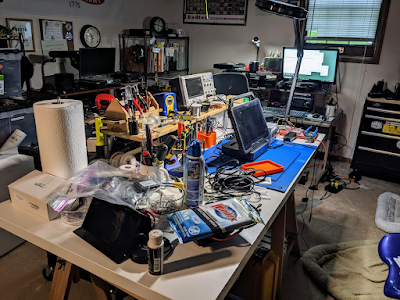
The view from the bench is... messy

I've already told my employer that I intend to retire around Christmas 2023. The retirement finances are lining up (as long as the current administration doesn't screw things up even more) and my wife and I have decided it's just the right time.  There's so much stuff we want to do while we are physically able to do it.

That includes more radio projects. The way these projects are stacking up, I'm beginning to think I should have retired a few years ago.

  • I've built a HobbyPCB HardRock50 amplifier for use with my Yaesu FT-818, KX2 and IC-705. The kit I bought from a seller on QRZ.com was new-in-the-box. It seems to work fine with the FT-818, but now I need to finish putting together the tuner. It's a project I've been putting off, and off. Time to finally get it done so I can test it with the Icom IC-705. That's a radio badly in need of a good 50 watt amplifier/tuner.
  • How about a TNC for the IC-705? I'm still trying to figure out how to get my Mobilinkd TNC3 working with the IC-705, so I can do VHF packet (and maybe APRS?) on it. Any ideas?
  • As for APRS, there's more to do be done. I'm increasingly curious about APRS and its potential use for emergency communications. Sadly, there are few good out-of-the-box solutions. The biggest issue is the difficulty of composing and managing messages. This is where the Yaesu FT-3DR (and, I suspect, the FT-5DR) fails. Spectacularly. To be fair, offerings from other manufacturers like the otherwise great Kenwood TH-72D and 74 had the same issue: lousy messaging interfaces. The best solutions I've seen so far are third party apps like APRSDroid for Android and APRS.fi for iOS, linked by Bluetooth to a TNC like a Mobilinkd TNC4
  • Speaking of Yaesu, Kenwood & Icom, things have been very quiet on the new announcement front. While not normally a bad thing, these are not normal times. Yaesu has done a good job of keeping interest going in their radio lineup with some new releases like the FT-5DR, the FT-DX10 and the FT-710, but there's been almost nothing out of Icom, and Kenwood has been silent on new releases since before the pandemic. With the announced demise of the IC-7100, Icom has a huge hole in their HF/VHF offerings. Specifically, Icom has no high power HF DSTAR offering, a significant market gap for a company that has hitched it's ham radio star to DSTAR (pun intended). All eyes are on Hamvention!
  • Web map development. The ARES Southeastern US Situational Awareness Map is slated to receive a major clean-up, where I'll be pulling selected data layers from the map to improve performance. Many of the more esoteric layers that get little, if any, use will be dropped in an attempt to improve map load and refresh times
  • I've about finished my hunt for the perfect laptop for use during outdoor activations, and I've got an upcoming post on the topic. After spending over a year testing and evaluating I've found my ideal. And it's not just good - as Tony the Tiger says, "It's great!"
  • I'm getting back to an earlier interest in HF-based off-grid emergency communications. I covered the topic in some depth a few years back, but the new player on the scene - VarAC (Vara Chat) - looks like it's lapped the previous HF chat application leader, JS8CALL. Back in October I did a short post on it, but since then the pace of development on VarAC has been almost frantic, as the author and his supporting developers rush to incorporate new features. As a result the application interface has gotten a bit messy. My feeling is that the developers now need to take a pause and work on the interface and do an overall look and feel improvement
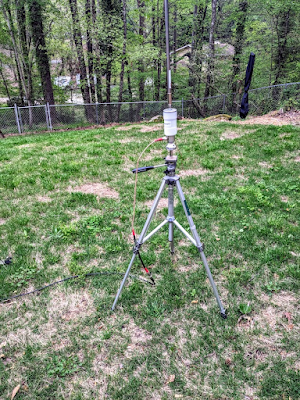
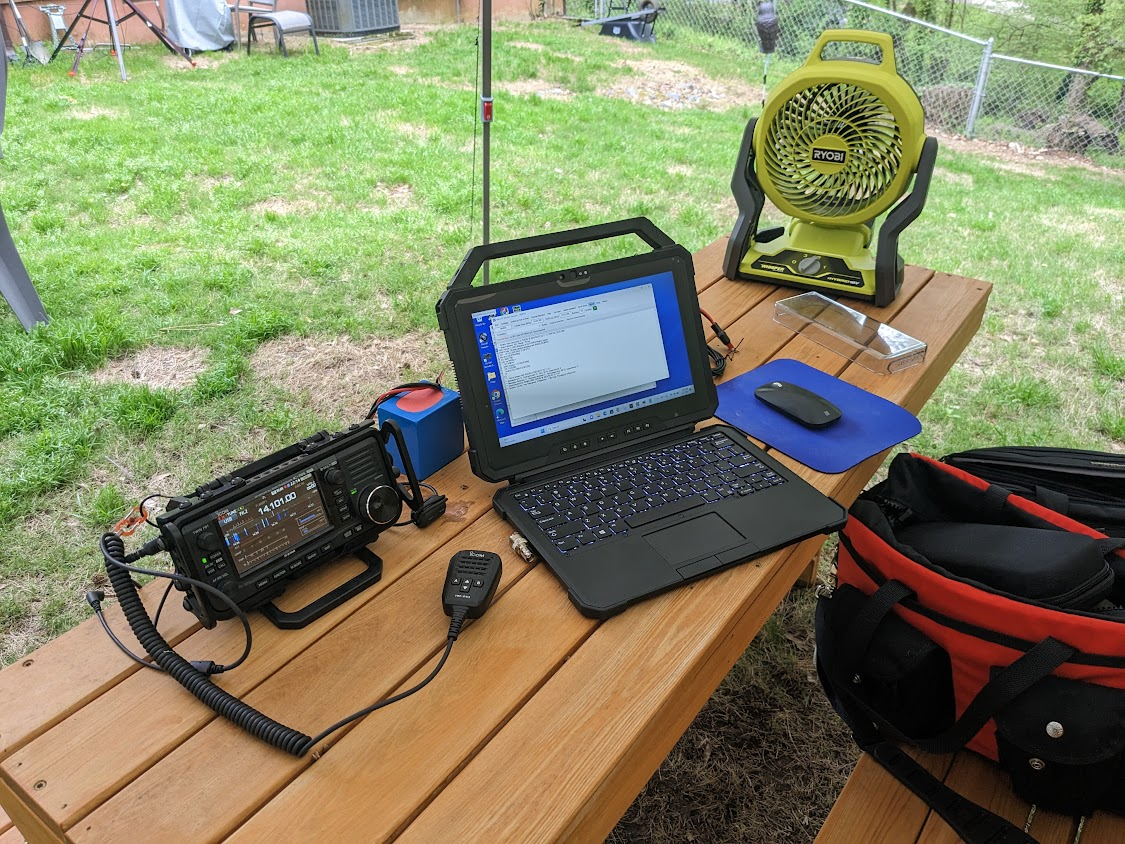
  • And last, sometimes the simplest works just fine. Yesterday I had a limited window of opportunity to 'play radio' in my back yard before a cold front with rain pushed through. I wanted to do some Winlink and if possible a few VarAC sessions, but I got caught up in some antenna issues. After fumbling with various configurations I just said 'screw it' and stuck a 17' Chameleon collapsible whip on a tripod with one counterpoise. I was surprised to find that combination worked just great on 10 - 40 meters (using a tuner, of course). I was hitting Winlink RMS nodes up to 400 miles away on 10 watts. I'll take that!
Chameleon 'mini' base with a 17' collapsible whip
and one counterpoise

The battery powered Ryobi fan does a great job of
keeping the little biting buggers away and the
operator cool. Runs almost all day on a
4 ah battery

Have a great day! W8BYH out.

14 November 2022

The HF Renaissance In The US Army

Today I'm taking it easy and letting someone else do the hard presentation work 😄.

There are a number of good YouTube videos on the resurgence of HF communications in the US Army  that have been released in the last decade, and I've touched on the topic in this blog. For me this is a fascinating topic - I'm very much an 'everything old is new again' kind of guy. 

This presentation by Colonel Stephen Hamilton from the Army Cyber Institute is probably the best single presentation on the topic. If you've followed this topic at all in the past few years you've seen a lot of this material, but this is probably the best compilation of all the information, and COL Hamilton clearly has mastery of the topic.

The presentation was hosted by The Radio Club of America. Highly recommended, and definitely worth tagging as a favorite in your YouTube account.


W8BYH out

02 April 2022

MARS Mod

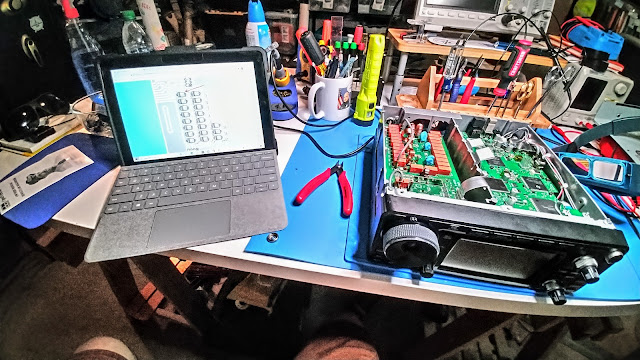
In past posts I've hinted that I'm not afraid to get into the gust of certain radios to do what is referred to as the 'Mars mod'; open the radio up for wide band transmit for use on MARS and SHARES frequencies. To date I've done it on two Icom IC-7100's, two Yaesu FT-891s and, before I got adventurous with a soldering iron, paid to have it done on an Icom IC-7200, a 7300 and a Yaesu FT-991A.

A week ago, as part of my pure fleet initiative, I bought a used IC-7300 from a seller on QRZ.com. I've been haunting various ham radio equipment sale and swap sites for a while now, looking for a good deal on a used 7300, so when this one popped up I grabbed it. Even before I had it in-hand, I was thinking about doing the MARS mod myself. The modification procedures for many HF rigs are available on the internet, and for modern Icom radios it usually means removing a diode from the main board to open up the transmit stage (opening up the receive side is usually not necessary). In the past I used a soldering iron to loosen the solder holding the surface mount diode to the board, and that's a worrisome mix of shaky hands, teeny-tiny closely packed components and a hot soldering iron. But as I was discussing this process a few days ago with my good friend Ken, AI4UW, he asked two key questions: Do you intend to ever re-install the diode? Is the diode in a location you can get to it with a pair of miniature side-cutters? No to the first, yes to the second. Well, he said, just go in with a small set of side cutters and snip it off the board. Just make damned sure you snip the right diode! Ken does high level aviation electronic system repair for Delta Airlines. If you fly Delta into or out of Atlanta, odds are good that Ken has worked on an electronics system on that plane. He knows what he's talking about, so I decided to follow his advice and go the 'snip' route.

The diode we're after is on the underside of the main board, so we have to
remove the bottom cover

We're after diode D422, and ONLY D422

It's important to have your references at-hand when doing this work. The last
thing you want to do is remove the wrong component

You're gonna' need magnification. Lots of it. 

It was hard to get the camera to focus, but the diode is about where the arrow is pointing

Again, poor focus, but you can see the pad for the diode after it was removed by snipping it out

Glamour shot! Here's a wider view of the radio from the bottom, looking at the underside of the
main board and the build-in tuner. The IC-7300 is actually a very beefy radio

I have to say, it was a very simple process, and a lot easier and a lot less anxiety-invoking that trying to remove the diode with a soldering iron. The shears I used were the Crescent miniature wire cutters available from Amazon, Home Depot or Lowes. Because the cutters are angled and ground flat, they can also act as side-cutters, which allows you to get flat to the circuit board when performing this operation.


Easy and simple process, yes. But did it work? Have a look:


This gives me two identical high performance HF rigs that can be used across all the Amateur, MARS and SHARES frequencies, and allows me to dedicate a rig for each role. If one fails, the working radio can be easily and quickly re-configured to take over the job of the other. It's a simple configuration file upload from an SD card. I'm happy.

W8BYH out

31 December 2020

The Death Of The Basic HF Rig?

Something happened during the COVID year. It appears the Big Three manufacturers (Icom, Kenwood, Yaesu) have abandoned the basic 100 watt HF rig market. The thought struck me as I was perusing the radio offerings on the Gigaparts website earlier today.

I define a 'basic' HF rig as a tabletop radio that cost less than $800 new and covers 80 thru 10 meters and offers 100 watts of output power. The basic rig doesn't have to have a tuner, or a sound card interface, but it should come with a CAT interface. Right now the only tabletop rig for sale that meets this criteria is the 'venerable' (that's my way of saying 'really old') Icom IC-718. This was my first rig when I got my General ticket back in 2002, and it was a few years old even then!

Icom IC-718. Older than many Amateur Radio operators,
and still in production

In fact, you have to look down into mobile rig territory to find anything else that fits the basic rig definition, and that's the Yaesu FT-891 and the Icom IC-7100. The FT-891 is arguably a much better HF rig than the 718, but it's a radio with its own set of issues. 

The Icom IC-7100 gets special recognition. Rebates put the street price right around $760 (retail is $860) and the price/performance ratio is very high. In my mind this makes the IC-7100 the single best option for a basic rig. It is a very, very good rig, and in the basic category it sweeps all before it. But it stands alone in a field that used to be fairly crowded.

The IC-7100. The best 'basic' HF rig currently available.
But for how long?

In the past year or two a number of really good basic HF rigs were dropped by their manufacturers and replaced with... nothing:

  • Yaesu FT-450D
  • Yaesu FT-857D
  • Icom IC-7200
  • Alinco DX-SR8, and maybe even the DX-SR9
  • Kenwood TS-480
To be fair, most of these radios (with the possible exception of the IC-7200) were really old designs, and for many of them parts availability started to become an issue. Some radios, like the Yaesu FT-857D, were pushing a 20 year production life and needed a mercy killing. Others. like the Yaesu FT-450D were still very viable and competitive little rigs, and still had a lot of life left in them. The real problem is, the manufacturers didn't introduce anything to backfill the market gaps created when they stopped production on these radios.  

At some point, maybe as soon as 2021, currently manufactured basic rigs like the IC-7100 and the IC-718 will be pulled from production. It's inevitable. Every radio goes out of production at some point. What then? Does the market definition of a basic HF rig move up to the $1,000 price point? Do one or more of the Big Three introduce a new 'affordable' rig? Do the Chinese step in with new categories of low cost 100 watt rigs? Do new players enter the market? For example, why haven't the Koreans played the ham radio market? They certainly have the technical and manufacturing expertise, and market presence (think Samsung, Hitachi or LG). Do boutique manufacturers like Elecraft or FlexRadio step up?

Or... are we truly seeing the end of the basic low cost 100 watt HF radio?

One thing's for sure - 2021 will be a very interesting  year in Amateur Radio.

Happy New Year!

W8BYH out

22 September 2018

Farewell To The Icom IC-7200

With no official announcement from Icom, this week US distributors quietly began marking the Icom IC-7200 as 'discontinued' on their websites


IC-7200 with the optional grab handles

This is a darned shame. The IC-7200 had something of a cult following; it was rugged, military like in it's design and it just looked cool. But it was no slouch - it offered great HF performance and incorporated a sound card interface that made using it on digital modes like PSK-31 or for Winlink a snap.

The IC-7200 was declared dead once before back in 2016, but a year later customer demand spurred Icom to put it back into production. One dealer, Gigaparts, capitalized on the radio's rugged appeal and offered the radio in several custom colors done up by an after-market paint shop. Some of the designs were a bit outlandish, but the 'Vietnam olive drab' option was an attention grabber.


I've owned my IC-7200 for about a year and was so impressed with its performance and rugged build that I was planning to buy a second as a back-up. Alas, it looks like I'll be looking for a used one if I don't move fast.

I'm also scratching my head wondering just why Icom killed off this radio but keeps the very long in the tooth IC-718 in production. The IC-718 went into production almost 5 years before the IC-7200 first came to market. It's a good radio, and Icom has sold truckloads of them, but it's an archaic design by today's standards and other than a low(er) price and the Icom name badge it really doesn't offer any thing that would make it competitive. In fact it's direct competitor in the Yaesu lineup - the FT-450D is a much better radio. The IC-7200 could hold its own against the FT-450D, but not the IC-718.

My guess is that Icom figured out that the IC-7200's sales were eating into sales of the IC-7100 'shack in the box'. Just speculation. Or maybe Icom's got a nifty IC-7200 replacement waiting in the wings. Maybe a ruggedized manpack HF rig, 20 watts out, internal battery pack, takes a whip antenna for operations on 10 and 6 meters, fully integrated handset. Hey c'mon Icom, make Daddy happy!

But in the meantime my IC-7200 will soldier on. I recently had the MARS/CAP mod done on it and it gets dragged to the field now and again for some fun.

IC-7200 running Fldigi from the back of my truck

It's a workhorse for sure. I'm keeping mine.

W8BYH out