The XYL and I are planning for a long road trip - winding our way north to Michigan to attend a family wedding, then wandering back down towards Atlanta and visiting family along the way (many of them helpfully live just off of I-75). Normally when we camp, ham radio is a big part of the trip. Hours and hours of tinkering and making contacts while my wife reads or naps. This trip is different. It's like a military campaign. Get to Michigan as quickly and efficiently as possible, hang out with long-lost relatives and friends, head back with stops along the way to visit other long-lost relatives. We have a 22' pull-behind camper, but our overnight stays at any one place will be brief and, again, the focus will be on visiting with relatives, not stringing wire.
And yet, ham radio must play a part, even if it's a small one. On this trip the focus will be on back-up communications. I intend to take an HF setup that is small, efficient, easy to deploy, and I know works well on Winlink. The whole package - radio, antenna, power source, cabling, etc. needs to be as small and light as possible.
The antenna decision has already been made - Chameleon Antenna's excellent Tactical Delta Loop. It's fast and easy to set up, and versatile. If there's no space for the full delta loop deployment it can be configured as a simple vertical. The back-up antenna is a Par End-Fedz trail friendly EFHW.
But the radio selection process is more involved. I have something of an embarrassment of riches when it comes to rigs. I'd normally just toss my IC-7300 into a Pelican case and be done with it, but on this trip that radio (and case) would be too big. Something smaller is in order. Here's my options:
Icom IC-705
Elecraft KX3
Elecraft KX2
Yaesu FT-818
The IC-705 would seem, to most, to be the logical choice. It may well be, but the radio with all of it's necessary out-boarded components (like the AH-705 tuner) fits into a very chunky box. I'll admit though, in that chunky box there's a LOT of capability, and the 705 is a proven performer. In past write-ups I've called it a 'digital mode beast', and it is. Once you get it set up using a wi-fi connection between the rig and your computer, the thing will loaf along all day on digital modes and get only slightly warm. Icom did a remarkable job with heat management on this rig.
Next, the KX3. This is the excellent Elecraft K3 desktop rig squeezed down into a surprisingly small package. What got left out was TX power. The KX3 puts out only 15 watts compared to the K3's 100 watts, but it retains all of the K3's world-class receiver performance. The KX3 overall is about the same size as the IC-705 but includes a built-in tuner and battery pack (although on internal batteries it only puts out between 3 - 5 watts). The radio requires an external soundcard for digital modes (I use an inexpensive Sbarent USB soundcard), but it's easy to configure and at moderate digital activity levels without getting too hot. I've installed an after-market heat sink, which helps. The KX3 with accessories fits into a Pelican case that is about 20% slimmer than the case the IC-705 fits into.
The KX2 is Elecraft's SOTA/POTA focused rig. They took the KX3, dropped 6 and 160 meter coverage, included a built-in tuner, lithium battery, internal charger, a built-in microphone and made it smaller and lighter than the KX3 by about 15%. Max output is only 10 watts, but you can actually achieve that for short periods on the internal battery. Yes the controls are cramped, but that's a reflection of the size of the radio. What Elecraft did retain from the KX3 is the large high contrast display. The display on both rigs is excellent - logically laid out, easy to read, and if you turn off the backlight, the radio sips just milliwatts on receive. No waterfalls, though. Like the KX3, this radio requires an external soundcard. The digital configuration is the same as for the KX3, but because of the smaller size of the KX2 it doesn't handle digital modes quite as well - it can get hot. But, for emergency Winlink use it's just fine. The KX2 doesn't get transported in a hard case. It travels around in a small soft bag.
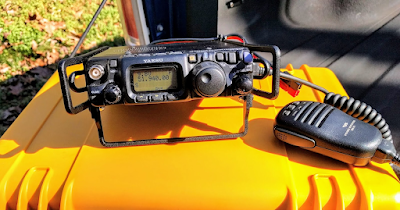
OK, the Yaesu FT-818 is not a serious contender for this trip, but it IS available if I'm thinking of something for a back-up rig. My 818 has the Windcamp lithium battery mod, and that turns the radio into a viable emergency use rig. Plus, the little thing is so easy to use - it's probably the last honest radio Yaesu released, honest from the perspective that all the controls are logically laid out, the small display shows you everything you need to know, and not a pixel more, it's easy to configure, doesn't throw any surprises your way, and runs remarkably well on digital modes with an external soundcard. In fact, compared to Yaesu's later offerings like the FT-891 or the FT-991A, the FT-818 is a simple joy to use.
So which is it? At this time I haven't made up my mind, so if you have any advice or suggestions let me know in the comments below!
This past weekend's reveal at the annual Japanese Ham Fair may kill off the market for good used Yaesu FT-817s & 818s. Yaesu announced the pending release of their FT-818 replacement, the FTX-1F.
From what we know so far, this new radio looks like it's got a pretty good feature set. There are some lingering questions about things like Bluetooth, Wi-Fi and GPS capability, but overall it looks like a worthy successor to the FT-818, and should give the Icom IC-705 some stiff competition. But we won't really know how 'stiff' until we start seeing some pricing information.
But if you are like me, and have one (or more) of the venerable old FT-818s sitting around, and are thinking hard about the FTX-1F, the question now becomes, what do I do with my old 818? Here's some options I've been pondering:
Put together a radio 'bug-out' kit with the FT-818 as a centerpiece and just leave it in my truck
Set it up in my ham shack as a back-up (to a back-up). The little rig does just dandy on VHF/UHF and with my exterior antenna I can hit our local repeater with ease. I may just designate it as an over-sized HT and call it a day
Hook it up to a SignaLink, park it on a single digital frequency, and turn it into something like a full-time JS8Call machine
Try to rig up some sort of manpack HF system
Sell it to help fund the possible purchase of an FTX-1F
Use it as a door stop
Like so many hams, I've got a soft spot in my head heart for the FT-817/818. It was a paradigm changer when it came out in 2004, and it's the radio that helped start the SOTA craze. It proved to be a rugged and versatile little beast that saw it used in some pretty unusual non-ham applications. How unusual? It was bought in large numbers by Central and South American revolutionaries and drug cartels (often one in the same) for short and long range jungle communications. While today it's a very outdated design, that's no reason to toss it. After all, every week we've got thousands of hams firing up even older tube-based gear to get on the air. Nobody today thinks of tossing a Collins S-line into the dumpster.
OK, so I've talked myself into hanging on to my FT-818. But what to do with it? Other than the ideas I've outlined here, anyone have any suggestions?
I got bored yesterday and decided to put together yet another one of my ham radio transceiver evaluation spreadsheets. This time I wanted to evaluate QRP and 100 watt HF rigs against the same criteria, but not have them compete in the same space. So I decided to take a look at 100 watt rigs and QRP rigs separately.
My evaluation criteria change around the margins from year-to-year, but there are always a core set of requirements I'm looking for. These are MY requirements, the features and capabilities that matter to me. I also only evaluate rigs I've got personal experience with, or rigs that have caught my eye. For example, as kind of a toss-in to see where the market is today I decided to add the new(ish) Yaesu FT-710 to the evaluation. I have no personal experience with the rig, other than about a 15 minute test session at my local HRO showroom, but felt it deserved to be evaluated against some of its older siblings like the FT-897 and the FT-891.
Some of the radios I evaluate are out of production, so their scores really are not relevant to anyone other than me. But, since they are in my radio arsenal, I figured they would serve a useful purpose to highlight how far current rigs have (or have not) improved in terms of features and capabilities.
Let's talk briefly about the evaluation criteria. As I said, these are features that matter to ME. However, I know from talking to a lot of hams that like to operate outdoors that many of you are interested in these features, too. I also weight the evaluation criteria. For example, I consider the a built-in sound card interface to be critically important, so I give it an evaluation weight of 3, as opposed to having back-lit buttons, which only gets an evaluation weight of 1. While I think back-lit buttons are important, I consider a built-in sound card interface to be three times as important.
Let's review some of the criteria:
Built in panadapter. This implies the radio has a real-time panadapter and waterfall display. Over the years I've found this a very useful feature, particularly when doing digital modes. A panadapter isn't absolutely critical; some high performing rigs on this evaluation, like the KX2, don't have them, but if the radio does have one that's a plus
Sound card interface. I've already discussed this above. My feeling is this - with a modern rig of any type, if you are a manufacturer and don't include a sound card interface, you are half-stepping it
Ease of digital mode configuration. It's one thing to have a built-in sound card. It's another to have a firmware set that makes it easy to configure for and run sound card digital modes. In my experience, Icom clearly excels at this. While no manufacturer's digital mode configuration settings are exactly 'easy', Icom's configurations are the least confusing and aggravating to set up and troubleshoot.
Internal battery. It used to be only QRP rigs came with internal batteries (and not all of them, at that). I can understand 100 watt rigs not having internal batteries due to cost and technical complexity (although that excuse is becoming harder and harder to swallow, given recent improvements in battery chemistries and charging technologies), but there is NO reason today for a QRP rig to not have replaceable, rechargeable internal batteries or, in the case of rigs like the IC-705 and the Lab599 TX-500, a battery holder that securely attaches to and integrates with the main radio body
MARS mod. This is important to me, but likely not to many others. I'm a licensed MARS operator, so the ability to do a wide-band TX mod on any radio I own is important. The good news is that just about any radio can take a MARS modification. The challenge is the cost and difficulty. Most radios need some physical modification - either the removal of diodes or, in the case of some Yaesu rigs, adding a solder bridge across two open pads on a board. But the all-time winner is Elecraft. Their MARS mods are done via software - quick, easy, elegant and reversable
Tuners. Most tuners built into 100 watt rigs are anemic, handling (at best) a 4:1 antenna mis-match. They'll tweak up an 'almost resonant' antenna, but choke when the SWR crawls above 5:1. But what if you are dealing with some serious mis-matches under something like disaster response conditions? Spare me the talk about only using resonant antennas. I operate in the real world, where I've got one antenna up, and it's got to work on 10 - 40 meters and, if possible, at reduced power on 80 meters. This is why I want a more robust tuner in my radio. I'm OK with a tuner that can handle a 4:1 mis-match, but if you can give me one that'll handle 10:1, and build it into the radio, you get an extra point in my evaluation
IP and MILSTD ratings for water/dust resistance and ruggedness. Every rig fails at this, but I keep it as aspirational evaluation criteria. Both Yaesu and Icom know how to build IPX and MILSTD radios - they do it every day for the military, marine, aviation, commercial and land mobile markets the serve, and they also do it for some of the ham radio UHF/VHF handheld radios they currently make, like the Icom ID-52. There is no reason why they can't put just one HF radio in their lineup that meets these standards
Factory ruggedized. This is the most subjective evaluation criteria I have. It is different from IP and MILSTD ratings, but the end goal is the same - a radio that offers improved water and shock resistance for field use. There two radios on my list that manufacturers have either implied or outright stated as built to a higher standard - the Icom IC-7200 (now out of production) and the Lab599 TX-500. I've opened up my IC-7200 several times, and I can tell you that radio is about as water resistant as a submarine with screen hatches. It looks rugged, but it's really just a plastic shell surrounding a huge heat sink. A good radio, yes, but in no way water resistant. Icom should be ashamed of itself for implying in their product literature that the IC-7200 was in some way more water resistant than other radios on the market. The TX-500 is a different story. Lab599 proudly states that the radio is built to offer a higher level of water resistance. While the radio doesn't meet IPX or MILSTD ratings, reports from the field are that the radio really does offer serious water resistance in light rain and snow (it's a Russian design so, yeah, snow). The TX-500 is the only radio I give an extra point to for being truly rugged
What's not in this evaluation criteria? UHF/VHF capability. Since I'm only interested in HF, I don't take into consideration any UHF/VHF capabilities the radio might have. Both the IC-7100 and the IC-705 offer UHF/VHF, but I simply don't care when it comes to what I'm looking at here. I also don't evaluate for CW capabilities. I'm not a CW operator. HF voice and digital only.
So, winners? Here's a few:
In the full-size 100 watt category, the IC-7300 is the winner. I've said this many times in the past - if you want an HF radio that works great in the widest number of scenarios, the IC-7300 is it. After over a decade in the market it really hasn't been beat. It's not a perfect radio by any means, but compared to all the others in it's market niche, it is still the best.
In the QRP rig category, the IC-705 is the clear winner. Like the IC-7300, it works best in the widest set of circumstances and offers those used to Icom's command and feature set a very similar menu structure. In fact, if you can operate a current Icom HF radio (7300, 7610) you can operate the 705 with ease. Performance on HF digital, with one exception, is a dream. It is hands down the easiest to configure and run digital QRP radio on the market. That one exception? RFI interference via the USB connection. This is a very serious issue, one that Icom has acknowledged, but not likely to address. The way around this is to run the radio on digital modes via wi-fi. There are several apps you can use for this, but I've had the most success with Icom's own RS-BA1 software
There's no losers, per-se. Just several second place finishers, and a few radios that should have been spared this comparison (like the Yaesu FT-818 and the Xeigu G90). The #2 finisher in the 100 watt category is the Icom IC-7100. Even after 15 years of production, this is still a very viable design, with an excellent feature set and great digital mode performance. Icom kinda' sorta' killed it off in early 2023, then resurrected it for another production run (and with a corresponding price increase). Speculation is that the 7100's replacement has been delayed due to chip shortages (boy, that excuse is wearing thin), and Icom scraped up enough parts to do a final production run or two of the 7100 as a 'gap filler' until the new radio can make it to market.
Some observations regarding other radios. The Yaesu FT-891 remains the radio that could have been. If you look at the score it received, a respectable 9, and then consider where that radio would have placed if Yaesu had put a sound card interface in it (giving the rig 3 more points), that would have put the radio in a solid 2nd place, ahead of the IC-7100. But considering Yaesu has a long history of snatching defeat from the jaws of victory. Jeezus guys, just a simple sound card interface!
The Yaesu FT-710 looks like a solid performer, and I have to admit that I quite liked the interface when I played with it at HRO. Far, far better than the awful interface on the FT-991A. But I've also heard some of the same stories regarding digital mode configuration with the 710 that I heard with earlier models. Again, an overly and unnecessarily complex command set. I'll be doing more research on this rig before making a final assessment.
In the QRP category, while the Elecraft KX line remain strong contenders, their single biggest weakness is digital mode operations. The KX2 is a bugger to configure and run on digital modes, and the rig heats up very quickly. It just seems that digital operations were an afterthought with these rigs. On sideband they are unmatched in their class - even better than the IC-705. The venerable old FT-818 is such a simple rig that it's actually easy to configure for digital modes, and it'll run all day long on its 5 watt output. Sometimes simpler is better. Too bad the old girl isn't really competitive in any other category. But hey, it's almost a quarter century old design, so it can be forgiven.
OK, this is it for now. Remember, these are MY selections based on MY criteria. I'm sure many of you will disagree, so let me have your comments!
I've been a ham since 1995 (original call KC5YNP). I'm very serious about the hobby, particularly the hardware side, and I've been blessed with the opportunity to test a wide variety of gear. It takes a lot to impress me, especially first impressions. I don't do 'fanboy' reviews - there's plenty of that crap out on YouTube. I'll tell you how I really feel about a piece of gear only after I've used and tested it over a long period of time. I also evaluate hardware within its original design envelope - how good was it when it was first released, not how well it works today. Here's an example - I'm frequently surprised by folks who buy a newly manufactured Yaesu FT-818 and then bitch about how it's a poor performer because it's not an SDR, or has poor filter options. Well duhhh. It's a 23 year old design! You have to evaluate hardware in the framework of its original design and when it was released to market. In its day the FT-817 (predecessor to the 818) was a groundbreaking little rig (and yes, it's on my list).
So how do I evaluate? To be honest, most of my criteria are subjective. But in general:
A radio must be well built - it must be physically rugged and able to provide years of service within its intended use case. What this generally means is that things like HTs need to be more physically rugged than an HF rig designed to sit on a desk
Whatever features a radio offers must be well implemented. For example, if an HT is 2 meters only, that's OK, but the features in the radio - thinks like navigating menus, entering frequencies directly into the VFO, etc. - must be well implemented and easy to figure out. I shouldn't have to turn to a manual to figure out what should be easy and obvious
Manufacturer specific features need to really work, and work well, and add value to the overall package. For example, a well known (and respected) manufacturer adds a lot of proprietary features to their radios that only work with other radios of the same brand. Things like group calling, group alerts, etc (experienced readers will figure out what manufacturer I'm talking about). I view these as cute parlor tricks that have little value in the real world. If adding these features to the radio incurs additional retail cost, or squeezes out other more useful features then that's a no-go
Value for money. A radio needs to offer good value for money. I have a lot more respect for a manufacturer that leaves out some bells and whistles to keep the cost down, as long as the overall package performs well.
There's also what I call the 'long term respect' factor. I've had radios that at first glance didn't impress me all that much, but after long periods of use I came to really respect them for one reason or another.
So without further ado, let's take a look at my list:
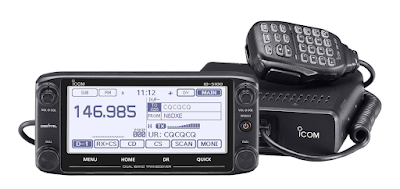
Icom ID-5100. The best dual band mobile rig I've ever used. This radio is, quite literally, my daily driver - I have it installed in my truck and it's been used daily for the past 3 years. I bought it for two features - DSTAR capability and the ability to do cross-band repeat. It does both of those spectacularly. I was so impressed with the first one I bought that I went out and bought a second for use in my shack.
Why I like it: Dual receive, very well implemented command set, a well thought out touchscreen interface, easy to implement cross-band repeat, rugged. An outstanding value for money, even if you don't use DSTAR.
Yaesu VX-6R. The sole survivor of Yaesu's classic 'rugged miniature' line of HTs that were very popular in the early 2000s. Just a simple, well implemented dual band (but not dual receive) radio in a small, rugged package. How rugged? I made a video once of me operating the radio during a tropical storm:
Why I like it: Rugged. Waterproof. Waterproof accessories. Well implemented command set. If you operate in wet conditions this is the radio to have.
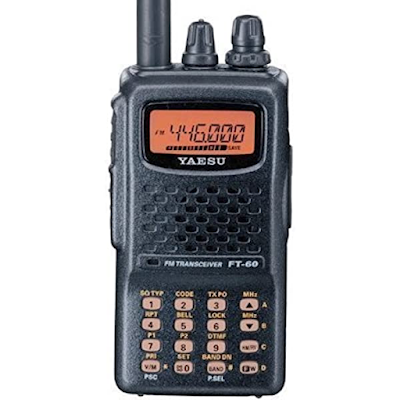
Yaesu FT-60. The HT that refuses to die. For good reason. Perhaps the best all-around, basic dual band radio on the market. It's unpretentious, extremely well made, has an easy to navigate menu system (thanks to the full keypad) and offers excellent receive audio - something more modern Yaesu HTs seem to struggle with. I've owned two, sold one, and gave the other away to a new ham. Now I'm seriously thinking about buying a third while they are still available.
Why I like it: for all the reasons I list above - it's rugged (although not waterproof like the VX-6), has a well implemented feature set, is easy to manage thanks to the full keypad (backlit, by the way), has great audio, and has real and easy to manipulate knobs for things like volume, squelch and channel selection.
Icom ID-51. I bought this radio strictly for the DSTAR features, and as I struggled to figure out DSTAR I found myself not really liking the radio. My frustrations with DSTAR had colored my perception of the ID-51, and I rarely used it. Heck, I almost came to resent the thing. All that money for a system I just couldn't figure out. Then one day I picked it up to use for a public service event where I needed to be able to monitor two analog repeaters simultaneously, and was forced to actually use the radio in a real-world scenario. I quickly came to love it. Although it just recently went out of production (replaced by the ID-52) I consider it, in its time, to be one of the best dual-band, dual-receive HTs ever made. This little radio is now one of my 'daily drivers', and it's the one I instinctively grab when heading out to a park, or just to walk the dogs around the neighborhood.
Why I like it: The feature set and controls are well implemented, the monochrome screen is easy to read, the audio is outstanding. It's also one of the most ergonomic radios on the market - it just feels good in the hand. Plus, it's rugged. Icom never really highlighted this about the radio, but the ID-51 carried an IPX7 rating, meaning it was highly waterproof. It's a lightweight, rugged little beastie.
Icom IC-7300. The radio that has re-defined the mid-range HF radio. I own two of these (one bought used) and I run them hard on both voice and digital modes. Think 90 watts on MARS digital modes. There simply is no better HF radio in the same price class, period. The 7300 deserves all the hype that surrounds it. Even today, almost seven years after it's introduction, it sells by the boat-load. Literally, by the boat-load; Icom can't make enough of them to meet demand. My only gripe with the IC-7300 is that it does not have back-lit buttons. That's it. I know several hams that have one or more of these in storage as back-ups in case their 'daily drivers' go down. But the thing is, they never seem to go down. The reliability of the 7300 is one of its hallmarks. It's almost like Icom built a 200 watt rig and put it into a 100 watt box. Psssst - here's a little secret: the IC-7300 is actually a pretty good portable rig. It's really not that large, is fairly lightweight, is quite rugged, and as long as you keep it out of the rain and dust it'll do just fine in The Great Outdoors.
Today, the IC-7300 is the only 100 watt HF rig I unhesitatingly recommend to new and old hams alike.
Why I like it: Outstanding feature set, pretty good internal tuner, perhaps the easiest 100 watt rig to configure for digital modes, build-in sound card interface, excellent digital mode performance, outstanding filtering, great TX audio, excellent third party support. An excellent value for money, particularly if you can find a good used one.
Yaesu FT-818. This is one radio I don't use all that often, but I just like knowing that I have it. It's the low power Swiss Army Knife of ham radio. It does everything. Often not particularly well, but it does it all - 70 cm thru 160 meters, FM/AM/USB/Digital. The radio design is over 22 years old, yet it's still relevant. No other QRP rig on the market offers the features, quality and reliability that the FT-818 does at a similar price-point. It is the value-for-money champ. It's issues are legendary - a lack of any real filtering, poor frequency stability (improved somewhat in the updated 818 with the inclusion of a factory TXCO), a laughably archaic charging and power management system (again, that 22 year old design coming to the forefront), and a maximum of 6 watts output. But what you do get works wonderfully, in a package little bigger than a large paperback book. Yaesu did an outstanding job with the form factor - it looks and operates like a radio should! I've griped about the FT-817/818 (essentially the same radio) in the past, but I've also come to appreciate its performance, features and quirks. And now I can't imagine ham radio life without it. What's it's niche in my stable of radios? It's like this - when my wife and I go camping, I always put a lot of thought into what HF radio(s) to bring. The mix always changes. But after I'm done selecting, packing and loading all my radio gear, I've got the camper all ready to go, all the camping gear is loaded, the truck is gassed up, everything's hooked up and the dogs are in their places in the back seat, I always run back into the house, grab the Pelican case that holds my 818 and chuck it into the bed of the truck. Just in case...
Why I like it: Extremely versatile, well built, very well supported by third party software and accessory manufacturers, easy to operate and figure out.
Elecraft KX-2: The KX2 is what you get when a team of very talented electronics designers and engineers who are also ham radio enthusiasts take the time to listen to their user community and design and build something to meet a very specific set of use requirements. The KX2 is so good at what it does it's almost scary. The radio is a QRP rig specifically designed for HF voice and CW. It'll do digital, but not nearly as well as it does voice and CW. It was also specifically designed to be small, light, easy to operate, and sip power so it can operate for long periods of time on relatively small batteries. And then someone asked, "Can we fit a tuner in this thing?" and next thing you know, the KX2 has one of the best internal tuners on the market. All in a package no bigger than a 1980's era 2 meter HT. But the icing on the cake is Elecraft's factory support. It is, far and a way, the best in the industry. What other manufacturer dialogs directly with their product owners through social media tools like Groups.io? I'm not talking about a designated corporate mouthpiece, but the actual designer of the radio, and one of the company owners? They will extend a helping hand regardless of how long you've owned your radio. I bought a very early production KX2, and I'm the third owner. I had some questions, and Elecraft happily answered my questions as though I had bought the radio new yesterday, and it was was still under warranty. I've written about my KX2 in the past, so I won't re-hash the issues here. Suffice to say, the KX2, six years after it's introduction, is still the best HF-only QRP rig on the market.
Why I like it: Excellent best-in-class HF performance, extremely small form factor, yet with a very well designed and easy to read display, an internal tuner that puts most other tuners to shame, an internal battery that will provide true 10 watts of output. The world's best manufacturer support.
Icom IC-705: Those that follow this blog probably figured I'd get here eventually. I won't say that with the IC-705, Icom hit it out of the park. But they did manage to put the ball squarely into the centerfield seats for a home run. I've written extensively about the IC-705 in this blog, and you can check out my posts by clicking here. The 705 continues to impress, and it's become one of my three main operating radios. That means it doesn't sit in a bag or Pelican case waiting for a POTA run. It is set up on my operating bench and gets used almost daily. In fact, I do all of my Winlink VARA testing and operations on the 705. Unlike any of my other QRP radios (KX2, 818, CTX-10), the 705 is a digital mode beast, and it is certainly no slouch on voice operations, either. I have two gripes about the 705, both of which deserve serious consideration by Icom. First is the radio's well documented lack of shielding, which makes the rig very susceptible to RFI, particularly over USB. The next is the form factor. The 705 tries to follow the Elecraft KX2 form factor, but the design team stumbled badly along the way. The form factor is just weird, the radio doesn't 'sit' right anywhere. It's an oddly awkward case design. But what the 705 does well, and overall better than just about any other QRP (or even 100 watt) rig is communicate. The front face of the rig is laid out like a miniature IC-7300, so if you are familiar with the 7300 or the IC-7610 you'll be able to set this rig up and start operating in minutes, without the manual. In typical Icom fashion, everything is well implemented and integrated. The build quality seems solid, although it does not carry any IP ratings. Like most new radios, there's still some question about the long-term reliability, but based on comments I've seen posted to the IC-705 Groups.io reflector and Facebook page, it seems to be holding up very well in outdoor use. Let's talk value-for-money. The IC-705 isn't cheap. Street price today is around $1,350. But when you compare its feature set with its closest competitor, the Elecraft KX3, the KX3 is more expensive and lacks many of the features the 705 provides. From this perspective I think the 705 actually offers quite a bit of value for its asking price.
Why I like it: Excellent overall performance on all modes, particularly digital, well thought-out control layout, excellent build quality, a very good power management system and surprisingly good battery life considering it's an SDR
Well, that's it for this list. If you have any questions or comments please post them below. Let us know about the radios that have impressed you the most over the years!