For me, the Icom IC-705 radio has been a very frustrating radio. One one hand, as a transceiver it's typical Icom. That means it's great. Icom builds excellent radios, and their user interface is the result of almost two decades of tweaking. It is perhaps the best in the industry. It's also, by a long stretch, the easiest radio to run on digital modes next to the IC-7300, which says a lot. The internal design is an engineering marvel, particularly considering how cool the little radio runs, even under constant digital mode operations (by comparison, the new Yaesu FTX-1 gets hot enough to light cigarettes off of).
On the other hand it's typical Icom in some not-so-good ways. An awkward case design, poor RF shielding, limited on-board battery capacity, a over-sized tuner that seems an after-thought, outdated connector technology (MicroUSB vs USB-C), a single combined HF & UHF/VHF antenna connector, overpriced accessories, and the need to buy expensive software (Icom's RS-BA1 package) just to get the radio to run properly on digital modes.
Honestly, the easiest way to get over most of these shortcomings is to buy an IC-7300 and take it to the field. The IC-7300 is a better field radio than the stock IC-705. There, I said it.
This leads to what will be a contentious observation. The IC-705 can be a better shack radio than the IC-7300. Not out of the box, of course. It takes some work (and expense), but it is possible to piece together a radio system, with the IC-705 at the center, that meets or beats the IC-7300 in fixed base operations.
So why can the 705 perform better than the 7300? Two things: wi-fi and Bluetooth. These two features, not found in the first generation IC-7300, can make shack operations much more effective. The built-in wi-fi capability allows you to take your radio control interface remote, to the next room or the next continent. Bluetooth is much more 'local' due to it's limited range, but the radio's Bluetooth capability means it can connect to a variety of Bluetooth devices like headphones, microphones, speakers and other devices.
(Let me pause and mention an elephant in the room - the new IC-7300MK2 which is hitting the store shelves as I write this. This new Icom has built-in network capability, but not wi-fi. You still need to hard-wire it (via CAT6 cable) to a router or other node, which can be wireless. So the IC-7300 gets us further down the road in terms of connectivity, but it's not natively wi-fi capable.)
OK, so what's needed to get the IC-705 up to snuff as a fixed station radio? Here's my list:
An amplifier with an integrated tuner. I'm using a HobbyPCB Hardrock 50 amp with a built-in tuner and a Bluetooth IC-705 interface (another good use for Bluetooth). The interface automates band switching and antenna tuning from the IC-705. A very slick and effective integration.
Duplexer. The 705 is both HF & UHF/VHF, but only has one antenna connector. Antenna switching is a real pain, and reflects one of the 705's design shortcomings. An antenna duplexer can fix this, so you can move from HF to VHF seamlessly without worrying about antennas and SWR. A duplexer is a bit clunky to drag to the field, but works fine in the fixed station mode.
Bluetooth headset & microphone. A feature that can free you up to move around the shack, or at least relieve you of the tyranny of the corded microphone. I use Icom's own VS3 Bluetooth mic & earbuds. It works quite well and allows me to roam in Bluetooth range and still engage in conversations. It works well with a wide range of Icom (and Kenwood!) Bluetooth enabled radios.
Software. The worst thing about Icom's RS-BA1 software is that you MUST have it to run digital modes, because of the 705's RF shielding problems. That said, the software is useful in this fixed station mode because of the radio control it provides over wi-fi. It also does an excellent job of out-boarding the band scope functionality. When connected via wi-fi I can carry my laptop to anywhere that I'm in range of the wi-fi node (my home wi-fi or my phone hotspot).
Remote tuning knob. Nobody's made a good remote tuning knob for desktop rigs since Ten-Tec left the market. Their Model 302 remote knobs with keypad were exceptional. I used one with my Jupiter and it fundamentally changed how you operate the radio. One of the best features was that the remote plugged into the radio and controlled it directly. I know hams who bought Ten-Tec radios specifically to get that remote knob functionality, it was that good. Today, with the exception of Elecraft and their K-Pod, no other manufacturer offers a direct connect remote knob for their radios. Icom, however, comes close. Their RC-28 remote tuning knob doesn't connect directly to the radio, but interfaces with it via the RS-BA1 rig control application via USB. In typical Icom fashion, it very well built, over priced, and offers only limited functionality. But the functionality it does offer is well executed in the RS-BA1 software interface. I have my RC-28 configured to do frequency steps up/down with button clicks, initiate a tuning sequence, change pre-amp settings, and can be used as a PTT switch when using a Heil headset.
When wired up, this combo makes a very good fixed station setup. Everything works quite well, plus there's the added bonus of having VHF & UHF available, and DSTAR (important in Georgia for state-wide emergency coverage).
Hams get grumpy when a radio doesn't offer all the features they want. I'm as guilty of this as anyone. But I also come from a communications environment - the US Army - where most radios were modular. You had the transceiver as a single low power unit, but then you were issued a separate battery module, power supply, amplifier, digital interface, antenna matching unit, vehicle mount, and more. Nothing was 'all-in-one', and this is a sound approach for ham radio. The IC-705 is a very good hub around which you can build an effective fixed station setup. But in the field, trying to operate at more than 10 watts... like I said, you're better off with an IC-7300.
It's late November and we're past the hyperventilating wonder of the 2025 releases of new radios like Yaesu's FTX-1, or yet another Xeigu (this time the 6200). I'm looking around at the pile of press releases, new product announcements and feature enhancements that might interest me, and there's only three that have held my attention through much of the year - two radios and a firmware upgrade.
The two radios are updates to existing products, but build on the success of the current platforms (which were already very good), and offer truly new and useful capabilities.
The first is an update to the classic, and ubiquitous, Icom IC-7300. The IC-7300Mk2 will be released in a few months, and I understand evaluation models are already in the hands of testers. The 7300Mk2 builds on the success of the original 7300, which is still for sale and is a great buy at current prices. The Mk2 adds reduced power draw on receive, reduced phase noise, an external RX antenna port, an ethernet port, USB-C, built in software server support (basically the server piece of Icom's RS-BA1 rig control software), HDMI video and audio output, and a few firmware gimmicks like CW decode.
Back of the Mk2 model, showing the new connectors
As long as Icom doesn't screw with the original IC-7300 features that I really admire - the excellent but little understood 'Emergency Mode', and a native quiet scan function that makes the 7300 the default choice for folks looking to run ALE - the Mk2 looks like a great, and truly useful, upgrade to the original IC-7300. A great radio made greater.
Next, the newly released Lab599 TX-500MP. A few years ago Lab599 teased out that they were taking their successful TX-500 field radio and re-configuring it as a true manpack rig. This new concept incorporates a built in battery pack and antenna tuner. Lab599, like most companies, got hit hard by Covid, and had the extra whammy of being a Russian based company, with Russia-based manufacturing. The Ukrainian dust-up also impacted them, and drove them to move production out of Russia and to the UAE. Through all this, Lab599 was able to keep production running and introduce a few new projects. The announcement of the manpack version generated an incredible amount of interest within the intersecting QRP/POTA/SOTA/EMCOMM communities.
TX-500MP. Look Ma, no VFO dial!
While many low power HF radios hint at being built for the outdoors, none are ruggedized in a true sense. They are not shock resistant or even remotely water resistant. They are just small and easy to drop in a backpack. Lab599, however, started their product design for the original TX-500 with the premise that it was going to be used outdoors in harsh conditions. This resulted in a radio that was highly water and shock resistant. While the radio (sadly) has never been certified to meet to any industry or MILSPEC water resistance standards, it never-the-less has developed a reputation as a highly water resistant and rugged unit.
The original TX-500 was (and still is) a successful radio, but it looks as though Lab599 wanted to take the product design further and develop a fully integrated and fully sealed rig. My suspicion is that Lab599 is after government and commercial contract with this radio, customers that want a more fully enclosed and idiot proof rig. The first thing you notice with the TX-500MP is the lack of knobs, and for good reason. Rotating knobs, like a VFO knob, tend to be major points of failure on any radio - they get knocked off or bent, and the encoder seals leak, letting in water or dust.
Lab599 recently posted pictures of TX-500 radios that had been used by Siberian reindeer herders, and returned for repair. The radios all worked, but many were missing their VFO knobs. Do you think any current production Icom or Yaesu HF radio could withstand this much abuse?
Eliminate rotary dials and replace them with push buttons, and it becomes much easier to fully seal the radio against water and dust intrusion. The TX-500MP isn't a radio for someone trying to hunt POTA stations or work contests. It's a radio designed to support voice or digital operations on pre-determined frequencies or channels. As far as I know, ham radio operators have never had access to a fully water resistant HF radio unless it's a very expensive commercial, marine or military rig. The TX-500MP brings a high level of field ruggedness to the ham radio world at a reasonable price. There's one on my shopping list.
My last item of interest falls into the 'teach an old dog a new trick' category. Elecraft's flagship HF rig, the K4, came with a neat audio tool built into the firmware called called Controlled Envelope Single Sideband, or CESSB. CESSB is a compression technique that increases signal output by up to 4 dB, with no distortion or splatter. In the real world it can almost double the effective received audio. Think of a 100 watt rig sounding like a 200 watt rig, in terms of signal power at the receive end. Last year Elecraft started to hint that, because the K4 and both the KX2 and KX3 share the same digital transmit processing lineage, it might be possible to implement CESSB in the smaller KX QRP radios. In the last few weeks, Wayne Burdick, N6KR, one of Elecraft's founders and the principal designer of the KX2 & KX3 radios, announced that they will be releasing a CESSB firmware upgrade for both the KX rigs. The firmware is still in testing, but Wayne reports they see no critical issues that will keep it from being released. This would have the effect of making a 10 watt KX2 sound like a 20 watt rig at the receive end.
An extra 10 watts for free? I'll take that!
Elecraft as a company continues to impress. The KX line of radios is over 10 years old. While that's not 'old' for a ham radio (Icom still sells an HF radio that have been in production for over 20 years), most manufacturers end firmware updates and support within just a few years of introduction. Elecraft is the exception. They still tinker with the firmware and push out bug fixes and updates as they appear. That they are about to release a major performance upgrade to two legacy radios, do it for free and fully support the upgrade is remarkable. It's one of the reasons I'm a big Elecraft fan.
When the CESSB update comes out, I'm looking forward to testing and tinkering with it on both my KX2 and KX3. It may well satisfy my 'lust' for a QRP rig that provides more than just 10 watts. I can finally take that Xeigu G90 out of my Radioddity shopping basket.
So of all the ham radio hoopla of 2025 - new HF rigs, new HTs, new mobile rigs, new antennas, etc. - these three releases are the only things that really grabbed and held my attention. Everything else was, honestly, boring or disappointing..
I got bored yesterday and decided to put together yet another one of my ham radio transceiver evaluation spreadsheets. This time I wanted to evaluate QRP and 100 watt HF rigs against the same criteria, but not have them compete in the same space. So I decided to take a look at 100 watt rigs and QRP rigs separately.
My evaluation criteria change around the margins from year-to-year, but there are always a core set of requirements I'm looking for. These are MY requirements, the features and capabilities that matter to me. I also only evaluate rigs I've got personal experience with, or rigs that have caught my eye. For example, as kind of a toss-in to see where the market is today I decided to add the new(ish) Yaesu FT-710 to the evaluation. I have no personal experience with the rig, other than about a 15 minute test session at my local HRO showroom, but felt it deserved to be evaluated against some of its older siblings like the FT-897 and the FT-891.
Some of the radios I evaluate are out of production, so their scores really are not relevant to anyone other than me. But, since they are in my radio arsenal, I figured they would serve a useful purpose to highlight how far current rigs have (or have not) improved in terms of features and capabilities.
Let's talk briefly about the evaluation criteria. As I said, these are features that matter to ME. However, I know from talking to a lot of hams that like to operate outdoors that many of you are interested in these features, too. I also weight the evaluation criteria. For example, I consider the a built-in sound card interface to be critically important, so I give it an evaluation weight of 3, as opposed to having back-lit buttons, which only gets an evaluation weight of 1. While I think back-lit buttons are important, I consider a built-in sound card interface to be three times as important.
Let's review some of the criteria:
Built in panadapter. This implies the radio has a real-time panadapter and waterfall display. Over the years I've found this a very useful feature, particularly when doing digital modes. A panadapter isn't absolutely critical; some high performing rigs on this evaluation, like the KX2, don't have them, but if the radio does have one that's a plus
Sound card interface. I've already discussed this above. My feeling is this - with a modern rig of any type, if you are a manufacturer and don't include a sound card interface, you are half-stepping it
Ease of digital mode configuration. It's one thing to have a built-in sound card. It's another to have a firmware set that makes it easy to configure for and run sound card digital modes. In my experience, Icom clearly excels at this. While no manufacturer's digital mode configuration settings are exactly 'easy', Icom's configurations are the least confusing and aggravating to set up and troubleshoot.
Internal battery. It used to be only QRP rigs came with internal batteries (and not all of them, at that). I can understand 100 watt rigs not having internal batteries due to cost and technical complexity (although that excuse is becoming harder and harder to swallow, given recent improvements in battery chemistries and charging technologies), but there is NO reason today for a QRP rig to not have replaceable, rechargeable internal batteries or, in the case of rigs like the IC-705 and the Lab599 TX-500, a battery holder that securely attaches to and integrates with the main radio body
MARS mod. This is important to me, but likely not to many others. I'm a licensed MARS operator, so the ability to do a wide-band TX mod on any radio I own is important. The good news is that just about any radio can take a MARS modification. The challenge is the cost and difficulty. Most radios need some physical modification - either the removal of diodes or, in the case of some Yaesu rigs, adding a solder bridge across two open pads on a board. But the all-time winner is Elecraft. Their MARS mods are done via software - quick, easy, elegant and reversable
Tuners. Most tuners built into 100 watt rigs are anemic, handling (at best) a 4:1 antenna mis-match. They'll tweak up an 'almost resonant' antenna, but choke when the SWR crawls above 5:1. But what if you are dealing with some serious mis-matches under something like disaster response conditions? Spare me the talk about only using resonant antennas. I operate in the real world, where I've got one antenna up, and it's got to work on 10 - 40 meters and, if possible, at reduced power on 80 meters. This is why I want a more robust tuner in my radio. I'm OK with a tuner that can handle a 4:1 mis-match, but if you can give me one that'll handle 10:1, and build it into the radio, you get an extra point in my evaluation
IP and MILSTD ratings for water/dust resistance and ruggedness. Every rig fails at this, but I keep it as aspirational evaluation criteria. Both Yaesu and Icom know how to build IPX and MILSTD radios - they do it every day for the military, marine, aviation, commercial and land mobile markets the serve, and they also do it for some of the ham radio UHF/VHF handheld radios they currently make, like the Icom ID-52. There is no reason why they can't put just one HF radio in their lineup that meets these standards
Factory ruggedized. This is the most subjective evaluation criteria I have. It is different from IP and MILSTD ratings, but the end goal is the same - a radio that offers improved water and shock resistance for field use. There two radios on my list that manufacturers have either implied or outright stated as built to a higher standard - the Icom IC-7200 (now out of production) and the Lab599 TX-500. I've opened up my IC-7200 several times, and I can tell you that radio is about as water resistant as a submarine with screen hatches. It looks rugged, but it's really just a plastic shell surrounding a huge heat sink. A good radio, yes, but in no way water resistant. Icom should be ashamed of itself for implying in their product literature that the IC-7200 was in some way more water resistant than other radios on the market. The TX-500 is a different story. Lab599 proudly states that the radio is built to offer a higher level of water resistance. While the radio doesn't meet IPX or MILSTD ratings, reports from the field are that the radio really does offer serious water resistance in light rain and snow (it's a Russian design so, yeah, snow). The TX-500 is the only radio I give an extra point to for being truly rugged
What's not in this evaluation criteria? UHF/VHF capability. Since I'm only interested in HF, I don't take into consideration any UHF/VHF capabilities the radio might have. Both the IC-7100 and the IC-705 offer UHF/VHF, but I simply don't care when it comes to what I'm looking at here. I also don't evaluate for CW capabilities. I'm not a CW operator. HF voice and digital only.
So, winners? Here's a few:
In the full-size 100 watt category, the IC-7300 is the winner. I've said this many times in the past - if you want an HF radio that works great in the widest number of scenarios, the IC-7300 is it. After over a decade in the market it really hasn't been beat. It's not a perfect radio by any means, but compared to all the others in it's market niche, it is still the best.
In the QRP rig category, the IC-705 is the clear winner. Like the IC-7300, it works best in the widest set of circumstances and offers those used to Icom's command and feature set a very similar menu structure. In fact, if you can operate a current Icom HF radio (7300, 7610) you can operate the 705 with ease. Performance on HF digital, with one exception, is a dream. It is hands down the easiest to configure and run digital QRP radio on the market. That one exception? RFI interference via the USB connection. This is a very serious issue, one that Icom has acknowledged, but not likely to address. The way around this is to run the radio on digital modes via wi-fi. There are several apps you can use for this, but I've had the most success with Icom's own RS-BA1 software
There's no losers, per-se. Just several second place finishers, and a few radios that should have been spared this comparison (like the Yaesu FT-818 and the Xeigu G90). The #2 finisher in the 100 watt category is the Icom IC-7100. Even after 15 years of production, this is still a very viable design, with an excellent feature set and great digital mode performance. Icom kinda' sorta' killed it off in early 2023, then resurrected it for another production run (and with a corresponding price increase). Speculation is that the 7100's replacement has been delayed due to chip shortages (boy, that excuse is wearing thin), and Icom scraped up enough parts to do a final production run or two of the 7100 as a 'gap filler' until the new radio can make it to market.
Some observations regarding other radios. The Yaesu FT-891 remains the radio that could have been. If you look at the score it received, a respectable 9, and then consider where that radio would have placed if Yaesu had put a sound card interface in it (giving the rig 3 more points), that would have put the radio in a solid 2nd place, ahead of the IC-7100. But considering Yaesu has a long history of snatching defeat from the jaws of victory. Jeezus guys, just a simple sound card interface!
The Yaesu FT-710 looks like a solid performer, and I have to admit that I quite liked the interface when I played with it at HRO. Far, far better than the awful interface on the FT-991A. But I've also heard some of the same stories regarding digital mode configuration with the 710 that I heard with earlier models. Again, an overly and unnecessarily complex command set. I'll be doing more research on this rig before making a final assessment.
In the QRP category, while the Elecraft KX line remain strong contenders, their single biggest weakness is digital mode operations. The KX2 is a bugger to configure and run on digital modes, and the rig heats up very quickly. It just seems that digital operations were an afterthought with these rigs. On sideband they are unmatched in their class - even better than the IC-705. The venerable old FT-818 is such a simple rig that it's actually easy to configure for digital modes, and it'll run all day long on its 5 watt output. Sometimes simpler is better. Too bad the old girl isn't really competitive in any other category. But hey, it's almost a quarter century old design, so it can be forgiven.
OK, this is it for now. Remember, these are MY selections based on MY criteria. I'm sure many of you will disagree, so let me have your comments!
I've been a ham since 1995 (original call KC5YNP). I'm very serious about the hobby, particularly the hardware side, and I've been blessed with the opportunity to test a wide variety of gear. It takes a lot to impress me, especially first impressions. I don't do 'fanboy' reviews - there's plenty of that crap out on YouTube. I'll tell you how I really feel about a piece of gear only after I've used and tested it over a long period of time. I also evaluate hardware within its original design envelope - how good was it when it was first released, not how well it works today. Here's an example - I'm frequently surprised by folks who buy a newly manufactured Yaesu FT-818 and then bitch about how it's a poor performer because it's not an SDR, or has poor filter options. Well duhhh. It's a 23 year old design! You have to evaluate hardware in the framework of its original design and when it was released to market. In its day the FT-817 (predecessor to the 818) was a groundbreaking little rig (and yes, it's on my list).
So how do I evaluate? To be honest, most of my criteria are subjective. But in general:
A radio must be well built - it must be physically rugged and able to provide years of service within its intended use case. What this generally means is that things like HTs need to be more physically rugged than an HF rig designed to sit on a desk
Whatever features a radio offers must be well implemented. For example, if an HT is 2 meters only, that's OK, but the features in the radio - thinks like navigating menus, entering frequencies directly into the VFO, etc. - must be well implemented and easy to figure out. I shouldn't have to turn to a manual to figure out what should be easy and obvious
Manufacturer specific features need to really work, and work well, and add value to the overall package. For example, a well known (and respected) manufacturer adds a lot of proprietary features to their radios that only work with other radios of the same brand. Things like group calling, group alerts, etc (experienced readers will figure out what manufacturer I'm talking about). I view these as cute parlor tricks that have little value in the real world. If adding these features to the radio incurs additional retail cost, or squeezes out other more useful features then that's a no-go
Value for money. A radio needs to offer good value for money. I have a lot more respect for a manufacturer that leaves out some bells and whistles to keep the cost down, as long as the overall package performs well.
There's also what I call the 'long term respect' factor. I've had radios that at first glance didn't impress me all that much, but after long periods of use I came to really respect them for one reason or another.
So without further ado, let's take a look at my list:
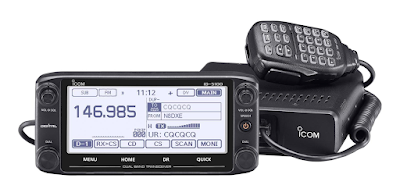
Icom ID-5100. The best dual band mobile rig I've ever used. This radio is, quite literally, my daily driver - I have it installed in my truck and it's been used daily for the past 3 years. I bought it for two features - DSTAR capability and the ability to do cross-band repeat. It does both of those spectacularly. I was so impressed with the first one I bought that I went out and bought a second for use in my shack.
Why I like it: Dual receive, very well implemented command set, a well thought out touchscreen interface, easy to implement cross-band repeat, rugged. An outstanding value for money, even if you don't use DSTAR.
Yaesu VX-6R. The sole survivor of Yaesu's classic 'rugged miniature' line of HTs that were very popular in the early 2000s. Just a simple, well implemented dual band (but not dual receive) radio in a small, rugged package. How rugged? I made a video once of me operating the radio during a tropical storm:
Why I like it: Rugged. Waterproof. Waterproof accessories. Well implemented command set. If you operate in wet conditions this is the radio to have.
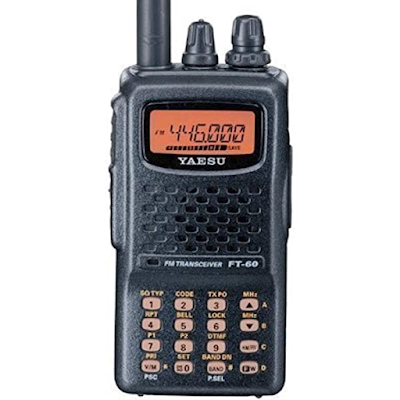
Yaesu FT-60. The HT that refuses to die. For good reason. Perhaps the best all-around, basic dual band radio on the market. It's unpretentious, extremely well made, has an easy to navigate menu system (thanks to the full keypad) and offers excellent receive audio - something more modern Yaesu HTs seem to struggle with. I've owned two, sold one, and gave the other away to a new ham. Now I'm seriously thinking about buying a third while they are still available.
Why I like it: for all the reasons I list above - it's rugged (although not waterproof like the VX-6), has a well implemented feature set, is easy to manage thanks to the full keypad (backlit, by the way), has great audio, and has real and easy to manipulate knobs for things like volume, squelch and channel selection.
Icom ID-51. I bought this radio strictly for the DSTAR features, and as I struggled to figure out DSTAR I found myself not really liking the radio. My frustrations with DSTAR had colored my perception of the ID-51, and I rarely used it. Heck, I almost came to resent the thing. All that money for a system I just couldn't figure out. Then one day I picked it up to use for a public service event where I needed to be able to monitor two analog repeaters simultaneously, and was forced to actually use the radio in a real-world scenario. I quickly came to love it. Although it just recently went out of production (replaced by the ID-52) I consider it, in its time, to be one of the best dual-band, dual-receive HTs ever made. This little radio is now one of my 'daily drivers', and it's the one I instinctively grab when heading out to a park, or just to walk the dogs around the neighborhood.
Why I like it: The feature set and controls are well implemented, the monochrome screen is easy to read, the audio is outstanding. It's also one of the most ergonomic radios on the market - it just feels good in the hand. Plus, it's rugged. Icom never really highlighted this about the radio, but the ID-51 carried an IPX7 rating, meaning it was highly waterproof. It's a lightweight, rugged little beastie.
Icom IC-7300. The radio that has re-defined the mid-range HF radio. I own two of these (one bought used) and I run them hard on both voice and digital modes. Think 90 watts on MARS digital modes. There simply is no better HF radio in the same price class, period. The 7300 deserves all the hype that surrounds it. Even today, almost seven years after it's introduction, it sells by the boat-load. Literally, by the boat-load; Icom can't make enough of them to meet demand. My only gripe with the IC-7300 is that it does not have back-lit buttons. That's it. I know several hams that have one or more of these in storage as back-ups in case their 'daily drivers' go down. But the thing is, they never seem to go down. The reliability of the 7300 is one of its hallmarks. It's almost like Icom built a 200 watt rig and put it into a 100 watt box. Psssst - here's a little secret: the IC-7300 is actually a pretty good portable rig. It's really not that large, is fairly lightweight, is quite rugged, and as long as you keep it out of the rain and dust it'll do just fine in The Great Outdoors.
Today, the IC-7300 is the only 100 watt HF rig I unhesitatingly recommend to new and old hams alike.
Why I like it: Outstanding feature set, pretty good internal tuner, perhaps the easiest 100 watt rig to configure for digital modes, build-in sound card interface, excellent digital mode performance, outstanding filtering, great TX audio, excellent third party support. An excellent value for money, particularly if you can find a good used one.
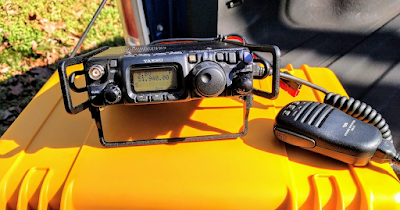
Yaesu FT-818. This is one radio I don't use all that often, but I just like knowing that I have it. It's the low power Swiss Army Knife of ham radio. It does everything. Often not particularly well, but it does it all - 70 cm thru 160 meters, FM/AM/USB/Digital. The radio design is over 22 years old, yet it's still relevant. No other QRP rig on the market offers the features, quality and reliability that the FT-818 does at a similar price-point. It is the value-for-money champ. It's issues are legendary - a lack of any real filtering, poor frequency stability (improved somewhat in the updated 818 with the inclusion of a factory TXCO), a laughably archaic charging and power management system (again, that 22 year old design coming to the forefront), and a maximum of 6 watts output. But what you do get works wonderfully, in a package little bigger than a large paperback book. Yaesu did an outstanding job with the form factor - it looks and operates like a radio should! I've griped about the FT-817/818 (essentially the same radio) in the past, but I've also come to appreciate its performance, features and quirks. And now I can't imagine ham radio life without it. What's it's niche in my stable of radios? It's like this - when my wife and I go camping, I always put a lot of thought into what HF radio(s) to bring. The mix always changes. But after I'm done selecting, packing and loading all my radio gear, I've got the camper all ready to go, all the camping gear is loaded, the truck is gassed up, everything's hooked up and the dogs are in their places in the back seat, I always run back into the house, grab the Pelican case that holds my 818 and chuck it into the bed of the truck. Just in case...
Why I like it: Extremely versatile, well built, very well supported by third party software and accessory manufacturers, easy to operate and figure out.
Elecraft KX-2: The KX2 is what you get when a team of very talented electronics designers and engineers who are also ham radio enthusiasts take the time to listen to their user community and design and build something to meet a very specific set of use requirements. The KX2 is so good at what it does it's almost scary. The radio is a QRP rig specifically designed for HF voice and CW. It'll do digital, but not nearly as well as it does voice and CW. It was also specifically designed to be small, light, easy to operate, and sip power so it can operate for long periods of time on relatively small batteries. And then someone asked, "Can we fit a tuner in this thing?" and next thing you know, the KX2 has one of the best internal tuners on the market. All in a package no bigger than a 1980's era 2 meter HT. But the icing on the cake is Elecraft's factory support. It is, far and a way, the best in the industry. What other manufacturer dialogs directly with their product owners through social media tools like Groups.io? I'm not talking about a designated corporate mouthpiece, but the actual designer of the radio, and one of the company owners? They will extend a helping hand regardless of how long you've owned your radio. I bought a very early production KX2, and I'm the third owner. I had some questions, and Elecraft happily answered my questions as though I had bought the radio new yesterday, and it was was still under warranty. I've written about my KX2 in the past, so I won't re-hash the issues here. Suffice to say, the KX2, six years after it's introduction, is still the best HF-only QRP rig on the market.
Why I like it: Excellent best-in-class HF performance, extremely small form factor, yet with a very well designed and easy to read display, an internal tuner that puts most other tuners to shame, an internal battery that will provide true 10 watts of output. The world's best manufacturer support.
Icom IC-705: Those that follow this blog probably figured I'd get here eventually. I won't say that with the IC-705, Icom hit it out of the park. But they did manage to put the ball squarely into the centerfield seats for a home run. I've written extensively about the IC-705 in this blog, and you can check out my posts by clicking here. The 705 continues to impress, and it's become one of my three main operating radios. That means it doesn't sit in a bag or Pelican case waiting for a POTA run. It is set up on my operating bench and gets used almost daily. In fact, I do all of my Winlink VARA testing and operations on the 705. Unlike any of my other QRP radios (KX2, 818, CTX-10), the 705 is a digital mode beast, and it is certainly no slouch on voice operations, either. I have two gripes about the 705, both of which deserve serious consideration by Icom. First is the radio's well documented lack of shielding, which makes the rig very susceptible to RFI, particularly over USB. The next is the form factor. The 705 tries to follow the Elecraft KX2 form factor, but the design team stumbled badly along the way. The form factor is just weird, the radio doesn't 'sit' right anywhere. It's an oddly awkward case design. But what the 705 does well, and overall better than just about any other QRP (or even 100 watt) rig is communicate. The front face of the rig is laid out like a miniature IC-7300, so if you are familiar with the 7300 or the IC-7610 you'll be able to set this rig up and start operating in minutes, without the manual. In typical Icom fashion, everything is well implemented and integrated. The build quality seems solid, although it does not carry any IP ratings. Like most new radios, there's still some question about the long-term reliability, but based on comments I've seen posted to the IC-705 Groups.io reflector and Facebook page, it seems to be holding up very well in outdoor use. Let's talk value-for-money. The IC-705 isn't cheap. Street price today is around $1,350. But when you compare its feature set with its closest competitor, the Elecraft KX3, the KX3 is more expensive and lacks many of the features the 705 provides. From this perspective I think the 705 actually offers quite a bit of value for its asking price.
Why I like it: Excellent overall performance on all modes, particularly digital, well thought-out control layout, excellent build quality, a very good power management system and surprisingly good battery life considering it's an SDR
Well, that's it for this list. If you have any questions or comments please post them below. Let us know about the radios that have impressed you the most over the years!
In past posts I've hinted that I'm not afraid to get into the gust of certain radios to do what is referred to as the 'Mars mod'; open the radio up for wide band transmit for use on MARS and SHARES frequencies. To date I've done it on two Icom IC-7100's, two Yaesu FT-891s and, before I got adventurous with a soldering iron, paid to have it done on an Icom IC-7200, a 7300 and a Yaesu FT-991A.
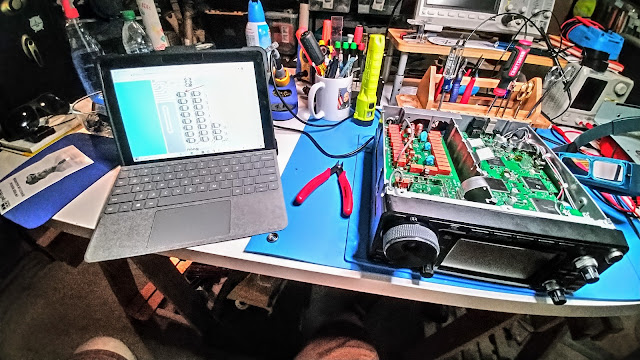
A week ago, as part of my pure fleet initiative, I bought a used IC-7300 from a seller on QRZ.com. I've been haunting various ham radio equipment sale and swap sites for a while now, looking for a good deal on a used 7300, so when this one popped up I grabbed it. Even before I had it in-hand, I was thinking about doing the MARS mod myself. The modification procedures for many HF rigs are available on the internet, and for modern Icom radios it usually means removing a diode from the main board to open up the transmit stage (opening up the receive side is usually not necessary). In the past I used a soldering iron to loosen the solder holding the surface mount diode to the board, and that's a worrisome mix of shaky hands, teeny-tiny closely packed components and a hot soldering iron. But as I was discussing this process a few days ago with my good friend Ken, AI4UW, he asked two key questions: Do you intend to ever re-install the diode? Is the diode in a location you can get to it with a pair of miniature side-cutters? No to the first, yes to the second. Well, he said, just go in with a small set of side cutters and snip it off the board. Just make damned sure you snip the right diode! Ken does high level aviation electronic system repair for Delta Airlines. If you fly Delta into or out of Atlanta, odds are good that Ken has worked on an electronics system on that plane. He knows what he's talking about, so I decided to follow his advice and go the 'snip' route.
The diode we're after is on the underside of the main board, so we have to remove the bottom cover
We're after diode D422, and ONLY D422
It's important to have your references at-hand when doing this work. The last thing you want to do is remove the wrong component
You're gonna' need magnification. Lots of it.
It was hard to get the camera to focus, but the diode is about where the arrow is pointing
Again, poor focus, but you can see the pad for the diode after it was removed by snipping it out
Glamour shot! Here's a wider view of the radio from the bottom, looking at the underside of the main board and the build-in tuner. The IC-7300 is actually a very beefy radio
I have to say, it was a very simple process, and a lot easier and a lot less anxiety-invoking that trying to remove the diode with a soldering iron. The shears I used were the Crescent miniature wire cutters available from Amazon, Home Depot or Lowes. Because the cutters are angled and ground flat, they can also act as side-cutters, which allows you to get flat to the circuit board when performing this operation.
Easy and simple process, yes. But did it work? Have a look:
This gives me two identical high performance HF rigs that can be used across all the Amateur, MARS and SHARES frequencies, and allows me to dedicate a rig for each role. If one fails, the working radio can be easily and quickly re-configured to take over the job of the other. It's a simple configuration file upload from an SD card. I'm happy.
It's long past time that the Icom IC-7300 gets its own post. It's odd that I've written about other HF radios I own, and have used far less, but I've virtually ignored discussing this excellent rig. Let's change that.
I've owned my IC-7300 for about three years now, and it's my 'daily driver'. I mean that - this radio gets used every day, and for a wide variety of tasks. I use it to talk on nets, pass digital traffic, monitor frequencies for activity, participate in informal rag chews, and when the mood strikes, participate in contests. It's had the 'MARS mod' (really, just a wide-band TX mod) and I've installed the RadioAnalog PTRX-7300 RF output board (discussed in an earlier post). Although the rig has its own built-in (and very capable) antenna tuner, I have mine hooked up to to an external LDG AT200ProII tuner so I can run digital mode communications (JS8CALL, MARS MSC2020, PSK-31 and others) at full 100 watts output. The radio is a digital mode workhorse, and has become a backbone radio for a lot of heavy duty cycle applications like message center operations and ALE within the MARS system. And it's no slouch on voice modes, either.
My dusty, smudgy IC-7300 working PSK-31 via Fldigi
With the IC-7300, Icom fundamentally changed the mid-range HF transceiver market. It is a moderately priced (currently a squidge under $1,000), high performance SDR with a very well thought out user interface and feature set. How good is the IC-7300? Five years after its introduction the IC-7300 absolutely dominates its market space, and Icom still sells them by the boat load. Literally, by the boat load. Yaesu and Kenwood still don't have anything on the market that competes with the IC-7300. To be fair, Yaesu just announced their new FT-DX10, which seems to be aimed at the same market space. The FT-DX10 feature set is impressive, and one-ups the IC-7300 in a lot of areas. But remember, Yaesu had five years to watch this market space, study the IC-7300, and develop their response. Oh, and Yaesu's introductory price on the FT-DX10 is almost $700 higher than the current price of the IC-7300. That means Icom will still be selling boat loads of IC-7300's a year from now.
Is the IC-7300 perfect? No, of course not. But its real-world flaws are few and far between and, on balance, insignificant. Some internet commandos gripe about a lack of 'dynamic range', or poor selectivity, or poor receive audio performance, poor auto tuner performance, or complex menu systems... well, some folks will bitch about anything. Here's my evaluation - in the real world, when you are focusing on communicating, the IC-7300 is an outstanding radio. But it's not just me saying that. Go read the ratings for the IC-7300 on eHam.net.
Personally, my only gripe about the IC-7300 is the lack of back-lit buttons. That's it.
If you are looking for an all-mode radio, and particularly if you are looking for a radio to run high duty-cycle digital modes, you really don't need to look any further than the Icom IC-7300.