Showing posts sorted by relevance for query ic 705. Sort by date Show all posts

07 March 2021

When They Get It Right...

UPDATE: after reading this review, please read the follow up post The IC-705 Reassessed

...they get it right, and Icom got it real right with the IC-705. 

A few weeks ago my piggy bank got full enough that I could afford to go out and buy an IC-705. I think what pushed me over the edge was the ARRL review of the little radio in the February issue of QST Magazine. I had been waiting for a reputable test lab to run the numbers on this rig, almost hoping a major flaw would be revealed that would cause me to hold on to my money and keep my venerable FT-818 in service a little longer.

But nooooo.... Icom had to go and knock this one out of the park. I trust the ARRL test lab; they don't do fawning endorsements. But their review of the IC-705 is as close to an "oh hell yeah!" cheer as we're likely to see from them.

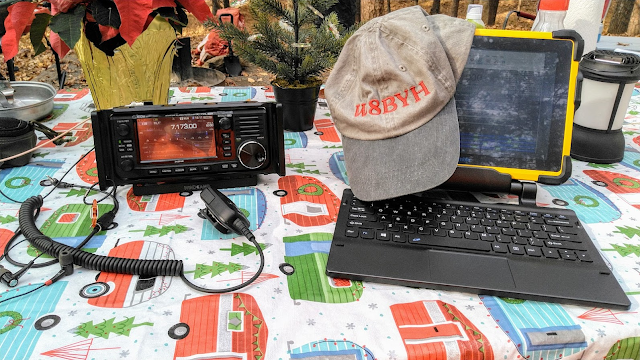
My IC-705 sitting on the Nifty Accessories stand (discussed below)

I've spent almost three weeks with the IC-705 now, learning its features and testing it in a controlled environment. To say I'm impressed by the radio, particularly on digital modes, would be an understatement. The radio is less a transceiver than it is a communications instrument - a high grade tool that provides most of the features needed to effectively communicate by any mode, under any conditions, at any location.

This is just an opening post on what I'm sure will be a series of write-ups on the IC-705. I won't waste your time by covering things all the other slobbering fanboys are writing or video blogging about. Suffice to say, there are plenty of "This is the bestest radio everrr made! I wub it sooo, sooo much!" reviews out there.

If you want to follow someone who's really putting the IC-705 through it's paces, I recommend you subscribe to OH8STN's YouTube channel. Julian knows how to make radios perform under real world conditions, and he calls things like they are. (His takedown of Yaesu over the release of the FT-818 is a classic.) If there's a flaw in Julian's reviews of the IC-705, it's that he uses the word 'magnificent' too much.


So let me address a few things that have come to light about the radio since I started testing it:
  • First things first - you MUST download and install the IC-705 specific USB drivers from the Icom website. Don't make the mistake I did in thinking that because I had run a number of Icom rigs on the laptop I've got hooked up to the 705 that I was just fine in the driver department. This cost me three days of frustration and almost resulted in me shipping the rig back to HRO. Once you have the drivers installed things start to get much better. Not perfect though, because...
  • Many ham radio software developers have not yet incorporated IC-705 specific settings in their rig control interfaces. As of this writing, Winlink and JS8CALL (which uses Hamlib for it's rig control interface) and Fldigi are the three I'm aware of. Ham Radio Deluxe added IC-705 support in their newest release, and it works like a charm. If your favorite software doesn't yet have IC-705 support don't despair. Just use the IC-7300 settings, making sure to set the IC-705 CI-V address to 94h (the IC-7300's default address). From there things will work just fine. 
  • As it sits on a desk all by itself the viewing angle is... awkward. Icom really should have included a small foot, bail or stand with the radio to prop it at a usable viewing angle. A lot of IC-705 owners resort to using a table-top tripod to support their radio, and that's a great option. I've gone with a heavy duty table-top tripod made by a British company called iFootage. It incorporates an excellent fluid ball head and can easily support the IC-705's weight. This tripod isn't cheap (about $70) or lightweight, but remember you are trusting the safety of a $1,300 communications instrument to it. It doesn't pay to go cheap with a flimsy $20 Amazon special.
  • Speaking of viewing angles and desktop stands (where we?), Icom will sell you a ridiculously priced ($45) plastic cradle to set your IC-705 into. Again, this is something Icom should have included as part of the basic radio package. But capitalism to the rescue! (for all you socialists out there reading this). The good folks at Nifty Accessories have come up with their own stand that provides a great viewing angle, uses a thumb screw to securely attach the stand to the radio AND it's cheaper than the Icom offering.
  • Rig control - I've been using Ham Radio Deluxe with this little radio, and it makes controlling all the features much easier. Now, doing the radio screen 'finger poke' a-la the IC-7300 isn't really a big problem, but being able to control everything from a larger laptop screen just makes life a bit more fun. Since the IC-705 incorporates wi-fi, I may buy the Icom RS-BA1 control software, but I'm really waiting to see if a competitor comes out with an equivalent product at a cheaper price.
  • What about the Icom backpack? Dunno, didn't buy one. But my good friend Joe, KI4ASK, did buy one and he speaks very highly of it.
The iFootage tripod in action. Very sturdy, very well made


What? No tuner?! Yeah, but get over it. As of this writing there are three tuner options on the market, a fourth just around the corner, and possibly a fifth in the development stage. There's more bitching about the lack of a built-in tuner than anything else, so let's review the options:
  1. The Elecraft T1 tuner. This little battery powered tuner is as minimalist as you can get - a plastic box about the size of a pack of cigarettes (remember those?) with a few BNC connections and some LEDs. The tuner has been on the market for a while now and is legendary for its ability to find a match for just about any antenna on any frequency. I've got one and have used it a bit with my FT-818 and have tested it with the IC-705. It works pretty good, but you have to put the rig into a continuous carrier mode (AM, FM) to tune - there's no automatic triggering.
  2. The mAT 705. This compact tuner is made in China but is sold (and supported) by Vibroplex here in the US. It was designed specifically for the IC-705, and was getting some enthusiastic reviews when it first hit the market after the IC-705's release. Then users started to notice issues, particularly with the battery and power management system. As a result, Vibroplex pulled the tuner from their website and had the manufacturer do a re-design. The new tuner, the mAT 705 Plus, is reported to have put all the original model's issues to bed and the tuner is once again available on the Vibroplex website.
  3. LDG Z-100Plus. This battery powered tuner has been on the market for some time now, and HRO is selling a bundle specifically for the IC-705. It's just the basic Z100Plus tuner, but with a control cable to connect the radio to the tuner, and a short BNC-to-PL-259 coax section. Since I already owned a Z-100Plus, I contacted LDG and asked what the special control cable was. They answered back in less than an hour(!) to tell me it was just a plain-Jane 3.5mm audio cable. I had one of those in my spare cable junk box, so I was up and running in a few minutes. The setup works great, and the tuner will auto-trigger a tune cycle if the radio detects high SWR. But like the Icom AH-705 (below), I think this tuner is a bit too large for portable use.
  4. Icom's own AH-705 tuner. This is the 'just around the corner' tuner. I believe Icom has released it for the domestic Japanese market, with the US market to follow soon. There are a few good Japanese language videos about it on YouTube. What strikes me is the size - it's every bit as big as the IC-705 itself! But it's Icom, and the tuner control logic is built into the 705's firmware, so I'm sure it'll be a capable and well integrated unit. One interesting note is that the AH-705 will tune both balanced antennas and random wire antennas (like the Icom AH-4). So for versatility this tuner may just take the cake.
  5. Something secret under development? Hmmm... When I contacted LDG about the control cable for the Z100Plus tuner, I also asked if they intended to come out with an IC-705-specific tuner. The tech rep stated no, they had nothing like that planned, but then went on to hint that LDG just might be working on a tuner/amplifier combo for the IC-705. So as they say, boys and girls, watch this space!
So you see, there are plenty of options available. The lack of a built-in tuner shouldn't really be an issue. 

But how does the radio perform on the air? Here's my initial observations:
  • On SSB voice, the radio is the equal of the IC-7300 in both sensitivity and selectivity. I've done some informal side-by-side testing of the two radios using headphones and the same antennas, and I simply can't detect any difference. That's a good thing - the IC-7300 has become renowned for its sideband performance
  • On digital modes, this radio operates flawlessly. It's a digital mode beast. So far I've tested it with Winlink, JS8CALL and Fldigi (PSK-31). Once I got the USB serial port driver and the IC-7300 emulation issues figured out, it's been smooth sailing. The rig stays cool, even when operating at 10 watts on long digital exchanges. I had a 23 minute Winlink session last night, downloading some email traffic from a node up in Indiana (I'm near Altanta). Propagation was poor, and VARA was struggling to get the traffic passed. The IC-705 was pushing out a lot of  full duty cycle ACKs (acknowledgments) as VARA was adjusting the baud rate to match the fluctuating band conditions. The temperature indicator on the little rig never got above 1/4 scale and did not feel the least bit warm to the touch. 
  • VHF, UHF & DSTAR. I have to admit, I have not used this radio yet on VHF or UHF! I'm so focused on figuring out sideband and digital modes that the opportunity to test the VHF and UHF side hasn't come up. But my friend Joe, KI4ASK, uses his IC-705 regularly on VHF and reports that it's as good as anything Icom has put out. I have had an opportunity to test DSTAR on HF simplex, again with Joe, and the radio worked as expected. In fact, the voice quality on this one simplex exchange was better than what I experience using my IC-5100 on the local VHF DSTAR repeater - no R2D2.
Let's close with a few random observations:
  • Build quality. the build quality on this radio is first rate. It's a marvel of small form factor engineering. The radio feels like a brick, and since it's essentially a magnesium box with a front plate, it is. Watch this guy take one apart:

  • Icom's commitment. It's clear Icom is putting a lot of development resources behind this radio. They have a winner and they know it, and they are (as we used to say in the Army) 'reinforcing success'. In the short time since I bought my radio, Icom has released two firmware updates. These updates didn't fix anything broken, they added new features or enhancements. I'm confident that Icom will continue to improve this radio and its Icom accessories (like the AH-705 tuner) for years to come. This won't become a piece of orphanware any time soon.
  • Competition. Many are saying that the IC-705 is a Yaesu FT-818 killer. Sorry, I don't see that. The significant price difference between the radios (the FT-818 sells for about half of what the IC-705 goes for) is enough that the FT-818 should continue to see strong sales. No, I see the IC-705's main competition as the Elecraft KX-3. The KX-3 was a groundbreaking radio, and remains one of the best receivers ever tested by Sherwood Engineering. When it came out it was considered an engineering marvel - a paradigm shift in form factor, and performance. Feature-for-feature, both radios come in around the same price point (if you add in the anticipated additional cost of the Icom tuner), but the Icom clearly offers more - an excellent panadapter display, UHF & VHF capability, built-in sound card modem for digital modes, GPS, Bluetooth and wi-fi capability and a better power management system. While I don't think the Icom will dig too deeply into KX-3 sales, I think it does show Elecraft where the QRP market is headed.
OK, that's it for this post. Obviously, I'll have more to say after I get more mic time with the radio. But I can say this - if you are hesitant about buying the IC-705, don't be. This little radio really is as good as it gets for QRP rig performance, and it's worth every cent of its $1,300 asking price. So empty your piggy banks and go get one.

W8BYH out


05 August 2023

Considering the IC-705?

Earlier today I watched a YouTube video by Ham Radio DX doing a 'should I buy' review of the IC-705. While the video is otherwise unremarkable, the author did mention a few things that clicked with me, and started me thinking.

I've owned my IC-705 for over two years, and really like it. Notice I say 'really like', not 'love'. There have always been a few things about the 705 - issues and shortcomings - that bother me. I've written about most of these issues on this blog, so I won't go back and beat the dead horse (just search on the blog for 'ic 705'). I'll just say that while the IC-705 stands alone in its class it still has some shortcomings.

Which leads us to this post, and the ideas spurred by the Ham Radio DX video. Here's my advice to folks considering buying an IC-705, or have bought an IC-705 and are struggling with some of its shortcomings:

The IC-705 should be considered as nothing more than the core of a larger radio system. It is minimally functional right out of the box, but requires a compliment of additional hardware and software to be considered a fully mature and capable system.

To be fair, this concept applies to virtually every other QRP rig I've owned or used, including the highly touted Elecraft KX series. However, Icom seems to specifically market the IC-705 as a complete, all-in-one rig that really doesn't need any add-ons. But out here in the real world, it does.

So, if you think about the IC-705 as being just the core of a larger 'system' you will be less likely to focus on its shortcomings and become disappointed. The other components of the system will effectively address the shortcomings and make it an incredibly capable best-in-class radio system, but at a cost.

What are these system components? Here's my minimum requirements list:

  • Environmental protection for the radio. Something like the Peovi or Windcamp cages or one of the dozens of 3D printed cages on offer on eBay. I particularly like the Peovi solution because of the available polycarbonate snap-on cover made by SideKX. ($285 current price for the Peovi)
  • Antenna tuner. Please, spare me the righteous talk about only using resonant antennas. This is the real world, and I like frequency agility. Compromised antennas are often a fact of life, particularly with lightweight portable radio setups. While just about any tuner will work with the 705, the one that works best in my experience is Icom's own AH-705. It's an incredible tuner, although somewhat big when compared to the radio itself. ($360 current street price)
  • Power. To get the full 10 watts out of the IC-705 you'll need an external power source. The good news is that it doesn't need much external power. Like a lot of 705 owners, I use a small 4.5 amp hour lithium-iron phosphate battery that will keep the 705 running at 10 watts for well over 8 hours. ($65 from Bioenno)
  • Software (and the computer to run it on). Software is only required if you run digital modes, but since most folks buy the 705 for its digital mode capabilities, some software is required. The only software package I consider absolutely essential is Icom's own RS-BA1 v.2 software. It is the remote server component of this package that allows you to control the radio via a wi-fi USB connection. Why not just use the USB port on the radio? Because Icom failed to properly shield the IC-705 and the radio is highly susceptible to RFI coming in over the USB connection. It is so bad that, when running digital modes like FT8, it overwhelms the radio on all bands. I wrote about this in an earlier post so I won't re-hash it here. Suffice to say, you'll need the RS-BA1 software. ($140 current street price)
These minimum system add-ons come to $850, in addition to the base cost of the IC-705. There are cheaper options on the market for things like the protective cage, tuner and battery, so consider this $850 a high-end estimate. It just reinforces that reality that most IC-705 owners will face at some time or another. You don't have to buy these at the same time you buy your radio, but to exploit the full capability of the 705, at some point you'll likely need to add them.

If you go into the IC-705 purchase knowing it takes these add-on items to reach what we called in the Army 'full mission capability' you are much less likely to be disappointed with your radio.

W8BYH out

13 December 2021

Holy Grail

Note: I started this post back in early October, and got pulled away from completing it by other interests. It sat unpublished in my Blogger stack and I lost track of it until a few days ago. Although I've published posts about the KX2 since then, what I have not yet done is compare it in depth to the Icom IC-705. So I decided to polish up the post and put it out there for those with an interest in both radios.

A few weeks ago I stumbled on one of the Holy Grails of modern COVID-induced shortage radios - a reasonably priced, good condition Elecraft KX2 kit. The seller was asking a cracking good price for a very complete kit - radio with internal tuner and clock, the after market SideKX end panels, heat sink and snap-on cover, Elecraft paddles, the AX-1 antenna with the 40 meter coil and tripod mount, assorted Elecraft connector cables, and a LowePro carry pouch. The only thing missing was the owners manual. For once I didn't hesitate or ruminate - I shot the seller an email and told him I'd take it if it was still available. I really didn't think I had a chance at the radio - surely someone else had already beat me to the punch. But to my surprise he wrote right back and told me I was first in what was quickly becoming a very long line of interested buyers. The radio was mine. 

If you have spent any time reading this blog you are probably asking, "But don't you already have multiple QRP rigs?" Umm, yeah. So what's your point? I've had an interest in the Elecraft KX line for some time. My interest was actually heightened by my purchase of the Icom IC-705. Last year I thought surely - surely - the IC-705 would punch a deep hole in the KX line's sales. The KX3 and KX2 are 'old' technology (as ancient at 2016 - when the KX2 was released). The IC-705 is new, modern, stuffed full of bleeding edge QRP rig technology. Who wouldn't pick the 705 over the KX2 for portable operations?

Well, it turns out lots of people are picking the KX2 over the IC-705. The demand for the KX2 is so strong that Elecraft reports delays of over 5 weeks on shipping. Just what is it about the KX2 that keeps demand high? I know the IC-705 pretty well, and I understand its strengths and weaknesses. It is a very, very good rig (with some annoying shortcomings), and it points the way to the future of feature-laden SDR QRP radios. But the heavy demand and overwhelmingly positive reviews of the KX2 had my interest piqued. Why were hams choosing the KX2 over the 705? What was it about the KX2 that made it a compelling radio? Inquiring minds wanted to know.

After playing with the KX2 for a few weeks I'm beginning to understand why the KX2 has such a strong following. It's not just about the radio, it's also about Elecraft, the company's philosophy, and their approach to service.

First, the radio. I'm comparing the KX2 to a number of other QRP radios I've worked with over the past few years: the Yaesu FT-818, the Icom IC-705, the CommRadio CTX-10. 

Let's start with the CTX-10. Feature-for-feature, the KX2's closest competition is this all-mode 80 - 6 meter QRP rig with built-in batteries and an antenna tuner. But the KX2 is smaller, has a much better user interface, has real, responsive, customer support, and comes without the embarrassing microphone drama that damned near killed the CTX-10 in the market. I fear that the CTX-10 will quickly fade into obscurity in the ham radio world, always the radio that could have been a serious QRP contender if the manufacturer had just paid more attention to customer requests, and addressed some of its very evident shortcomings. Owning a CTX-10 is like buying a new Ferrari that came off the factory floor with a faulty gearbox and no driver seat, and being told by Enzo himself that there's nothing wrong with the car.

Now the IC-705. In a feature-by-feature comparison, the KX2 loses out to the IC-705. It's really no contest. The 705 is a mash-up of all the functionality of the IC-7300, most of the IC-9700, with a dash of new features like Bluetooth, wi-fi, and GPS. The radio is a technological tour-de-force, and in typical Icom fashion, everything works. With the exception of a serious RFI over USB issue, all the functions and features are well implemented. But all of that wizardry comes with a penalty when considering QRP rigs - the 705 is chunky and awkward; it doesn't sit well in use. Icom flubbed the case design and should have built it with a better viewing angle. But Icom did get one thing right in this area - they incorporated a standard 1/4 x 20 threaded socked in the radio's case, making it easy to mount it on things like camera tripods. I suspect that the release of the IC-705 triggered a minor run on table-top tripods at Amazon. The 705 provides an unparalleled operating experience. It does everything very, very well and many things excellently. I particularly like the radio because it's a digital mode beast - it will operate on full duty cycle digital modes like JS8CALL for hours without breaking a sweat. The 705 is, in my mind, the reigning general purpose QRP field ops champ. But it's a big field ops champ in terms of picnic bench footprint, mainly because the radio lacks a built-in tuner and the Icom AH-705 tuner is almost as big as the radio itself. The AH-705 is a very capable tuner, but the overall footprint for a complete IC-705 station can be quite large for a QRP rig.   


Next up, the Yaesu FT-818. The 818 is the (effectively unchanged) descendant of the Yaesu FT-817. The 817 was designed in the late 1990s and released in 2001, is still in production, and is still a strong seller. Why? Well, a feature-for-feature count of the 818 as compared to the KX2 tells the story. While the 818 lacks any real filtering, has a weak battery and power management system, only puts out 6 watts max, lacks an internal tuner, it is more of a 'shack-in-a-box' than the KX2 will ever be. It offers 160 - 6 meter HF coverage, plus 2 meter and 70 cm band coverage on all modes. Also, having been in the market for so long it enjoys excellent after-market support. Perhaps most important, a brand new FT-818 sells for $650, while a stripped (no tuner, no internal clock) KX2 sells for $900. That $250 price difference alone is the reason the FT-818 continues to sell well. Plus, the 817 and the 818 are proven performers in the field. For over a decade before the KX2 hit the market, hikers and SOTA operators were carrying their FT-817s to peaks all around the world and logging thousands of contacts with this capable little rig.

Now, the KX2. The first thing that struck me, and this is something many have commented on, is that it's small. I mean, real small. You pick it up and say, "Really? There's a transceiver, an antenna tuner and a battery in here?" How small is it, really? Well, this picture says it all:

Elecraft KX2 perched atop an IC-705

 
Here's another perspective on size that will help you visualize just how small the KX2 is. If I removed the after-market side panels and re-installed the factory originals on this radio, it is small enough to comfortably slip into the cargo pocket of a set of Army BDU or ACU trousers, with space left over for a microphone and a Par EndFedz Trail Friendly long wire antenna. Think of that - a fully capable HF rig, microphone and long wire antenna in just one cargo pocket. 

Some would argue that the 705 looks bigger because of the front facing speaker. Yeah, OK, but you still have to make space for the VFO knob. And remember, there's an extremely capable antenna tuner and a battery inside the KX2 case, and the battery will power the rig at a full 10 watts longer than the 705's external snap-on battery pack will power it at the 5 watt level.

Another intangible that comes with the KX2 is support. I purchased a very early first year production rig, and Elecraft treats me like I bought a factory new radio just last week. I contacted Elecraft a few times with questions about programming software, ordering components and doing a MARS mod on the rig. Every question was swiftly and completely answered by their customer support staff. And speaking of components, you can buy almost an entire KX2, piece-by-piece, from the Elecraft website. Scratch  up the clear faceplate that covers the LCD display? Lose one of the screws that holds the battery cover in place? Need a replacement VFO knob? No problem. These components and lots more can be ordered off of the Elecraft website. I think the only KX2 components you can't order are the main board and the LCD display.

Elecraft's corporate culture encourages direct contact with its customer base. In fact, Wayne Burdick, N6KR, one of the founders of Elecraft and the principal designer of the KX series of rigs, regularly gives interactive talks on YouTube and actively participates in discussions on the Elecraft KX Groups.io reflector. Elecraft management is not shy about reaching out directly to their customer base and interacting with them. When was the last time you saw an Icom, Yaesu or Kenwood VP or product designer participate one-on-one with an end user? 

Drawbacks of the KX2? Sure, there's a few. 
  • The KX2 is nowhere near as good on digital modes as the 705 is. Not even close. Digital mode operations seem to be something of an afterthought in the KX2's design. You'll need an external sound card device (I use a Sbarent sound card dongle), and configuring the little rig for digital operations can be somewhat fiddly. Plus the KX2 can get hot - really hot - when running full duty cycle digital modes. By comparison, the 705 just loafs when running full duty cycle ops.
  • You have to physically open the back of the radio to remove the battery for charging. This was an intentional design choice by Elecraft - when the little radio was designed back in 2015 - 2016, lithium ion battery charging technology wasn't as advanced as it is today. Elecraft knew they needed lithium ion batteries to provide the needed power density in a package small enough to fit inside the case, but they were concerned about battery explosion and fire due to poorly implemented board-level charging circuits. So Elecraft wisely chose to have the battery charging take place outside of the radio. You open the radio up, remove the battery, hook it up to the external charger, reinstall and keep operating. Interestingly, word from Elecraft as of November of this year is that they are about to release an upgrade to the KX2 that allows for internally charging a battery. 
  • The KX2 (and the KX3) is about as moisture proof as a submarine with screen doors. True. The KX series case design is what you could generously call 'open', as in, there's lots of openings for moisture and dirt to get in. This is NOT a rig  you'd want to operate in the open during heavy weather events. There's lots of discussion on the KX forum on Groups.io about carrying the little rig around in a zip lock bag, or covering it with a clear shower cap, or putting it into a Tupperware box with holes cut in the side, or... OK, you get the idea - this is not a foul weather radio. But to be fair, neither is the 705. Icom makes no claim that the 705 is even remotely moisture resistant. Run it in the rain at  your own peril. But I tend to think that the 705 would survive a light shower better than the KX2.  
The last topic to address is the idea that the KX2 and the 705 compete with each other in the same market space. I honestly don't think so. There's enough elbow room between the feature sets of both radios that I could justify hanging on to both. The IC-705 is an outstanding portable rig that is a digital mode beast, but requires a few added bits & pieces (tuner, external battery) to reach its full potential, while the KX2 is an outstanding uber-small full featured rig that shines in the SSB and CW roles. If I'm going to hike the Appalachian Trail I'll take the KX2. If I'm going to the local park for a day of fun, I'll take the IC-705.

W8BYH out

05 June 2021

The IC-705 Reassessed

Two months ago I wrote an initial review of the IC-705, giving it all-around high praise.

Today I have to pull back on that somewhat slobbering fanboy of a review, and remove the IC-705 from my 'recommended' list. The radio has a major, and crippling, RFI issue if you want to run it on digital modes over USB under field conditions.

Simply put, the induced or coupled RF noise picked up by the USB cable floods the rig with RFI. We are talking noise and hash from one end of the band to the other, and the noise gets worse if the software you are running, like Winlink, initiates a command dialog with the radio (in Winlink, that's referred to as 'starting a session'). And it's a complex issue. It's not simply USB line coupling, or laptop interference, or antenna location. It seems to be a sensitive interplay of all three. You can never really be sure what the real root of the problem is. The one key factor, however (based on my testing) seems to be antenna location. The further away your antenna, the less of a problem you will have.

I didn't notice this issue when I did my first post back in March because I hadn't run the IC-705 in a portable (field) environment. All my testing was done in my shack, where my antenna is 75 feet away on the other side of my house. Operating this way, the radio is a champ on digital modes, and that's how I wrote it up in my March review. But a week later I set the radio up at a local park using my Chameleon vertical antenna and the same laptop I use in my shack, and that's when I discovered the noise. I've since had the rig in the field twice more, testing with various antenna setups - a mag loop and an EFLW - and the problem is always present.

Here's a video I made while using the IC-705 and my Chameleon mag loop antenna a few weeks ago during a POTA activation:


Now, this RFI problem is not unique to me, or to my radio. I have three friends in my local Amateur Radio club who own IC-705's and they report the same issue. If you go to the IC-705 Facebook page or the IC-705 Groups.io email reflector you'll find plenty of discussions on this issue. Of course the fanboys will crawl out of the woodwork and tell you you're not keeping enough cable separation, or you are using the wrong type of USB cable, or you've got a 'noisy' laptop, or you are not using enough chokes, or the solar flux-to-ground coupling ratio is too low, or some such bullshit. I have tried every reasonable fix for this issue. I've tested against multiple laptops and Windows 10 tablets, I've tried a wide variety of heavily choked USB cables. I have enough common mode chokes attached to the feedlines to soak up a nuclear-level EMP. Nothing fixes the problem entirely - the 'hash' is always there at some level.

As I mentioned above, the one big delta - the variable that seems to provide the best mitigation - is antenna location. All things being equal - the same radio, laptop, USB cable, feedline chokes and antenna design (EFLW) - at home I get virtually no noise or hash when running digital modes, in the field the radio is overwhelmed by RFI.

The IC-705 was specifically designed for portable field use, and that's how Icom markets it. The owner has a right to expect that the radio will work in the field, on all modes, with a less-than-ideal antenna and cabling setup. The expectation shouldn't be that the owner has to schlepp around 75' of coax and enough iron ferrite (in the form of chokes) to sink sink a small boat, just to send a Winlink message. 

So let me recap where I'm at with the IC-705:

  • On voice modes, whether in your shack or portable, this is a superb little rig. It is every bit as good as its fanboys claim it is
  • On digital modes, in the right environments, the IC-705 is a digital mode beast. I have run my rig, in my shack, on JS8CALL for eight hours continuously and it never broke a sweat
  • Portable on digital modes, however, it's a mess, particularly with Winlink and JS8CALL. The RFI issue makes it all but unusable and it's virtually impossible to fully mitigate the interference

Because of this last bullet point, I no longer recommend the IC-705.

This RFI issue is Icom's to address and fix. Frankly, I'm surprised this issue wasn't caught by Icom in testing, and I'm disappointed that the ARRL test lab didn't catch is in its otherwise outstanding review of the radio.

There's more to come on this RFI problem. Right now I'm focusing on the radio's wi-fi connectivity feature as a solution, but I'm still testing and evaluating. So stay tuned for an update on the 705 saga!

W8BYH out

31 January 2026

The IC-705 In Fixed Station Mode

For me, the Icom IC-705 radio has been a very frustrating radio. One one hand, as a transceiver it's typical Icom. That means it's great. Icom builds excellent radios, and their user interface is the result of almost two decades of tweaking. It is perhaps the best in the industry. It's also, by a long stretch, the easiest radio to run on digital modes next to the IC-7300, which says a lot. The internal design is an engineering marvel, particularly considering how cool the little radio runs, even  under constant digital mode operations (by comparison, the new Yaesu FTX-1 gets hot enough to light cigarettes off of).

On the other hand it's typical Icom in some not-so-good ways. An awkward case design, poor RF shielding, limited on-board battery capacity, a over-sized tuner that seems an after-thought, outdated connector technology (MicroUSB vs USB-C), a single combined HF & UHF/VHF antenna connector, overpriced accessories, and the need to buy expensive software (Icom's RS-BA1 package) just to get the radio to run properly on digital modes.

Honestly, the easiest way to get over most of these shortcomings is to buy an IC-7300 and take it to the field. The IC-7300 is a better field radio than the stock IC-705. There, I said it.

This leads to what will be a contentious observation. The IC-705 can be a better shack radio than the IC-7300. Not out of the box, of course. It takes some work (and expense), but it is possible to piece together a radio system, with the IC-705 at the center, that meets or beats the IC-7300 in fixed base operations. 

So why can the 705 perform better than the 7300? Two things: wi-fi and Bluetooth. These two features, not found in the first generation IC-7300, can make shack operations much more effective. The built-in wi-fi capability allows you to take your radio control interface remote, to the next room or the next continent. Bluetooth is much more 'local' due to it's limited range, but the radio's Bluetooth capability means it can connect to a variety of Bluetooth devices like headphones, microphones, speakers and other devices.

(Let me pause and mention an elephant in the room - the new IC-7300MK2 which is hitting the store shelves as I write this. This new Icom has built-in network capability, but not wi-fi. You still need to hard-wire it (via CAT6 cable) to a router or other node, which can be wireless. So the IC-7300 gets us further down the road in terms of connectivity, but it's not natively wi-fi capable.) 

OK, so what's needed to get the IC-705 up to snuff as a fixed station radio? Here's my list:

  • An amplifier with an integrated tuner. I'm using a HobbyPCB Hardrock 50 amp with a built-in tuner and a Bluetooth IC-705 interface (another good use for Bluetooth). The interface automates band switching and antenna tuning from the IC-705. A very slick and effective integration.
  • Duplexer. The 705 is both HF & UHF/VHF, but only has one antenna connector. Antenna switching is a real pain, and reflects one of the 705's design shortcomings. An antenna duplexer can fix this, so you can move from HF to VHF seamlessly without worrying about antennas and SWR. A duplexer is a bit clunky to drag to the field, but works fine in the fixed station mode.
  • Bluetooth headset & microphone. A feature that can free you up to move around the shack, or at least relieve you of the tyranny of the corded microphone. I use Icom's own VS3 Bluetooth mic & earbuds. It works quite well and allows me to roam in Bluetooth range and still engage in conversations. It works well with a wide range of Icom (and Kenwood!) Bluetooth enabled radios.
  • Software. The worst thing about Icom's RS-BA1 software is that you MUST have it to run digital modes, because of the 705's RF shielding problems. That said, the software is useful in this fixed station mode because of the radio control it provides over wi-fi. It also does an excellent job of out-boarding the band scope functionality. When connected via wi-fi I can carry my laptop to anywhere that I'm in range of the wi-fi node (my home wi-fi or my phone hotspot).
  • Remote tuning knob. Nobody's made a good remote tuning knob for desktop rigs since Ten-Tec left the market. Their Model 302 remote knobs with keypad were exceptional. I used one with my Jupiter and it fundamentally changed how you operate the radio. One of the best features was that the remote plugged into the radio and controlled it directly. I know hams who bought Ten-Tec radios specifically to get that remote knob functionality, it was that good. Today, with the exception of Elecraft and their K-Pod, no other manufacturer offers a direct connect remote knob for their radios. Icom, however, comes close. Their RC-28 remote tuning knob doesn't connect directly to the radio, but interfaces with it via the RS-BA1 rig control application via USB. In typical Icom fashion, it very well built, over priced, and offers only limited functionality. But the functionality it does offer is well executed in the RS-BA1 software interface. I have my RC-28 configured to do frequency steps up/down with button clicks, initiate a tuning sequence, change pre-amp settings, and can be used as a PTT switch when using a Heil headset. 

When wired up, this combo makes a very good fixed station setup. Everything works quite well, plus there's the added bonus of having VHF & UHF available, and DSTAR (important in Georgia for state-wide emergency coverage).

Hams get grumpy when a radio doesn't offer all the features they want. I'm as guilty of this as anyone. But I also come from a communications environment - the US Army - where most radios were modular. You had the transceiver as a single low power unit, but then you were issued a separate battery module, power supply, amplifier, digital interface, antenna matching unit, vehicle mount, and more. Nothing was 'all-in-one', and this is a sound approach for ham radio. The IC-705 is a very good hub around which you can build an effective fixed station setup. But in the field, trying to operate at more than 10 watts... like I said, you're better off with an IC-7300.


W8BYH out

26 August 2023

The Most Important Amplifier In Ham Radio

The title is a pretentious joke, but there is a kernel of truth in there.

A few days ago I wrapped up my HobbyPCB HardRock50 amplifier build, and I'm in the process of testing it with a variety of QRP rigs. So far so good with the Yaesu FT-818 and the Icom IC-705, and testing with the Elecraft KX2 is coming up. Right now I'm updating the external interface for the IC-705 that is manufactured by HobbyPCB, an interface that allows the amplifier to follow band changes on the radio and trigger tuning cycles

Earlier today I created a video showing the start-up procedure when using the amp and the IC-705 interface with the IC-705. The video shows how the IC-705 interface controls band switching (via Bluetooth), tuning and amp triggering. The interface works quite well, but it is an extra cost item ($70 as I have it configured) from HobbyPCB. Note - you DO NOT need this interface to run the IC-705 with the amplifier - the interface just takes care of the band switching and tuning duties, something you can do without the interface. You just have to do those tasks manually, and it's not at all difficult. 


I'm quite happy with the output. Signal reports from fellow hams are good, and I'm easily getting 50 watts PEP on sideband when driving the amp with 3 watts of output from the radio.

Building this amp was, as it's popular to say today, 'a journey', and I've outlined much of it in earlier postings. This is the second of these amp kits that I've built, and I learned a LOT on the first build. The reason I built this new amp is because the previous amp kit was an early model (shipped in 2014 but never built) and it had some issues regarding the ability to interface with the IC-705. I figured I'd start with a clean slate (and somewhat improved soldering skills) with a current production kit from HobbyPCB that included the internal tuner board. While this is not a tough kit to put together, it took me several months to get it done as work, family commitments and other factors got in the way. 

One of the hiccups was a blown capacitor on the amp board, which the manufacturer put down to it being a tantalum cap with known tendencies to let out the smoke when voltage is first applied. Jim Veatch, the owner of HobbyPCB, said they are likely going to switch capacitor types on the next production run. He cheerfully sent me two replacement caps. The job to replace them gave me the convenient excuse to buy a hot air re-work station to get the remains of the old cap off the board, get things cleaned up and the new cap in place. 

Poof!
Luckily the damage was limited to the blown capacitor

Getting set to replace the blown capacitor

Another issue was the maddening discovery that the mounting holes for the tuner board had been mis-drilled in the case - basically they were drilled 'backwards', but you don't immediately know that until you go to mount the tuner board in the case and button everything up for testing - it just doesn't fit, and too much forcing can result in some bent connector pins (don't ask me how I know...). Again, Jim at HobbyPCB got back with me and let me know that their recent production runs had the holes on some of the cases drilled improperly, and he's only finding them when people like me bring up the issue. He offered to replace the case but I had to ship the old one to him first, or he could send me a template that would allow me to drill my own holes in the proper location. I opted to go the template route.


So, I can't emphasize too much that this is a 'hobby' build - the instructions are very good, and on-line support is good (Jim answers emails promptly and very courteously), but you are still likely to run into glitches like I did. This is where the hobby aspect comes into play, and you're kind of expected to do your own troubleshooting. Adversity builds character, right? But HobbyPCB also states that the price of the kit includes a working amplifier, so if you get it all together and simply can't get it working you can ship it off to Jim and he'll diagnose and fix whatever's wrong, for free.

The IC-705 interface module - a box that connects between the amp and the 705 and allows
automatic band switching and tuner operation. It's basically an Arduino board with a Bluetooth
interface. I just got through soldering in the add-on board that drives the tuner in the HardRock50
(the lighter colored board in the upper right)

Another challenge for those of you not used to running bootloaders is updating the firmware. Your kit will likely ship with a slightly outdated firmware version. Updating the firmware isn't tough, but you have to install a bootloader on your computer and run the update from there. It's a well documented procedure, but might put off those with limited computer skills.

Last, although everything about this amp and the add-on components like the tuner and control interface are well documented, the HobbyPCB website is something of a dog's dinner in terms of organization, and HobbyPCB has some dead links and pointers to outdated files out there. They need the help of a good web developer.

So what's the use case for this amp? For me it's simply this - with the demise of portable all-band, all-mode 100 watt rigs like the IC-7100 or the FT-857, I am looking for more 'oomph' for both my IC-705 and my KX2. I love those rigs, but feel that they are limited by their 10 watt output, particularly when working voice. Let's focus on the IC-705 - an incredibly capable radio that brings together all the features anyone would need for portable operations. I consider 50 watts as something of a sweet spot for portable work. In most cases going from 50 - 100w output doesn't really get you much beyond greater power consumption. I also like the idea of the two components in separate packages. If I only want to run digital I can go out with just the radio and work at 10 watts. If I want to run voice, I can bring along the amp and push things up to 50 watts. With the internal tuner in the amp I can also leave the Icom tuner behind. It's all about options and capability.

OK, what about this silly 'most important amp in ham radio' claim? Well, here's the truth of it. To be an effective portable shack-in-a-box radio the IC-705 needs to put out more than 10 watts. This is particularly important if you want to use the rig for EMCOMM applications. Ten watts may be enough for digital modes, but for SSB it's not enough for reliable & repeatable comms. There are a number of solid state amps on the market that will work with the IC-705, but they generally fall into two categories - low cost, low output Chinese manufactured amps of poor quality, and high quality (and expensive) 100+ watt amps designed for in-shack use from companies like Elecraft, RM, ACOM and others. The HardRock50 is the only high quality, field portable, well supported and reasonably priced amp available for QRP rigs. This means the HardRock50 stands alone as an amplifier that can turn the IC-705 into a serious field radio for EMCOMM use. So while not the most important amp in all of ham radio, it is still the best option to turn your field QRP rig into an effective tool for reliable communications.

The next step is testing using a battery instead of a power supply - I'll test using a 12 amp hour LiFePo battery to see how long that holds up in field use. I'll also be testing with the KX2. So stay tuned!

W8BYH out

13 September 2024

I Don't Care How Good Your Receiver Is

With Yaesu's recent announcement of their new FTX-1F QRP radio, lots of wish-casters are commenting about how this new radio just has to come out with top-of-the-heap receiver ratings. Otherwise the radio is a complete failure. Hmmm... Now, odds are this radio will exhibit excellent receiver performance; Yaesu long ago figured out how to make great communications receivers. But if that's what you are focusing on, you are focusing on the wrong thing.

Most of the major radio manufacturers - Yaesu, Icom, Kenwood, Elecraft, Flex, and others - know how to make radios with great receivers. Right now Yaesu, Flex, Icom and Elecraft are duking it out for top position on the Sherwood Engineering receiver ratings, and Yaesu has a surprising number of rigs in the top six slots. I think it's safe to say that the FTX-1F will have a pretty good receiver.

What Yaesu (and Icom) don't seem to understand are the requirements for a low power field radio - a rugged, battery powered radio that is easy to pack and carry long distances and is highly integrated - built-in sound card interface, wireless connectivity, tuner, modern power management - and provides transmit output beyond the conventionally defined QRP levels. But as far as receiver performance, that's not the most important thing. For a radio that's marketed as a low power field radio, receiver performance is less important than form factor, user interface, non-RF features, ruggedness and TX  output. Here's a few examples:

  • Yaesu's own FT-817 was never a top-notch receiver. In fact, among it's peers when it was first introduced in 2004, it was just middle-of-the-pack. But the radio became a phenomenon mainly because Yaesu nailed the non-RF features and form factor right out of the gate. Users were fine with merely OK receiver performance because the rest of the little rig was outstanding. It didn't just 'fit the QRP mission', it defined the mission, and it stayed in production for almost 20 years. It was that good
  • Elecraft's KX2 took the FT-817 example up a bunch of notches - improved receiver performance, an easy to view front panel, excellent internal battery performance, and an internal tuner that is truly world-class. The KX2 is still the only all-mode HF radio you can slip into the cargo pocket of your trousers and take to the field and effectively communicate for hours at a time. You can even use it as an HF walke-talkie. The KX2's receiver performance isn't first class, according to Sherwood (though it' is still very good), but Elecraft understood the QRP field radio requirements and nailed the features and form factor right out of the gate. That's why, eight years after its introduction, there's still a waiting list for newly manufactured units
  • Icom IC-705 is a high quality radio that packs a bewildering variety of features and capabilities into a small package, and it ranks higher on the Sherwood receiver test results than the KX2. Yet the IC-705's design reflects a lot of compromises that make it a less capable field radio than the KX2. Why? Because Elecraft paid more attention to the QRP field radio requirements than Icom did. All Icom wanted to do was get a QRP radio, any QRP radio, to market. They squished down the IC-7300 and tossed in a bit of ID-51. Although they did a great job of integrating all the technology, the resulting form factor is a chunky and awkward box that doesn't sit well at any useful angle, lacks an internal tuner, only offers one antenna connection (no separate HF / VHF & UHF connectors) and the stock battery performance is a bit anemic. This means the IC-705 field footprint will grow - an external battery, an external tuner, a transverter so you can run HF and VHF/UHF without antenna switching, and some sort of stand to hold the radio at a useful angle. When you lay it all out on the picnic table at your POTA location and ponder the footprint, you end up asking yourself why you didn't just bring your IC-7300. Again, Icom didn't understand or ignored the QRP field radio requirements when designing the 705
It's looking like Yaesu is following Icom's lead. The FTX-1F will be a mash-up of Yaesu's successful FT-710 HF rig, and their FT-5DR UHF/VHF handheld. Lots of technology in a small box. Yaesu seems to have addressed a few of the IC-705's shortcomings - dual HF & VHF/UHF antenna connectors, a snap-on tuner, a large capacity snap-on battery pack (the two of which, unfortunately, can't be used together). The fully functional footprint of the FTX-1F may well be smaller than the IC-705's. Good thing. But based on what we know right now, it's still just a run-of-the-mill QRP rig that's not optimized for field use. I may be wrong. I hope I'm wrong, but right now it looks like the FTX-1F will be little more than a warmed-over IC-705.

As a ham radio operator with money to spend, I've grown real tired of this QRP thing. QRP radios as Icom and Yaesu envision them are so dull, so unoriginal, and so unnecessary. Designing and building just another QRP rig reflects complacency and laziness on the manufacturer's part. Yaesu's had three years to study the IC-705 and its market performance. They could have focused tightly on the  QRP field radio requirements and included features that make the FTX-1 more compelling than the IC-705. Things like 20 watt TX capability with an integrated battery pack, an IPX and MILSTD rating, an integrated tuner, improved form factor and user ergonomics. That would have set them apart in the market space, taken  market share from Icom, and assured the long term success of the FTX-1. 

Instead, when the new Yaesu hits the market the only real discriminator will be the digital mode. If you are a C4FM guy or gal, you'll buy the Yaesu. If you are a DSTAR guy or gal, you'll buy the Icom. That's about it.

From a philosophical standpoint it's just a swing... and a miss

W8BYH out

02 March 2022

Cage Match

One of the key issues with the new(ish) Icom IC-705 is that it's designed to be a field /portable radio, yet it's also easily subjected to knocks and bangs in the field. I'm not saying it's a fragile little thing - it's essentially a magnesium 'bucket' inside a tough plastic shell, and all the board mounted components are neatly stacked inside the 'bucket' and are well protected. But the front panel, including the touch sensitive display, is not protected at all. Plus... it's a $1,400 radio, and even if it were made out of ballistic Kevlar it still deserves some protection from rough handling.

But protecting the 705 is a bit of a challenge. We can't simply wrap the radio in another hardened shell, for two reasons. First, the radio relies on ambient cooling. It has no fans or fins. The radio is a cool runner, even on digital modes, but wrapping it up in another enclosure could introduce a heat problem. Next, the radio has a built-in GPS, and the GPS patch antenna can be easily blocked by things outside the rig, like boxes, cases or cages.

For months I've been singing the praises of the Windcamp Ark-705 cage. It's a well designed and built aluminum cage that offers very good protection for the 705. However, it has a serious design flaw - the metal of the top portion of the cage blocks the GPS antenna. I'm not sure just where the GPS antenna sits inside the IC-705, but I have to guess that at the top of the case - that's the only location that makes sense. I've watched the only IC-705 tear-down video available on YouTube several times, but just can't figure out precisely where the GPS antenna is*. Regardless, my testing shows that the Windcamp cage does block GPS signals. Not completely - if you set the radio outdoors beneath an open sky it will eventually achieve GPS lock, but it takes a lot longer than if the radio is sitting 'nekkid'

Ark-705 case. Nicely made, but looks like it interferes with GPS reception

This discovery caused me to take another look at the Peovi 705 cage. The Peovi 'cage' as originally designed is really just a mounting frame and offers no protection to the rear of the radio. It is well designed and executed, but it falls short of offering any real protection to the radio. I was an early customer of Peovi, buying one fairly soon after they were introduced, but became disenchanted with the lack of protection it offered. It's at this point that I turned to the Windcamp.

The original Peovi cage looks good from the front, but...
 
Doesn't offer any protection for the rear of the rig

But recently, and without any fanfare, Peovi released an add-on for their original cage that ads a bit more wrap-around protection. I first caught hints of it on one of the IC-705 Facebook pages. Called the Full Wrap Protection Add-On Kit, it doesn't really 'wrap around' the radio, but it does offer some bump protection. As they say on late night TV infomercials, "but wait, there's more!". In cooperation with Peovi, Gemsproducts, the company that makes the highly regarded Side KX polycarbonate snap-on covers for the Elecraft KX line of radios, developed a similar cover that fits into the Peovi carry handles and fully protects the front of the radio. The new Peovi add-on protection kit and the Side KX snap-on cover caught my attention and drew me back to the Peovi solution.
    
Peovi 'full wrap' add-on kit

Side KX snap-on cover

I bit the $$$ bullet (add up the pricing for all the components and you'll understand why I use the term 'bit the $$$ bullet') and ordered the full wrap kit and the Side KX cover. They came in a few days ago and I assembled everything and did some testing. I have to say this - the Peovi full wrap kit is very elegantly machined; it's almost a work of art. It offers somewhat less protection to the top and rear of the radio, but as we'll see in a minute that's actually a plus. The Side KX polycarbonate cover is tough - tough to snap in, tough to snap out, and tough enough that I'm convinced you could drop the rig on its face and the cover would fully protect it. You could probably beat the cover with a baseball bat and it would just laugh at you. It's that tough.


Included with the wrap kit is what looks like a carry handle, but it's actually intended for use as a tilt stand or bale. It works quite well - folds away when not in use, swings out to prop the rig up at an ideal viewing angle when in use.

*So what about GPS reception? Well, while writing this post I was also holding a running conversation on the GPS antenna question with 705 owners over on the IC-705 Groups.io email reflector. Apparently full schematics for this radio have not leaked out (yet), but a few folks commented that the GPS antenna is part of the control head unit (along with the display panel, VFO knob control buttons, etc.). The GPS receiver is integrated into the front panel circuit board, and the antenna is snugged up into a small space between the speaker and Multi knob. If you watch the linked Japanese CQ teardown video and freeze it at the 2:04 mark you'll see the back of the control head showing the circuit board and the antenna (circled below):


One of the benefits of the Peovi cage seems to be that it interferes less with GPS reception. With the Windcamp cage the 705 rarely established GPS lock indoors, even when near a window. Outdoors the radio, still in the Windcamp cage, would establish a lock but it took several minutes and was easy to lose if you moved the radio. With the Peovi cage, the 705 quickly establishes GPS lock indoors or out, and holds that lock better when the radio is moved around outdoors. If you compare the Windcamp and Peovi cages in the area where the antenna is located there's not a whole lot of difference in the amount of metal. But the difference is just enough - the little extra metal in the Windcamp cage definitely interferes with reception.

So going forward I'll be using and testing the Peovi cage, and I'll report back time-to-time. Stay tuned!

W8BYH out

20 September 2024

A Useless Appendage

That's what UHF/VHF is in a QRP rig. Useless. It's a marketing gimmick.

"Icom, why didn't you build a tuner into the IC-705?" Icom: "Hey look, it's got UHF & VHF!"

"Yaesu, why didn't you design your new FTX-1F field radio so it gets an IP rating?" Yaesu: "Hey look, it's got UHF & VHF!"

Building UHF & VHF bands into their QRP rig offerings reflects laziness on the part of the product design teams. Why? Because it gives the design teams the excuse to not get other, more important things right. Like an integrated tuner, like an IP rating for water resistance, like better RF shielding, like more power output, like a better form factor.

I don't care a damn about 70 centimeter or 2 meter capabilities in a QRP radio. If I want to talk on those bands at low power I've got HTs that do a much better job. If I want more UHF/VHF 'oomph' I've got a selection of 50 watt mobile rigs that do a better job. And it's not just me. Over the past few weeks I've talked to a number of IC-705 owners, and they all report that, other than using it to occasionally hit local repeaters, they never use the UHF/VHF side of their radios. 

Like I said, it's a gimmick. 

It looks like Yaesu is about to release a radio that, in form and function, is little more than an IC-705 clone. Icom got lazy with the design of the IC-705, and Yaesu is doubling down on laziness by copying the 705's capabilities, and little else. The FTX-1F's packaging may be a bit more clever, but at the end of the day it really won't do anything that the IC-705 already does.

"Let's just throw in the guts of an HT, toss it over to marketing
 and call it a day"

Think of what could have been. A highly refined HF-only portable field communications package that offers real performance under all conditions, and puts out enough wattage to make a difference. Yaesu is aiming at the wrong target with the FTX-1F. They're aiming at the IC-705. Instead they should have been aiming at the Elecraft KX2, and taken the opportunity to define a whole new class of radio.

Yeah I'm pissed. I'm almost 68, and it looks like I'll be dead before either of these two companies get it right.

 W8BYH out

19 December 2021

The View From The Bench - 19 December 2021

First, Merry Christmas! 

What's been going on this week?

Well, a random thought rattling around in my head. I find it interesting that hams who buy QRP rigs often think that the absolute best antenna to use with them is some sort of a reduced length vertical, as though that will magically overcome every QRP rig's greatest shortcoming - low output power.

I admit, I'm guilty of the same. The KX2 looks sooooo cute sitting next to that neat little AX1 vertical.


Truth is, any shortened antenna is a compromised antenna, and it's the worst thing you can use with a QRP rig. When operating at low transmit levels, the efficiency is all in the antenna. You need something that is both resonant and BIG! The bigger, the better. Think this:


Not this:


Short verticals have their place, and they can be a lot of fun to play with. I always have one with me as a 'quick setup' option, but for serious QRP work a long wire antenna simply can't be beat. My go-to design is the end fed half wave. It is fast and easy to get set up, as long as there's a tree or two available (and in Georgia there's always a tree or two available). I've got examples from several different manufacturers. All of them are good. For portable QRP work I highly recommend the Par EndFedz Trail-Friendly EFHW, sold by Vibroplex. It was recommended to me by my buddy Joe, KI4ASK, who's a dedicated SOTA/POTA guy. I've used mine fairly regularly for about a year, and I've got it adjusted so it's resonant on 10, 20 & 40 meters, so no tuner is needed. And it's small, really small. When wound up on its carrier it is about the size of an HT. 


If I'm doing longer term or more serious communication duties, or bad weather is expected, I'll hang one of my EFLW antennas that can handle 100 watts or more and is weatherproof. I have examples from Chameleon, MyAntennas and perhaps one or two more manufacturers. All of them are good, and all of them are certainly better than any vertical antenna combo I've got.

Cables

I run a couple of LDG tuners with my Icom radios. The work great together, but there is one weak point - the LDG manufactured cables that connect the tuner to the radio. I've had several go bad on me - whoever makes them for LDG does a lousy job of crimping and soldering the Molex pin connections. I've had to repair two of them so far, and just yesterday one I had repaired in the past broke again. Grrrr... In the good old days I could just swing by the local Radio Shack and pick up an extra Molex connector or two. But these days everything is on-line. So I've got a pack of them on order from Amazon, but they won't be here until Tuesday. I guess no playing around on ALE until then.


ALE

Speaking of ALE, someone finally published a good user guide for the Ion2G ALE software package. It wasn't written by the program's author, Devin Butterfield. This was written by one of the alpha and beta testers for Ion2G. It always befuddles me why so many software developers don't think putting together documentation for their applications is important.

Cobbling Together

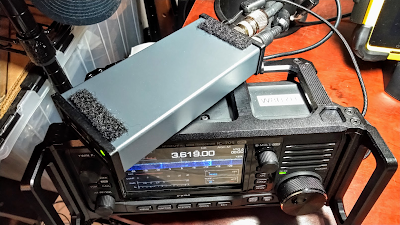
I continue to play around with physical configurations for my IC-705. In case you hadn't heard... there's no tuner built into the IC-705. There are some good external tuner options - the Icom AH-705, the Vibroplex mAT 705 and the LDG Z100. All of them will interface directly with the 705 so that they will do 'sensed tuning'; if the tuner senses high SWR on a frequency when transmit starts it'll trigger a tuning cycle. All three are very good tuners. but the smallest by a wide margin is the mAT 705. I was looking at it last night and thought to myself, "Self, why can't we figure out a way to mount this thing to the IC-705's Windcamp ARK 705 cage for easy setup and a smaller footprint?" Self says, "Why not, let's give it a try!" After an hour or so of trying different mounting locations, I settled on what you see here. Through the modern miracle of Velcro, I give you the cobbled together IC-705/ARK 705/mAT 705 mash-up.


I think I'll do a dedicated post on this at a later date, once I've matured out the concept.

That's it for now. Once again, Merry Christmas, and Happy New Year!

W8BYH out