12 March 2023

Backyard NVIS

Yesterday between yard care sessions (I'm refusing to surrender my Bermuda sod to the weeds), errands and other duties, I found the time to give an initial try to something I've wanted to test for a while now - using a lightweight off-center fed dipole (OCFD) in NVIS mode with either my Icom IC-705.

A few months back I bought a lightweight 10 - 80 meters OCFD from Tim Ortiz, N9SAB (check his eBay store here). This antenna was getting pretty good reviews, and for a time Chameleon was selling them (heck of an endorsement right there). 
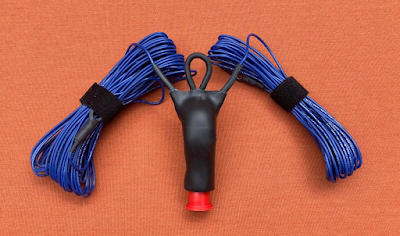

Once I got it I began to think, would there be a way to deploy this in my yard, without having to sling lines in trees? Then I spied a small pile of fiberglass electric fence stakes I'd used on another project and thought, "... hmmm, why not give an NVIS seup a try?" So, off to Tractor Supply for more electric fence stakes. In ham radio one can never have too many electric fence stakes. When I laid out the antenna I realized that it was too long to fit in my back yard! I would have to lay about 15' of the antenna over the chain link fence at the back of my property. That wasn't going to work. I ended up dog-legging the last 20 feet or so of the antenna. I figured that would make for an interesting radiation pattern!

Aerial shot of my house showing the dog-leg layout. The blue dot is the feedpoint

Setup was quick and simple - just place the fence stakes at regular intervals and drape the antenna wire over them. The feedpoint was set close enough to my deck that I could reach it with 20' of RG-58.
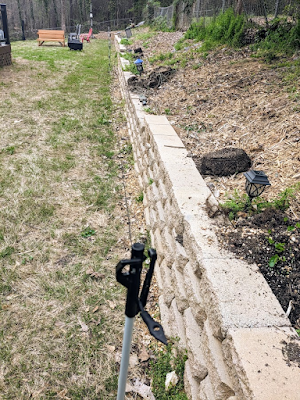
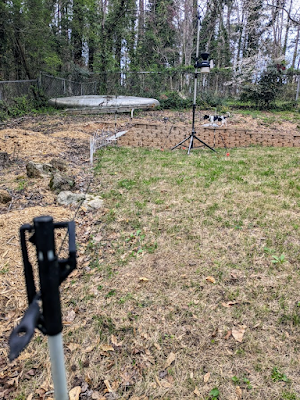
One end of the OCFD. If you look close you can
see the rest of the stakes stretching out in the distance

The far end of the OCFD, at the end of the 'dog-leg'.
That's my Davis weather station in the background,
which you can monitor on APRS.fi
(just search for W8BYH)

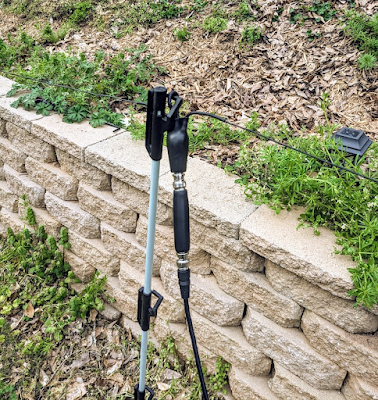
Here's the feedpoint of the OCFD, with a small common mode choke

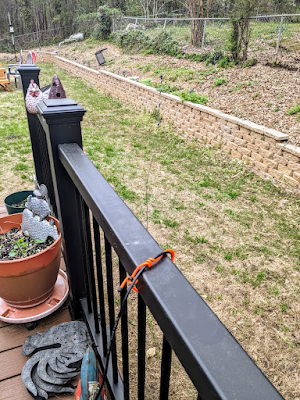
The feedline is lashed to a deck rail using a large
Nite-Ize gear tie - very handy

In the end I had the antenna set up only 3' off the ground, right up against a stone retaining wall and dog-legged at the far end. Would it tune? Would it get a signal out? Will Ross and Rachel ever get married? (Oops, sorry - the XYL's been binge-watching Friends and that stupid show's just stuck in my brain.)

I hooked up my IC-705 I did some SWR testing without the tuner. I was surprised and delighted to find that this antenna is well below 1.5:1 on 10, 20 & 40 meters, and just a bit less than 3:1 on 80 meters. In fact, on 40 & 20 the SWR was almost dead flat. 

Next it was a trial with Winlink on 40 meters using just the IC-705 factory battery (meaning only 5 watts or less output). The Winlink propagation prediction window said it was a lousy time for 40 meters, at best a 60% chance of hitting any station. But what's life without challenges, eh?
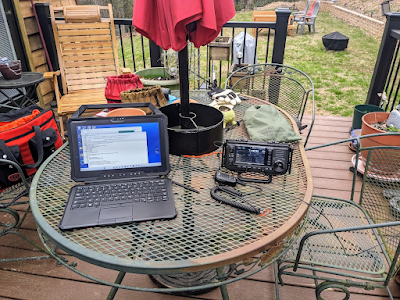
IC-705 running 'barefoot'. I'm guessing my ERP was probably
just 2 - 3 watts

OK, I'll admit it, connecting to a gateway on 40 meters was tough. but I did manage to get to the AJ4GU gateway (about 50 km) and W4MRB (200 km). Because of time constraints I did not get to hook up the tuner and try for an 80 meter gateway. I'll try that another day soon.

What are the take-aways from this? First, that NVIS does work, and works on low power digital modes. The second is that with a handful of fiberglass electric fence stakes I can set up an effective NVIS antenna just about anywhere. And third, this is just a whole lot of fun!

W8BYH out

04 March 2023

Mother Nature Will Have Her Way

Japan is a highly developed, wealthy, highly cultured and thoroughly modern nation. Japan is also no stranger to earthquakes and tsunamis. In fact, Japan leads the world in earthquake-resistant construction techniques, earthquake prediction, and advanced warning systems, and the entire Japanese population is highly tuned to the threats of both earthquakes and tsunamis. They live with earthquakes as part of their daily lives, they plan for them, run endless drills to respond to them, and have built their infrastructure to be earthquake resilient.

And yet... March 11th, 2011. A magnitude 9.1 earthquake 70 miles east of the Oshika Peninsula, deep in the Pacific Ocean, instantly overwhelmed Japan's ability to respond. Now known as the Great Tohoku Earthquake, it was the most violent ever recorded in Japan, and the resulting tsunami crested at over 130 feet in some areas. To make matters worse, a 50' high wall of water hit the Fukushima Nuclear Power Plant, knocking cooling systems off-line and ultimately causing a melt-down in three of its four reactor cores. Japan is still dealing with the mess today.

I recently stumbled on this video put together in 2021 by the Japanese public broadcaster NHK. It is 49 minutes of mostly raw, unedited film footage of the disaster, and the few days following. It's clear the Japanese authorities, despite their best efforts, were immediately overwhelmed. Nothing could have prepared them for a disaster of this scope and scale. In the video you'll witness food & water shortages, shelter shortages, fuel shortages, medical shortages, even shortages of blankets and warm clothing (at one point workers at a shelter was pulling curtains off the windows to use as blankets), 

I don't care how good FEMA or your state and local EMAs are, at some point nature will rear her ugly head and we'll be dealing with a situation that quickly spins out of control. The Japanese learned the hard lesson: Mother Nature will have her way. This is San Francisco (1906 earthquake), New Orleans (Hurricane Katrina), Puerto Rico (Hurricane Maria). Each time the authorities were confident they could handle it. Each time, Mother Nature made fools of them.

What's the point in all of this? Preparedness. Not just communications, but preparedness and security in all its aspects. Food & water security, shelter security, energy & power security, financial security, physical and personal security. Watch the video. Absorb the lessons. 


W8BYH out

22 February 2023

AN/GRC-106

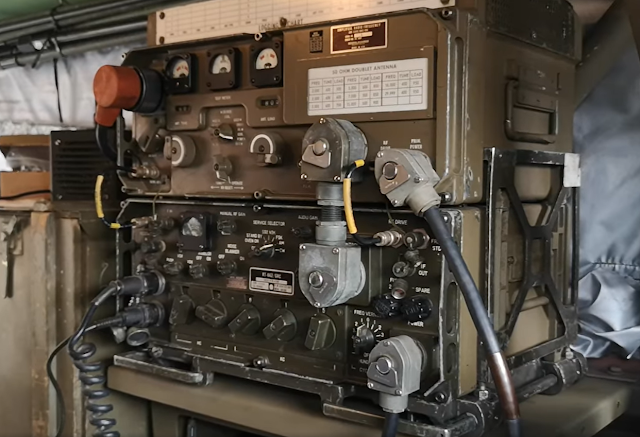
 Boy, this picture brings back memories.

I grabbed this screen shot from a video posted on the Vintage Military Radio group on Facebook. It's a surplus AN/GRC-106 HF radio in its vehicle mount. These radios were in regular use in the Army well into the 1990s. The transceiver is on the bottom, the amplifier is on the top. What you don't see is the power supply or hook-up to the vehicle's 24 volt power system. The power supply is as large as the amplifier section.

I had one of these in just about every unit I was assigned to when in the Army, and when filling a command position I had to inventory and maintain these things. The transceiver/amplifier stack you see in this image is, easily, 150 lbs of mid-20th century military radio technology.

Without the amp you'd get 20 watts of output on USB. With the amp, it was (if I remember correctly) 400 watts of output. When you keyed up, and all the cooling fans kicked in, it sounded like a tornado was in the room with you.

In the late 80's I was assigned to the 864th Engineer Battalion at Fort Lewis, WA. We had one company stationed at The Presidio outside of San Francisco. Once a month we'd set up a GRC-106 at both locations and run communications exercises using different antenna configurations. I didn't have my ham radio ticket then, but our battalion commo chief did, and I remember him mentioning that you could use these radios on the ham bands. I thought that was really cool.

Years later, after I got my General ticket, I was working at Fort Bragg, NC as an exercise evaluator. Late one night I was in a company TOC (tactical ops center) and they had their GRC-106 set up and running. I had no idea who they were supposed to talk to, because I knew the battalion TOC wasn't set up to work HF. I reached over and switched the radio to USB, cranked over to the 20 meter band and clicked around to see if I could pick up any ham traffic. There wasn't much going on, but I did hear one guy calling CQ. I keyed up and answered him back. He acknowledged my callsign but said my signal was very weak. Four hundred watts and weak? Something didn't add up. I went outside and traced the coax to the antenna which, to my surprise, was a HMMWV mounted VHF vertical whip. Someone clearly just went through the motions of setting up the radio to satisfy an evaluator ("See sergeant, we set up our 106 - can we get credit for that?"). At the time I was surprised I didn't burn out the transmitter finals. Later I remembered that the amplifier had something like five tubes in the transmitter stage and could soak up a heck of a lot of SWR.

Today you can easily duplicate the AN/GRC-106's 'barefoot' capabilities with something like an Elecraft KX2, an Icom IC-705, or a Xeigu G90. But that's not the point, is it? The AN/GRC was a glorious piece of mid-20th century, Rube Goldberg-esque, military radio technology that was so well designed and manufactured it stayed in service for almost 40 years. So let's celebrate the AN/GRC-106 for what it is - an unapologetically over-built, over-complex, over-weight and dead reliable radio, and one I'd love to have running in my shack.

W8BYH out

12 January 2023

Battery Angst

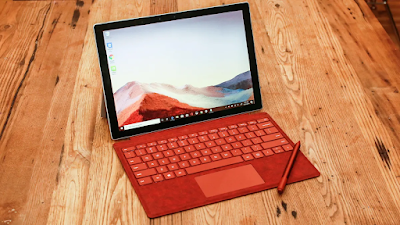
 Aaaarrrgggghhh! The battery on my Surface Pro 7 is giving up the ghost. Yesterday during a conference the screen started to flicker slightly and I noticed the battery level was dropping at a rate faster than I'd seen before. I knew it was inevitable, and I've been seeing indications of declining battery capacity for a few months now.


This is a work tablet, so I didn't pay for it. It's served as my office laptop for several years and I've come to really appreciate the Surface tablet form factor. I retire in less than a year, so I'm likely stuck with finding a replacement on my own (nothing provided by employer largesse). I've got several personal laptops that can fill the gap, but what I really like about the Surface line is the ability to outboard video to a dual monitor setup using the Surface docking station. My question now is, do I invest in a closed hardware solution? Surface Pros can not be opened up for a battery replacement. Microsoft wants you to toss it and buy a new one. Planned obsolescence. I'm thinking that any new laptops or tablets I buy for field use in Amateur Radio will have replaceable batteries.

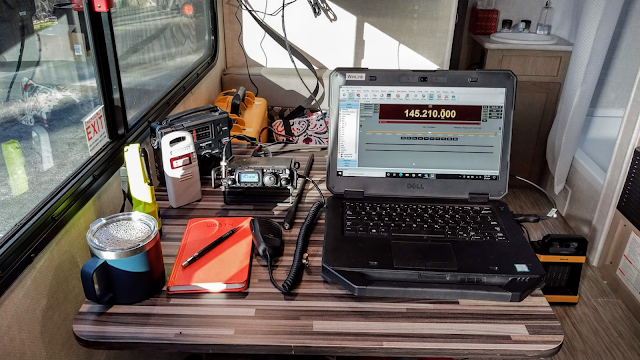
I've got a very good Dell 5414 rugged laptop that I bought used about 4 years ago. It's my ham radio field laptop. It's got an i5 processor, 16 gb of RAM and a 128 gb SSD. It's a workhorse, and even four years on is still a very viable computer. It's only real drawback is that it'll eat a battery in about a year. But that's OK, because the design of this laptop means I can open the battery bay door and slide in a new battery. No dying battery angst. 


My experience is that the ability to easily replace batteries extends the service life of a laptop or tablet for at least a year. After three years most mobile device batteries start to show a serious decline in capacity; it's just the nature of the technology. Users find themselves plugging in their laptop or tablet more frequently to 'top it off', and very quickly the device turns into a small format desktop computer, permanently tethered to a power supply. A replaceable battery restores the functionality of the device - it gives your laptop or tablet a new lease on life. The vast majority of laptops and tablets, particularly laptops, are still very viable computing devices when they get tossed into the electronics recycling bin. The only reason they are there is because the batteries died.

Replaceable batteries also makes the concept of the fully off-grid computer possible. My expectation for a field computer is that I get at least 6 hours of laptop use with a 10% reserve. If that means I've got to swap out batteries in that 6 hour period, so be it. The design of laptops like the Dell 5412 (and its successors) means this 6 hour requirement is easy to achieve, and even exceed.

Of course all computers and tablets have limited lifespans. At some point my Dell will be orphaned by Microsoft (I already know I can't install Windows 11 on it), replacement batteries will become impossible to find, or I'll have a hardware failure. But considering that this is a 4 year old laptop that still has more than adequate processing power for today's routine tasks, and that I've been able to do two battery replacements on it for a small fraction of the cost of a new laptop, I'd say my plan to buy future devices only if they take replaceable batteries is a sound one.

W8BYH out

04 January 2023

Giggle

I giggle when I read things like this: 

For those who have trouble reading the screen capture, it goes like this:

"I forwarded a few questions from HF Pack list members to a Special Forces commander whose unit has been using KX2s in the field for three years. He passed along the following additional comments:

"We prefer to use Off Center Fed Dipoles (OCF). They work for us because they present a consistent, predictable mismatch on the frequencies we use. I made a few small baluns out of binocular cores that are 4:1, which handle the output of the KX2 on Voice, CW and digital all day long. Typically the dipoles area strung up arms-reach-high in the field, which gives us easy 300 - 400 mile range in our KX2 nets. If we're fortunate enough to have a tree, that OCFD with a center height of 10 to 15 feet or so works perfect for NVIS, at least for us.

"You'd be proud to know my KX2 has survived remote jungles, 14-er peaks in Colorado, -30 degree F temps, a helicopter crash, and gunfights / IED blasts... I think the radio has held up better than I have."

Wayne, N6KR, is one of the co-founders of Elecraft and is the main designer of the KX2. He posted this on the HFPack Groups.io site back in 2020 in response to some folks who were looking for more information on the US Army Special Forces use of the KX2 as a back-up radio. The topic recently re-surfaced on the Elecraft KX Groups.io site.

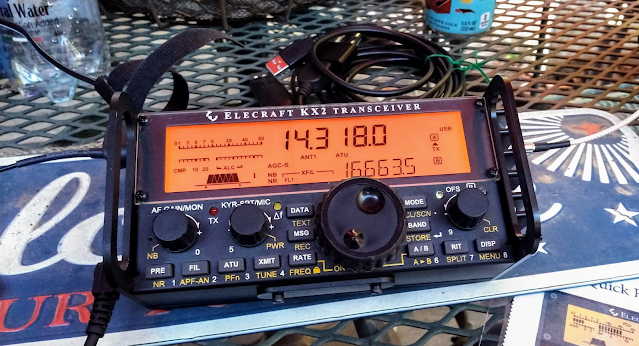
I find it funny (the giggle part) that today, folks who use the Icom IC-705, the Lab599 TX500, the Yaesu FT-818 and other QRP rigs struggle to put together a deployable package that includes the radio, tuner, battery, cables, connectors, etc. and end up with a pile of stuff the size of a desktop printer, while all of that fits inside of the KX2, a radio you can hold in the palm of one hand.

This is one of the reasons why in today's era of IC-705 SDR do-everything QRP market dominance, the KX2 - a 7 year old design - is perpetually on back-order.


Also note the use of an OCF dipole. No sooper-dooper sneaky-pete million dollar Special Forces antenna solution. Just a plain-jane dipole. The US Army is actually very pragmatic about antenna designs for their radios - you just can't cheat physics. If an antenna's gotta' be a quarter wavelength, it'll be a quarter wavelength.

W8BYH out

29 December 2022

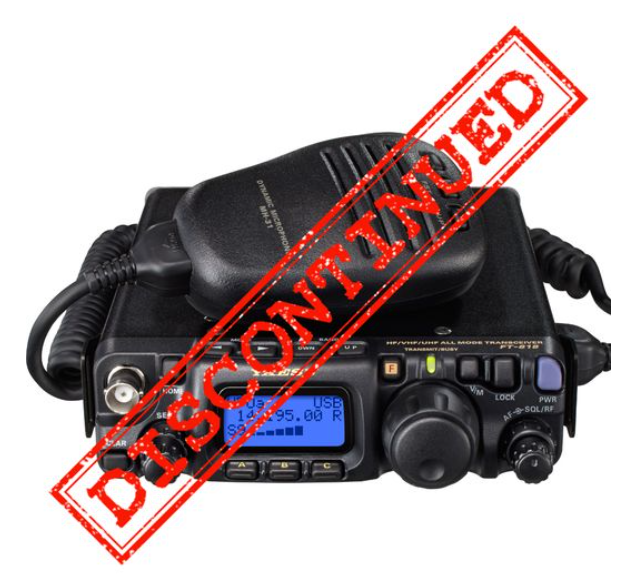
FT-818 QRT

Word dropped yesterday that the venerable FT-818 was taken out of production by Yaesu. As of this morning Gigaparts does not list the radio at all on their website, and HRO shows it either out-of-stock or low stock at all of its stores.

 
I've written extensively about this little radio on this blog and on various Facebook sites. I consider it the last of the 'good' generation of Yaesu radios, along with its sister rigs - the FT-897 and the FT-857. The FT-818 had a 20+ year production run, perhaps the longest of any Amateur Radio (although I think the Icom IC-718 may be giving it a run for its money). In the end it was killed off by the one thing no electronics system can escape - parts availability. According to Yaesu they couldn't source many of the components needed to build this radio. Of course they could have re-designed the rig to take advantage of components that are available in the market. A lot radio manufacturers have had to do this - including Icom and Elecraft. My guess is that Yaesu gave it some thought but realized that, given the age and design of the radio, it was just time to let the old girl go and work on bringing something new to market. At least I hope that's what Yaesu was thinking. Yaesu is being very cagey about what might be coming. I'll say this though - throughout the pandemic and chip shortages, Yaesu has been the one Amateur Radio manufacturer that hasn't been shy about bringing new products to market. Some have been minor refreshes like the FT-5DR handheld, some have been new development products like the FT-710. But while all the other manufacturers have been sitting on their hands waiting for things to shake out, Yaesu has pushed ahead. To me this indicates that Yaesu is likely to already have a replacement for the FT-818 waiting in the wings.

In an earlier post I mentioned that in 50 years there'll be more FT-817/818 rigs still on the air than  Icom IC-705s, and I truly believe that. Given the sheer number of 817/818 radios out there, and the fact that the 20 year old design is easier to maintain than an SDR, I'll wager that in 2101, the 100th anniversary of the FT-817s introduction, there'll be special event stations dedicated to firing up these great old rigs and getting them on the air. By that time the IC-705's will all be recycled electronic waste. 

So raise a glass to the old gal, the radio that defined the QRP shack-in-the-box concept and helped  launch the SOTA movement. And if you have one, make sure she gets on the air every now and then.

W8BYH out 

26 December 2022

No One Radio Can Do It All

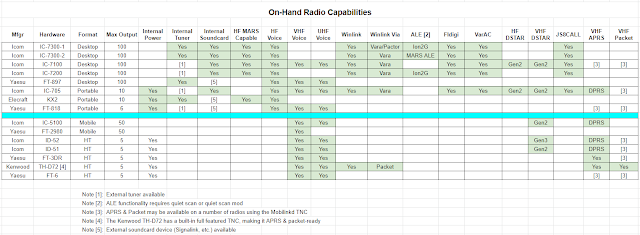
Last month I attended a Georgia AUXCOMM class, and one of the key take-aways (for me) was always knowing what your communications capabilities are. I own too many a lot of radios, and it's been a few years since I did a feature comparison. My question was, which radio I currently own offers the broadest range of capabilities; a true shack-in-a-box. 

While nothing fit the bill 100%, I was only slightly surprised when the winner emerged - the Icom IC-7100. Sadly, this incredibly capable radio was taken out of production by Icom a few months ago. I can only hope there's a replacement already waiting in the wings, and Icom's only holding back on shipping them because the northern sea lanes between Japan and the port of Los Angeles are still choked with dangerous icebergs.

It should be no surprise that the Icom IC-705 is the runner-up. That little radio is just begging to be up-sized. I'm hoping it's the up-sized version that's being held up by the icebergs


Other radios on the list have their own unique capabilities, which is why I hang onto them. The Icom IC-7200 is a no-frills, built like a bulldozer HF rig. All it does is HF, but it'll do it all day, every day, for months on end. The KX2 may not look like it does much, but what it does it does better than any other radio on the market. It's an amazing piece of technology to behold - and you can behold it in the palm of just one hand, with room left over.

Given my current stable of radios, what would I grab going out the door for a SHTF situation? Well, it wouldn't be just one radio. I'd need at least three. Based on the combination of requirements I anticipate - both HF voice and digital, using a variety of modes, the ability to do wide band TX (the 'MARS mod'), the ability to do ALE scanning and HF chat using either Vara Chat or JS8CALL, the choices came down to:
  • IC-7200
  • IC-705
  • ID-52
Some of you are surely yelling, "you're letting your inner Icom fanboy leak out!". No, and yes. In the past I've been a Yaesu fanboy, a Ten-Tec fanboy, a Hammarlund fanboy, even a cheap Chinese radio fanboy. I'm still an Elecraft fanboy. For a long time I didn't particularly like Icom products. I thought they were over-polished and over-priced; slick toys that didn't offer anything better than the competition, but at a higher price. In my mind I was paying extra for the Icom badge. It took a few years of struggling with Yaesu's configuration settings on several of their HF radios to appreciate Icom's well developed and mature interface and settings libraries that spans much of their product line. Icom radios are easy to set up for digital or voice operations, share operating principles across all of their modern rigs - HF and UHF/VHF, and share Icom-developed apps like the RS-BA1 wi-fi rig control package, the RS-MS1A Bluetooth rig control package, and the ST-4001A picture utility program. While none of these packages will win any awards for world-class features or functionality, they are solid apps that allow different Icom rigs to be operated through a shared interface, and to share data across platforms, mostly via DSTAR. 

The IC-705 and the ID-52 (and the ID-51) go even further and share battery packs. This means I only have to worry about one type of battery pack and charger for two different radio models. 

You may ask, "why not the IC-7100, if it's so capable?". Truthfully, it was initially in the mix as I was writing this post, but then I figured I'd need to scan ALE channels using either Ion2G or MARS ALE, and the 7100 can't do that. Only the IC-7200 (with the quiet scan mod) or the IC-7300 can do that. The IC-7300 would seem the next logical choice, but I wanted a 100 watt HF rig that could run continuous duty cycles on digital modes like Vara Chat, and the IC-7200 with its better cooling arrangement just seems a better candidate.

By grabbing these three specific radios I'll have all the coverage I need for voice and digital comms, with redundancy. One hundred watts of HF voice and digital, a 10 watt backup, and a 5 watt hand held. The IC-7200 is a high duty cycle radio that can do voice, digital and ALE scanning, The IC-705 provides an advanced SDR capability on HF, Gen3 DSTAR capability and wideband receive. The ID-52 provides handheld UHF/VHF dual watch voice and Gen3 DSTAR capability. Bases covered.


So remember, in today's market there's not one single radio that can do it all, from any vendor. If you need to relocate for any reason - your own house is damaged or destroyed, or you are deploying to provide comms support for a disaster - you'll need a mix of radios to cover all the requirements. 

Yes, there's a point to all this. It's called Winter Field Day 2023. 

W8BYH out