Showing posts with label preparedness. Show all posts

04 March 2023

Mother Nature Will Have Her Way

Japan is a highly developed, wealthy, highly cultured and thoroughly modern nation. Japan is also no stranger to earthquakes and tsunamis. In fact, Japan leads the world in earthquake-resistant construction techniques, earthquake prediction, and advanced warning systems, and the entire Japanese population is highly tuned to the threats of both earthquakes and tsunamis. They live with earthquakes as part of their daily lives, they plan for them, run endless drills to respond to them, and have built their infrastructure to be earthquake resilient.

And yet... March 11th, 2011. A magnitude 9.1 earthquake 70 miles east of the Oshika Peninsula, deep in the Pacific Ocean, instantly overwhelmed Japan's ability to respond. Now known as the Great Tohoku Earthquake, it was the most violent ever recorded in Japan, and the resulting tsunami crested at over 130 feet in some areas. To make matters worse, a 50' high wall of water hit the Fukushima Nuclear Power Plant, knocking cooling systems off-line and ultimately causing a melt-down in three of its four reactor cores. Japan is still dealing with the mess today.

I recently stumbled on this video put together in 2021 by the Japanese public broadcaster NHK. It is 49 minutes of mostly raw, unedited film footage of the disaster, and the few days following. It's clear the Japanese authorities, despite their best efforts, were immediately overwhelmed. Nothing could have prepared them for a disaster of this scope and scale. In the video you'll witness food & water shortages, shelter shortages, fuel shortages, medical shortages, even shortages of blankets and warm clothing (at one point workers at a shelter was pulling curtains off the windows to use as blankets), 

I don't care how good FEMA or your state and local EMAs are, at some point nature will rear her ugly head and we'll be dealing with a situation that quickly spins out of control. The Japanese learned the hard lesson: Mother Nature will have her way. This is San Francisco (1906 earthquake), New Orleans (Hurricane Katrina), Puerto Rico (Hurricane Maria). Each time the authorities were confident they could handle it. Each time, Mother Nature made fools of them.

What's the point in all of this? Preparedness. Not just communications, but preparedness and security in all its aspects. Food & water security, shelter security, energy & power security, financial security, physical and personal security. Watch the video. Absorb the lessons. 


W8BYH out

26 December 2022

No One Radio Can Do It All

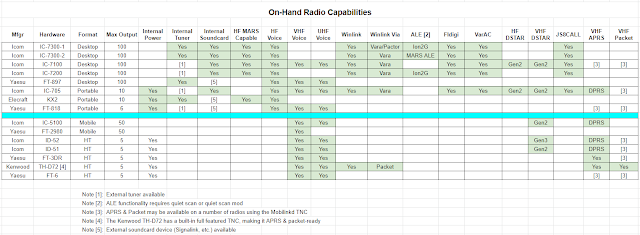
Last month I attended a Georgia AUXCOMM class, and one of the key take-aways (for me) was always knowing what your communications capabilities are. I own too many a lot of radios, and it's been a few years since I did a feature comparison. My question was, which radio I currently own offers the broadest range of capabilities; a true shack-in-a-box. 

While nothing fit the bill 100%, I was only slightly surprised when the winner emerged - the Icom IC-7100. Sadly, this incredibly capable radio was taken out of production by Icom a few months ago. I can only hope there's a replacement already waiting in the wings, and Icom's only holding back on shipping them because the northern sea lanes between Japan and the port of Los Angeles are still choked with dangerous icebergs.

It should be no surprise that the Icom IC-705 is the runner-up. That little radio is just begging to be up-sized. I'm hoping it's the up-sized version that's being held up by the icebergs


Other radios on the list have their own unique capabilities, which is why I hang onto them. The Icom IC-7200 is a no-frills, built like a bulldozer HF rig. All it does is HF, but it'll do it all day, every day, for months on end. The KX2 may not look like it does much, but what it does it does better than any other radio on the market. It's an amazing piece of technology to behold - and you can behold it in the palm of just one hand, with room left over.

Given my current stable of radios, what would I grab going out the door for a SHTF situation? Well, it wouldn't be just one radio. I'd need at least three. Based on the combination of requirements I anticipate - both HF voice and digital, using a variety of modes, the ability to do wide band TX (the 'MARS mod'), the ability to do ALE scanning and HF chat using either Vara Chat or JS8CALL, the choices came down to:
  • IC-7200
  • IC-705
  • ID-52
Some of you are surely yelling, "you're letting your inner Icom fanboy leak out!". No, and yes. In the past I've been a Yaesu fanboy, a Ten-Tec fanboy, a Hammarlund fanboy, even a cheap Chinese radio fanboy. I'm still an Elecraft fanboy. For a long time I didn't particularly like Icom products. I thought they were over-polished and over-priced; slick toys that didn't offer anything better than the competition, but at a higher price. In my mind I was paying extra for the Icom badge. It took a few years of struggling with Yaesu's configuration settings on several of their HF radios to appreciate Icom's well developed and mature interface and settings libraries that spans much of their product line. Icom radios are easy to set up for digital or voice operations, share operating principles across all of their modern rigs - HF and UHF/VHF, and share Icom-developed apps like the RS-BA1 wi-fi rig control package, the RS-MS1A Bluetooth rig control package, and the ST-4001A picture utility program. While none of these packages will win any awards for world-class features or functionality, they are solid apps that allow different Icom rigs to be operated through a shared interface, and to share data across platforms, mostly via DSTAR. 

The IC-705 and the ID-52 (and the ID-51) go even further and share battery packs. This means I only have to worry about one type of battery pack and charger for two different radio models. 

You may ask, "why not the IC-7100, if it's so capable?". Truthfully, it was initially in the mix as I was writing this post, but then I figured I'd need to scan ALE channels using either Ion2G or MARS ALE, and the 7100 can't do that. Only the IC-7200 (with the quiet scan mod) or the IC-7300 can do that. The IC-7300 would seem the next logical choice, but I wanted a 100 watt HF rig that could run continuous duty cycles on digital modes like Vara Chat, and the IC-7200 with its better cooling arrangement just seems a better candidate.

By grabbing these three specific radios I'll have all the coverage I need for voice and digital comms, with redundancy. One hundred watts of HF voice and digital, a 10 watt backup, and a 5 watt hand held. The IC-7200 is a high duty cycle radio that can do voice, digital and ALE scanning, The IC-705 provides an advanced SDR capability on HF, Gen3 DSTAR capability and wideband receive. The ID-52 provides handheld UHF/VHF dual watch voice and Gen3 DSTAR capability. Bases covered.


So remember, in today's market there's not one single radio that can do it all, from any vendor. If you need to relocate for any reason - your own house is damaged or destroyed, or you are deploying to provide comms support for a disaster - you'll need a mix of radios to cover all the requirements. 

Yes, there's a point to all this. It's called Winter Field Day 2023. 

W8BYH out

20 September 2022

Deja-vu All Over Again

Or should this be titled Groundhog Day?

Hurricane Fiona tracked just offshore of Puerto Rico on Sunday, and wiped out virtually all power on the island and severely damaged other infrastructure. This is almost five years to the day that Hurricane Maria did her best to wipe Puerto Rico completely off the map.


There's a question and an observation here. First the question. Post Maria, the federal government pumped billions of dollars into Puerto Rico to help rebuild and harden the infrastructure. My question now is, what failed, and why? What did those billions buy? It certainly doesn't look like it bought any effective infrastructure improvements. I can understand some of the island going dark, or even a lot of the island going dark, but to have the entire island go dark should be raising red flags regarding infrastructure investment and how the money was spent. My suspicion is that, given the current political climate, those questions will remain unasked.

Now the observation. I've said this repeatedly, I don't care how good your infrastructure is, Mother Nature will have her way. Think about it - the entire island is without power. No phone, no internet, no lights, no clean water, nothing. Yesterday you were watching Game of Thrones and surfing the internet, today you're trying to figure out if your relatives in the village on the other side of the ridgeline are still alive. A total service outage can, and at some point will, happen. 

Are you ready?

W8BYH out

14 May 2022

First Aid

Like a lot of Amateur Radio operators, there's a good bit of 'prepper' in me; taking the steps to make sure we've got the supplies and expertise to make it through the most likely disaster scenario is important. After 23 years in the Army, where we prepped for everything from nuclear war to frostbite, being ready for anything gets under your skin becomes a way of life. So a few weeks ago I did a post-COVID check or our first aid kits and was surprised to find that much of what we have on-hand has expired. Now, stuff like gauze and band-aids that are stored in cool, dry conditions actually have a long shelf life, but supplies that are stored under hot, humid or cold conditions for extended periods of time actually have short shelf lives and need to be rotated regularly. I was shocked to discover that much of what we have in our automobile kits was badly out-dated (2018 expiration dates), so I just tossed the kits and ordered new ones.

I like to build my own kits, based on intended use. For example, we carry a large medical kit in our camper I could probably use to treat a mass casualty event, and it also includes medications for our dogs, who we take camping. Likewise, the kit we keep in our house (which is really more like a complete shelf full of stuff in our linen closet) could stock a small emergency room and has supplies specifically for small children (our grandkids). 

I also have a small personal kit that I carry when I'm out fishing or doing something like a POTA activation. The contents of that kit were in pretty rough shape, with many of the wet packets, like alcohol prep pads, betadine wipes, and hand wipes having gone completely dry, and the packaging for some of the gauze packets starting to yellow. Ouch, that's bad.

So I did what I often do - I checked on Amazon to see if they carry what I need. Indeed they do! In fact, many of the standard supplies like gauze pads, tape, adhesive bandages, and single pack medications (acetaminophen, ibuprofen, Sudafed, antiseptic cream, etc) are dirt cheap when bought in bulk. This means I can rotate stock frequently and not really worry about the cost.

Out with the old, in with the new

A few quick observations. 

  • A personal kit is just that - enough supplies to get you and a companion through the normal scrapes and bumps of a short outdoor adventure. If you are stocking to be able to treat sucking chest wounds caused by automatic gunfire, well, you are out of the 'personal kit' league
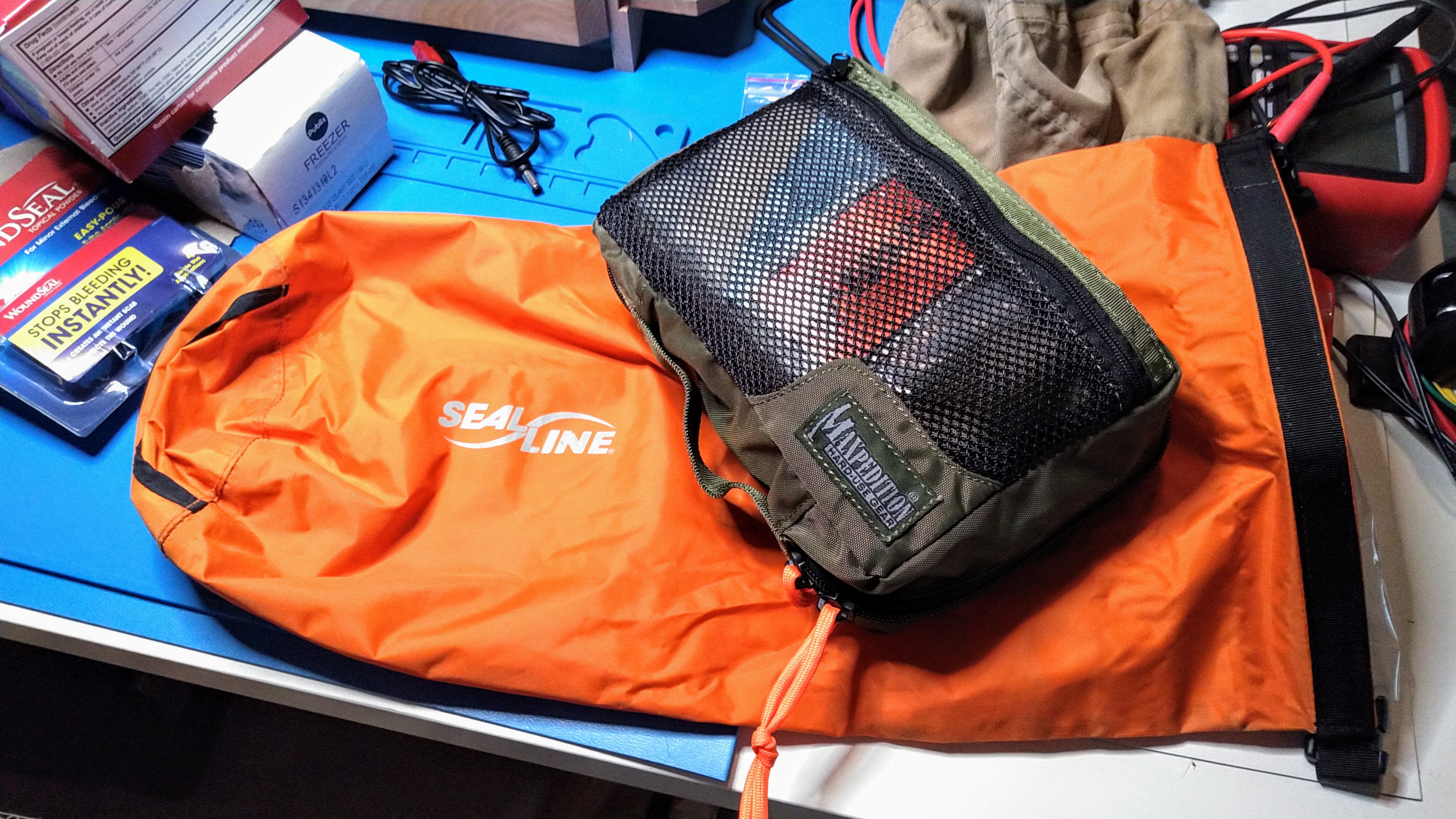
  • Keep everything dry. All my personal kit supplies are in ziplock bags, and the entire kit is carried in a waterproof SealLine bag (see below)
  • Consider your unique health requirements. For example, if you are allergic to acetaminophen (Tylenol) then don't carry it. Double up on aspirin or ibuprofen
  • I've heard from more than one Army medic with actual battlefield injury treatment experience that you can never carry enough 4" x 4" or 3" x 3" sterile gauze pads. They are the swiss army knife of emergency supplies, used for treating everything from puncture wounds to burns
  • I hang out with a lot of old folks, and old folks take a lot of blood thinners. This means they can bleed, and bleed a lot, from the simplest cut. I include a lot of 'quick clot' powder in my kit. Trust me, I've had to use it more than I ever thought I would
  • I live in the south, where every damned insect either bites or stings. I carry a 'Sting-Eze' applicator, plus hydrocortisone cream packets 
  • Ticks are a constant problem here in the south, and the quicker you get them off of you the less likely the chance you'll get one of the many diseases they carry. I have a small set of tweezers in my kit for dealing with the little bastards, and splinters, thorns, etc.
  • Leave the snakebite kits at home. Better yet, toss them in the trash. Get bit? Get to the hospital ASAP
  • Have a supply inventory sheet you can check against to make sure you're not forgetting anything

Keep everything dry, and if something does get wet, toss it and replace it

Keep a supply list with your kit. This one's outdated, but you get the idea

Last, not least, and in fact most important - GET TRAINING! At a minimum, get training in basic first aid and CPR. Never think you'll use it? I took CPR training for over 30 years and never thought I'd use it. Then one day I found myself kneeling next to a heart attack victim, giving him CPR. It CAN happen. 

Be the Boy Scout. Be Prepared.

W8BYH out