24 January 2022

The View From The Bench - 23 January 2022

Happy (belated) New Year! Boy, what a January it's been, and it's not even over. Let's take a look at what's been going on since before Christmas.

  • Disgust. I've had it with Yaesu's overly complicated configuration settings on their HF radios. I've wasted more time trying to set -and keep - settings where they should be for digital comms on Yaesu's current line of HF radios. I can understand why ham radio software developers are programming first for Icom radios (the IC-7300 has become something of a default standard for radio programs - the developers will code for it first and then move on to other models). It's sad, because Yaesu makes really good radios. They really do. But I'm too old now to waste time trying to figure out Yaesu's command and configuration settings. I'm moving to an 'Icom pure' fleet just as fast as I can
  • China. I've also had it with China. I spent a good chunk of January helping to care for a very close relative who was near death for a few days due to the Omicron variant. Thank God she pulled through, but she left the hospital with scarred lungs and a persistent case of viral pneumonia. We can argue endlessly about whether the COVID 19 release was intentional or accidental, but there's no arguing that China intentionally hid the truth about the true nature of the disease long enough for the virus to get a devastating foothold in the US and other countries. I've never used this language on my blog before, but in this case it's deserved: Fuck You, China. I have stopped intentionally purchasing Chinese made products, and that includes Amateur radio gear. I know not buying Chinese products is impossible in the larger sense - damned near everything sold in Wal-Mart is made in China. But on discretionary purchases I will not intentionally buy a China-manufactured product. That includes Icom, Kenwood or Yaesu branded items that are made in China, and it damned sure includes Xeigu/Baofeng/AnyTone/Wouxun/Banggood/whatever
  • MARS mod. Six months after selling my Icom IC-7100 to a fellow ham, stupidly thinking my Yaesu FT-991 would fill the need (see above), I went out and bought another. Life is better now. But I needed to do the MARS mod to it. The mod isn't difficult - you just remove a single diode from the board - but it's a very small diode that sits on a portion of the mainboard that is tightly packed with diodes that need to remain unmolested. I've done MARS mods to Icom and Yaesu radios in the past, and in particular, I had done the mod to the IC-7100 that I had sold to my fellow ham, so I knew what I was up against. So, it was back inside the guts of this new 7100 with a soldering iron and shaky hands. Damn, these components are small!
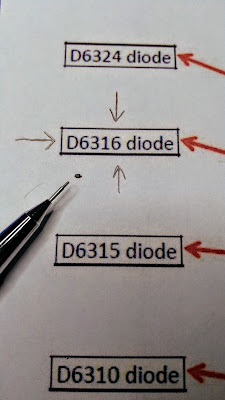
That speck at the tip of the pencil is the diode!

Setting aside my previous rant about Yaesu radios, I actually prefer how Yaesu handles these wide TX mods. Rather than yanking something off the board, Yaesu just has you place a solder bridge across two open pads on the board. Much easier to do, and much easier to recover from if you make a mistake.

  • Things On The Horizon
    • Winter Field Day! Winter field day is next week, and our club is planning to set up at a nearby state park and have some fun. I'm sure I'll be reporting on it later. Right now I'm in the equipment selection mode. What modes do I want to run, and what hardware do I need? I'll probably make the final decision just before I pull out of the driveway. Stay tuned.
    • DSTAR. Our local DSTAR repeater has been disconnected from the internet. This was done as a cost saving measure as we work on relocating it to a new tower that provides better (and cheaper) internet access. We can talk on it using the local repeater mode, but we can't connect to any of the reflectors. We had some rough weather move through earlier in the week and the state ARES directors were telling folks to monitor reflector 30A. Oops. So I went hunting for a DSTAR hotspot. Talk about another supply chain and chip shortage victim! The only one I found was a ZUMSpot USB dongle, and the one I got was one of only two left in HRO's US inventory (up in the New Hampshire store). Right now I'm watching it wander slowly in my direction via USPS. 
    • Scanners. Our county (Fayette County, GA) is planning on switching over to its new P25 digital public service radio infrastructure sometime later this spring.  This means my old (but very capable) Radio Shack trunk tracking analog scanner will go silent. Grrrr... This transition is over a year behind schedule (COVID, contract issues, the usual stuff), but when it's turned on the transmissions will be encrypted. Double Grrrr... I don't know if the encryption applies only to law enforcement, or involves public utilities, transportation (school busses), and other non-LE users. Personally I feel going full time encrypted is a big mistake. I can understand it for certain tactical channels (for police or sensitive emergency operations), but there's no reason to encrypt EVERYTHING. There is good reason to keep things unencrypted. When bad weather hits, the first thing I do is turn on my scanner to monitor what's happening in the county. Discussions about power outages, trees down, roads blocked, etc. are  usually multi-agency discussions, between police, fire and public works. They provide much needed situational awareness without the need to phone  
W8BYH out

09 January 2022

Pandemic Radio

I'll likely expand on this topic in a later post, but I think it's important (and hopefully interesting) enough to do an initial report on.

Greetings from COVID land

A week ago I got a call that my sister, who lives by herself in Philadelphia, had been hospitalized with COVID-related pneumonia. She wasn't doing good. At all. She has very complicated underlying medical conditions that make her a prime target for any respiratory ailment, and Omicron hit her hard. As I headed to the hospital all I knew was that she was in a step-down ICU COVID ward and not doing well. Thank you, you CHICOM bastards.

I knew my trip would be open-ended; I could be there for days, or weeks. I packed a laptop so I could get work done, enough clothes to last me a week, then took a pause. This would not be my first trip to Philly in response to my sister's health issues. I knew that between hospital visits, doing what work I could remotely, and regular household chores around her apartment, there would be a lot of down time. I thought about bringing along a ham radio. I didn't want to schlepp it through TSA security, answering endless questions from clueless TSA 'professionals' (who, in ATL, are anything but...), so I knew it would have to go into my checked baggage. But could I fit an HF station (radio, battery, tuner, antenna, cables) into my one checked bag?

Everything had to fit into one checked bag...

Yes. This is another area where the tiny Elecraft KX2 absolutely shines. A KX2 with an internal tuner and batteries (two of them), a 20 - 40 meter vertical whip, an end fed half wave wire antenna, a counterpoise wire and 20' of ultra-thin 50 ohm coax fit nicely into a small carry bag that, with enough squeezing, fit into my checked bag. The radio had enough padding around it that I didn't worry about rough handling. I was really more concerned about a baggage handling monkey opening up my bag and saying "Oooh, this looks interesting". Yes, it does happen.

Everything arrived in Philly just fine. I dropped my bag off at my sister's apartment and headed to the hospital. It was rough, but she eventually pulled through and was sent home a few days after I arrived. Her care requirements, my work requirements and just the stuff of daily life - grocery shopping, doing laundry, preparing meals, etc. - meant I only got one chance to operate. My sister's apartment is actually a condominium in a high rise that was built in the 60's very close to Independence Hall. The 31st floor is a large community/party room that opens to a sun porch. The sun porch area was closed for the season, and it would have been too cold to operate in the open anyway. So I set up in the community room and had the place all to myself for an hour or so.


Conditions were tough. More accurately, my conditions were tough. Five watts, a compromised vertical antenna, inside a steel reinforced concrete structure, with hurricane-proof windows that only opened to the south, and shielded by metallic blinds. I was lucky to make the one contact I did - the USS New Jersey Battleship Museum's ham radio station, NJ2BB. The ship was just across the river from me, in Camden NJ, operating 800 watts into the ship's iconic bow mounted discone antenna. 

The USS New Jersey's iconic bow-mounted discone antenna.
This antenna was fitted to all Iowa-class battleships during their 1960's
refits for fire support service off the Vietnam coast

It may seem silly to put the antenna just in front of the guns, but the big 16" guns
never fire directly forward. They always fire to the side. The antenna is actually in a very
safe location

At 800 watts you can bet I heard him just fine. To my surprise, he heard me just fine on 5 watts! We had a lovely QSO, and I bagged a contact with one of my favorite museum ships. I heard a few other stations on 20 meters, but virtually nothing on 40, and I copied the daily 10-10 net on 10 meters but didn't try to check in. 

I'm happy with just that one contact. Why? Well, it proofed a concept. I can travel by air and carry along a complete and effective station that fits into a checked bag. I plan on visiting my sister again in April, when the sun deck will be open, and I plan to have my Elecraft along. I'm excited to see just how well I can do with a 20 & 40 meter vertical at 400 feet above ground level, in the open air. Stay tuned!

W8BYH out

01 January 2022

New Year, New Map

2022 is finally here, and with it a new Georgia ARES Situational Awareness Map!


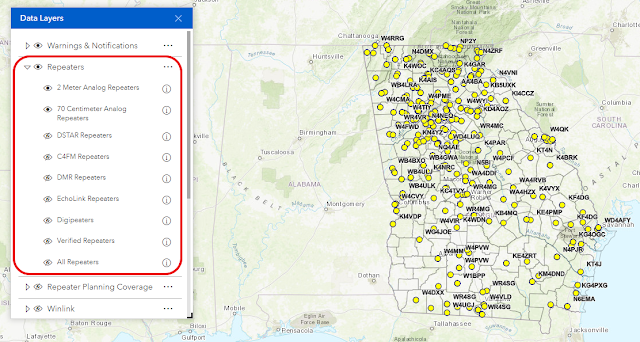
The map has been rebuilt using a new web mapping platform provided by ESRI called Experience Builder. Experience Builder is a web app development environment that provides greater functionality and flexibility than the technology platform the old Situational Awareness Web Map was built on.

ESRI's Experience Builder is still a maturing product, so all the functionality I want to add to the Situational Awareness Map is still not available. But Experience Builder as a development platform is far enough along that I decided it was time to make the switch.

All of the data (map) layers that were in the old map have been brought forward into this new map - repeater information, weather watches and warnings, critical infrastructure, traffic data, etc.

The single biggest change in this new map is in how these data layers are managed. In the old Situational Awareness map, all the data layers were in one very long and often confusing stack. It could be tough to find the data layer you wanted to turn on or off. This new map takes advantage of the ability to create logical layer 'groups' - expandable and collapsible groupings of related map data. For example, the new Data Layers listing now groups all repeater data under a single expandable heading called Repeaters.


Most of the functionality that was in the old Situational Awareness Map has been included in this new map:

  • The ability to view the data attribute tables
  • The ability to conduct pre-formatted searches for repeaters by callsign, and search for street addresses and individual counties
  • The ability to identify points on the ground by latitude/longitude, street address, US National Grid and UTM coordinates
  • The ability to switch base maps
  • The ability to do basic linear and area measurements
  • The ability to share the map on social media
  • The ability to generate elevation profiles (a new feature not available in the old map)
There is some functionality that has not been ported over from the old map, at least not yet:
  • The ability to do markups (graphics) on the map
  • The ability to print from within the map
  • The ability to overlay custom grids
I'm confident this missing functionality will become available as ESRI updates the Experience Builder platform.

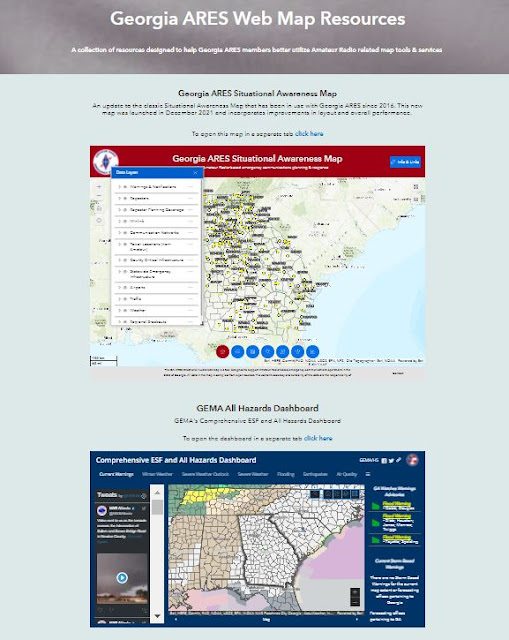
So, how do you find this new map? Simple! The new Situational Awareness Map is a component of the larger Georgia ARES Web Map Resources website


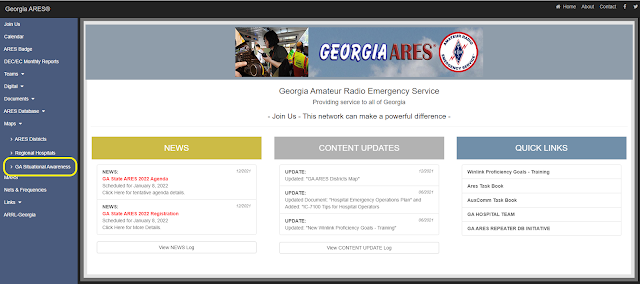
This website was launched in early 2021 and is linked from Georgia ARES website under the Maps pull-down listing on the left side of the page.


I'm scheduled to do a presentation on this new Situational Awareness Map at the 2022 Georgia ARES State Meeting scheduled for 8 January at the Georgia Public Safety Training Center in Forsyth, GA (COVID permitting). If you can't make this meeting, or want more information on this new map, or arrange a web-based presentation for your Amateur Radio or EMCOMM group, feel free to contact me at w8byh@arrl.net.

W8BYH out

31 December 2021

Things I Finally Figured Out In 2021

Life is a strange journey, and 2021 was stranger than most. It was a rough ride for many people. While my family and I had a relatively smooth trip around the sun, the rest of the world's problems got me thinking more deeply than I have in past years. I could dive into deep discussions about the philosophy of life, the impact of COVID, the paradox of the expanding universe. 

But naaah, I'll just talk about some of the ham radio things I've finally figured out. 

  • There are no new ideas in Amateur Radio. Lots of good old ideas, even great old ideas, but no new ones. The theoretical and practical tools and methods for communicating over the airwaves have all been figured out. So stop looking for the next 'new thing' and instead just get on the air with what you have, and have fun
  • The radio industry will never make exactly what I want. That's not a complaint, just a statement of fact. I'm doomed to pass from this life without the perfect radio. But that's OK, because I'll shuffle off this mortal coil without the perfect pickup truck, the perfect computer, the perfect hamburger, the perfect waistline. That's life
  • Bigger is better. Bigger antenna. Bigger power supply. Bigger transmit finals. Bigger DSP. Bigger touch screen. If you are just getting into ham radio, don't start small, start big and save yourself the frustration of low power, low sunspot counts, low antennas. Go Big. That said, however...
  • Nothing hones your practical skills like QRP  
  • Don't fear the tuner. The internet is full of ham radio 'experts' pointing their fingers and laughing at others who are seeking advice about tuners. In their minds, real hams use resonant antennas, all others are weak sisters. That's bullshit. If you need a tuner, use a tuner, and don't be ashamed about it
  • The era of the sub-$1,000 basic 100 watt HF rig is over. Icom learned a huge lesson with the introduction of the IC-705. The ham radio community griped endlessly about the radio's $1,300 street price, then they lined up in droves to fork over the cash. The same happened with the IC-7300. Five years ago the 7300 re-defined the concept of the basic rig, and Icom still sells them by the truckload at a $1,000 price point. Icom has already announced price hikes in the new year. Yaesu will follow. Chip shortages, supply chain issues, COVID, and escalating design and production costs means we'll soon be paying a kilo-buck or more for our basic rigs. It's the new norm
  • I'm too damned old to keep tying to deal with Yaesu's endlessly (and unnecessarily) complex menu structures on their HF rigs
  • Life is much better if you know how to solder
  • Cheap Chinese radios are worth exactly what you pay for them, and not a penny more
  • Lithium Iron Phosphate (LiFePo) battery chemistry is the future. All else pales in comparison
  • You can never have too many antennas. Plus, they are easier than radios to hide from your significant other 😄
  • You can fit ham radio into just about any activity. Birthday parties, camping trips, fishing trips, babysitting the grandkids, dog sitting, visiting long lost relatives, memorial services (don't ask me how I know). All you need is a radio and a wire
  • And last, the idea of retirement isn't so frightening. I can see it just over the horizon, in a year or two. 2021 was a huge perspective shift for me. After a half century of running on the hamster wheel I'm looking forward to extended navel gazing sessions, hanging out with the grandkids, walking the dogs, chasing the XYL around the camper, fishing, and playing with radios

So, boldly forward into 2022!

W8BYH out

27 December 2021

Pure Fleet

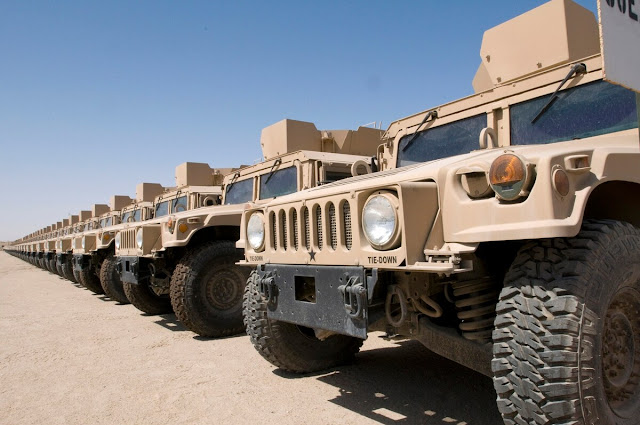
In the Army we had a concept known as 'pure fleet'. Pure fleet means that an Army unit, like a division, has only one type of vehicle for each mission. For example, back in the 90's, it was common for a division to have a mix of light utility vehicles - HMMWVs, militarized pickup trucks and SUVs (we called them Commercial Utility Cargo Vehicles, or CUCVs), mission specific vehicles like maintenance trucks based on the old Dodge Ram pickup series (M880 'contact trucks'), and more. One day some smart logistics guy took a look across all the motor pools stuffed full of this odd mix of rolling stock and said, "we need to standardize on just one type of vehicle, and it needs to be the HMMWV". The division commander agreed and the concept of the pure fleet was born. 

The benefits of a pure fleet are pretty obvious. You only have to train Soldiers to drive one type of vehicle, not three or four. Your mechanics only have to worry about maintaining one type of vehicle, not three or four. Your logistics guys only need to worry about supplying parts for one type of vehicle, not three or four. Assuming you make a good choice on the type of vehicle you standardize on - and the HMMWV was a great choice at the time - the pure fleet concept reduces a lot of headaches.

They all drive the same, function the same, use the same spare parts...

I've decided to adopt the pure fleet concept with HF radio and will likely extend it to VHF/UHF handhelds. I came to this decision after almost a year of struggling to get radios from different manufacturers working with a variety of digital mode software. I've worked with a number of Icom and Yaesu HF radios and a smattering of one-off rigs like the Elecraft KX2 and the Xiegu G90 (sorry, I'm just not a Kenwood guy). The only line of radios that was even remotely easy to configure across a wide variety of software packages - Winlink, JS8Call, FLDigi, Ion2G (ALE) and MS-DMT (MARS) - has been the Icom line. 

Yaesu's radio control settings are maddeningly complex, and it seems if you change one variable for one software package, you end up impacting settings for others. I can't tell you how frustrated I've become with Yaesu radios. Yaesu makes good, solid radios, and I think they are better sounding on SSB than Icom rigs, but configuring the radios for digital operations is maddeningly complex and confusing. The smattering of boutique rigs I've tested - the KX2, the G90, the CTX-10 - can be made to work on digital modes in some form or fashion, but they are QRP rigs, and not well suited to high duty cycle digital mode operations.

So I've decided to standardize on Icom and start shedding much of my Yaesu gear. My pure fleet will be Icom based.

Standardizing on Icom offers a number of significant advantages. 

  • My IC-7300, IC-7100 and IC-705 all share the same basic command set. For example, adjusting RX bandwidth (an important step for digital mode configuration) is the same process across all three radios. The button presses to get the the baud rate settings are the same across all three radios. The ALC level adjustments are the same across all three radios. Get the hint? Learn one, and the learning curve is flattened for the other two
  • Icom's current generation of radios are very well supported by digital mode software developers. In fact, the IC-7300 has become a benchmark radio for software development; developers today will code for the 7300 first, then branch out to other radios
  • With the exception of the IC-7200, every HF radio Icom has released since the introduction of the IC-7100 back in 2015 incorporates an SD card slot. This means the user can store different operating profiles on the card and recall them as needed. For example, on my IC-7300 SD card I have a rig profile for MARS MS-DMT, MARS ALE, Winlink, JS8CALL, and SSB voice. If I'm operating voice and want to reconfigure the radio to operate on MS-DMT it's a few taps on the rig screen, the profile is loaded from the SD card, and off I go
I'll still play around with other brands of radios. I'm particularly captivated by the dainty little Elecraft KX2 - it beats larger rigs so bad on both RX and TX that it's almost funny. But for primary voice and digital communications, particularly for EMCOMM work, it's all Icom.

W8BYH out

19 December 2021

The View From The Bench - 19 December 2021

First, Merry Christmas! 

What's been going on this week?

Well, a random thought rattling around in my head. I find it interesting that hams who buy QRP rigs often think that the absolute best antenna to use with them is some sort of a reduced length vertical, as though that will magically overcome every QRP rig's greatest shortcoming - low output power.

I admit, I'm guilty of the same. The KX2 looks sooooo cute sitting next to that neat little AX1 vertical.


Truth is, any shortened antenna is a compromised antenna, and it's the worst thing you can use with a QRP rig. When operating at low transmit levels, the efficiency is all in the antenna. You need something that is both resonant and BIG! The bigger, the better. Think this:


Not this:


Short verticals have their place, and they can be a lot of fun to play with. I always have one with me as a 'quick setup' option, but for serious QRP work a long wire antenna simply can't be beat. My go-to design is the end fed half wave. It is fast and easy to get set up, as long as there's a tree or two available (and in Georgia there's always a tree or two available). I've got examples from several different manufacturers. All of them are good. For portable QRP work I highly recommend the Par EndFedz Trail-Friendly EFHW, sold by Vibroplex. It was recommended to me by my buddy Joe, KI4ASK, who's a dedicated SOTA/POTA guy. I've used mine fairly regularly for about a year, and I've got it adjusted so it's resonant on 10, 20 & 40 meters, so no tuner is needed. And it's small, really small. When wound up on its carrier it is about the size of an HT. 


If I'm doing longer term or more serious communication duties, or bad weather is expected, I'll hang one of my EFLW antennas that can handle 100 watts or more and is weatherproof. I have examples from Chameleon, MyAntennas and perhaps one or two more manufacturers. All of them are good, and all of them are certainly better than any vertical antenna combo I've got.

Cables

I run a couple of LDG tuners with my Icom radios. The work great together, but there is one weak point - the LDG manufactured cables that connect the tuner to the radio. I've had several go bad on me - whoever makes them for LDG does a lousy job of crimping and soldering the Molex pin connections. I've had to repair two of them so far, and just yesterday one I had repaired in the past broke again. Grrrr... In the good old days I could just swing by the local Radio Shack and pick up an extra Molex connector or two. But these days everything is on-line. So I've got a pack of them on order from Amazon, but they won't be here until Tuesday. I guess no playing around on ALE until then.


ALE

Speaking of ALE, someone finally published a good user guide for the Ion2G ALE software package. It wasn't written by the program's author, Devin Butterfield. This was written by one of the alpha and beta testers for Ion2G. It always befuddles me why so many software developers don't think putting together documentation for their applications is important.

Cobbling Together

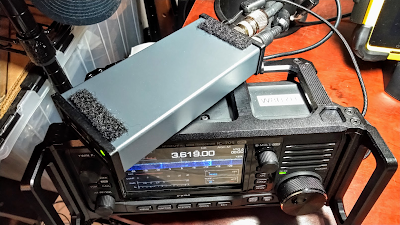
I continue to play around with physical configurations for my IC-705. In case you hadn't heard... there's no tuner built into the IC-705. There are some good external tuner options - the Icom AH-705, the Vibroplex mAT 705 and the LDG Z100. All of them will interface directly with the 705 so that they will do 'sensed tuning'; if the tuner senses high SWR on a frequency when transmit starts it'll trigger a tuning cycle. All three are very good tuners. but the smallest by a wide margin is the mAT 705. I was looking at it last night and thought to myself, "Self, why can't we figure out a way to mount this thing to the IC-705's Windcamp ARK 705 cage for easy setup and a smaller footprint?" Self says, "Why not, let's give it a try!" After an hour or so of trying different mounting locations, I settled on what you see here. Through the modern miracle of Velcro, I give you the cobbled together IC-705/ARK 705/mAT 705 mash-up.


I think I'll do a dedicated post on this at a later date, once I've matured out the concept.

That's it for now. Once again, Merry Christmas, and Happy New Year!

W8BYH out  

17 December 2021

Tablets

I've mentioned in a recent post that I've been around the world and back again with computing devices for Amateur Radio. I've bought, borrowed or re-purposed over a dozen different computers over the past few years in search of that 'perfect' computing device for use as both a general purpose shack computer and as a deployable, rugged, EMCOMM computer. 

I have to say that, with two exceptions, every computer I tested worked just fine as a device for running ham radio related software - Winlink, JS8CALL, Fldigi, Ham Radio Deluxe, Icom's RS-BA1 package, Ion2G ALE, RT Systems rig programming software, and more. This is what I call the 'ham radio software stack'. The computers I tested included:

  • Two Acer Aspire models (14" & 15")
  • At least two Dell laptops - a plain-jane Inspiron and a ruggedized Latitude 5420
  • Three Panasonic Toughbooks - two CF19s (early and late models), and a CF31
  • Four Microsoft Surface tablets - a Surface Pro 5 & 7, a Surface Go (original) and a Surface Go 2
  • A Raspberry Pi 3
  • A Trimble T10 ruggedized tablet
With a few exceptions, all of these computers did just fine running the ham radio software stack; they had enough computing power to get the job done with no sweat. The exceptions are an early Panasonic CF-19 running a single core Celeron processor, the two Surface Go's (nice form factor, but painfully anemic low-end CPUs) and the Raspberry Pi 3, which can't run Winlink. For me, the inability to run Winlink is a deal-killer. Forget Wine, or PAT or any other Windows emulator for Linux. If the OS can't run Winlink natively then I don't want to mess with it, especially for EMCOMM work.

Some of this computing hardware got left behind for what I'll call personal issues. I didn't like the keyboards, or the screens, or they weren't rugged enough, or didn't have enough USB ports, or an HDMI port or... OK, it's all subjective. Some computers clicked, some didn't. For example, the Panasonic CF-19 and 31 Toughbooks are great rugged computers, and good used examples are available from dozens of resellers at very reasonable prices. But the 'square' screen aspect ratio drives me nuts - things just don't look right.

The winners on this list include the Acer Aspires, the Dell Latitude 5420, and the Trimble T10. The Acer Aspire line is a good blend of performance and price. You get a lot of computing 'oomph' for less money than similar offerings from Dell, HP, etc. However, Acer achieves that low price by going light on the physical build. That's my way of saying they are flimsy. I wouldn't take an Aspire to the field too often, but if you are in the market for a good performing laptop for shack use, the Aspire line is well worth a look.

The Dell Latitude is a beast. It's part of Dell's rugged computer line - not quite as tough as a Panasonic Toughbook, but plenty tough enough, and it comes with some very good computing specs: a great backlit keyboard, a very good touchscreen, an i5 quad core processor, plenty of RAM and SSD storage, more ports than I can count. It's my go-to field laptop.

But the device I really want to talk about in this post is the Trimble T10. If you follow this blog you've seen this tablet show up in a number of photos, most recently here:


It's an odd piece of computing hardware because it's not marketed as a tablet. If you know anything about Trimble, you know they make high end surveying and GPS equipment. That's how I got to know about the T10 and get my hands on one. Trimble sells the T10 as a survey data collector - something you sync up with a high precision GPS receiver and go out and collect data with. But the T10 is really just a modified fully rugged (and MILSPEC) Windows 10 tablet running an Intel i7 processor. From that perspective it's like any of the half-dozen other ruggedized tablet brands out there on the market from Dell, Panasonic, Getac, and others. In fact, based on the form factor I suspect the T10 line may be manufactured in the same factory that makes Panasonic's Toughpads. 

Here's what puts this device head and shoulders above anything I've tested so far:
  • IP65 rated for water and dust protection
  • MILSTD 810G rated for vibration and shock resistance
  • Hot-swappable high capacity battery packs
  • 72 channel internal GNSS (GPS/GLONASS/Beidou/SBAS)
  • i7 core processor
  • 8 gb RAM
  • 512 gb of storage
  • 4G internal cell capable (yes, I've installed a SIM card, so no external wi-fi needed)
  • Excellent daylight readable touchscreen
In short, the thing is a beast. I could hammer tent stakes with it and it would still work. But therein lies one of its drawbacks; it's heavy and just a bit unwieldy. Plus the factory suppled 'docking' keyboard isn't the best, which is why I'm trying out Bluetooth keyboards.

The T10 is such a good computing device that it's actually one of my main shack computers. In fact, for digital operations for everything except MARS work, this is the computer I use. It sits in a multi-port docking station (that provides extra Bluetooth and an HDMI port) and runs my entire suite of ham radio software:
  • JS8CALL
  • WSJTX
  • Winlink
  • HRD
  • Fldigi
  • RT Systems programming software for a variety of radios
  • Icom's RS-BA1 software for controlling the IC-705
  • Elecraft KX rig control and programming software
  • LibreOffice (an open source replacement for Microsoft Office)

If I need to take a radio to the field for digital operations, I simply grab the T10 off of its docking cradle, toss it into a bag with a Bluetooth keyboard and mouse and head out. Rain or shine, it doesn't matter; the T10 simply doesn't care.

Like everything else Trimble sells, the T10 is (very) badly over-priced. That's why I don't own this particular tablet. It's on long-term loan from a company interested in evaluations of 'hardened' tablets. But when I do have to return it I'll go looking for a replacement. The T10 has proven to me the feasibility of the Windows tablet as a general purpose field computing device, and I'll likely go looking for a used Panasonic Toughpad with similar specifications. The good thing about the Panasonic line is that they absolutely dominate the rugged computing market, so there are always hundreds of used devices available on eBay or from resellers like Bob Johnson's Computer Stuff out of Delaware (I've bought a few Toughbooks from Bob Johnson's, and it's a good company)


But why a tablet instead of a laptop? For field operations I think a ruggedized tablet has some significant advantages over a laptop. First, it's easier to seal up a tablet than it is a laptop, so they tend to be slightly cheaper. Next, a tablet is more likely to have a built-in GPS, particularly if it's cell service (or 'data plan') ready. Many ruggedized tablets have external hot swappable batteries. You can run them effectively without a keyboard or mouse, using finger pokes, or a stylus. Because they are specifically designed to be used outdoors many come with brighter screens for daylight readability. They also tend to be physically smaller and lighter than a ruggedized laptop with a similar screen size.

Of course there's drawbacks. The biggest limitation is ports. Most rugged laptops come with only one or two USB ports, and no HDMI port. You'll need a port expansion dongle or a docking station. They also don't stand up by themselves very well - you end up having to prop it up against something, or get an add-on stand like a RAM Universal Stand. And because most manufacturers don't see tablets as general purpose computing devices, you normally get a lower system capability set - slower, mobile CPUs, less RAM and less storage than you'd get with a laptop of the same screen size. Remember, there's no cooling fans on tablets, and more processing power = more heat. These devices necessarily run at lower speeds and with lighter weight processors just to keep from melting down. Suffice to say, you won't be playing Call of Duty on a tablet, at least not for very long. But that's OK. Most ham radio programs are what I'll call 'low intensity' applications - they don't tax the system capabilities like gaming software does. Applications like Winlink and Fldigi run perfectly fine on tablet-class hardware specs. If you buy a tablet with at least an i5 mobile processor you should be fine.

So there you have it. If you're looking for a rugged, weatherproof computer to use for EMCOMM, don't just look at laptops. Take a look at some of the rugged tablets that are out there, particularly the used Panasonics or Dells. There's lots of good deals on eBay and from third party re-sellers. A tablet may just be a better fit for your needs than a laptop.

W8BYH out.