Showing posts with label receivers. Show all posts

04 July 2022

Chip Shortages - Still?!

 Thomas Witherspoon posted this a few days ago on his (excellent) SWLing Post blog:
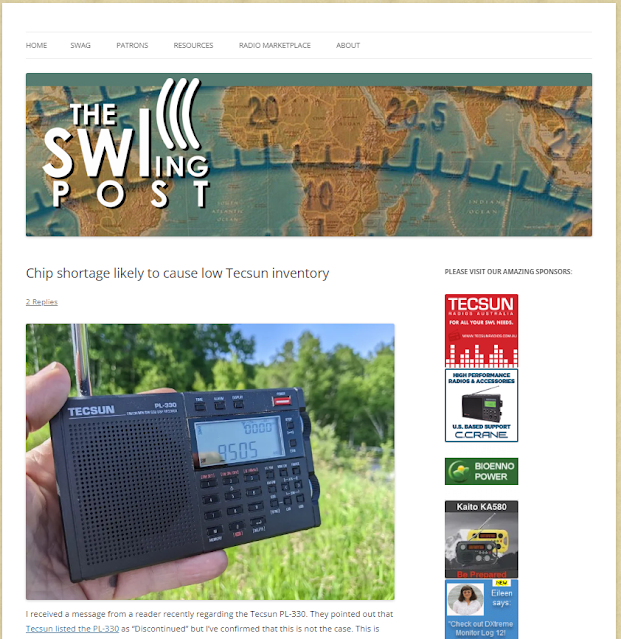

Silly me. I thought we were about out of the Great COVID And Fire-Induced Chip Shortage Of 2020 - 2022, but I was wrong. I guess if the current administration can blame everything else on Putin (Putin's Price Hike, Putin's Inflation, Putin's Food Shortage, Putin's Baby Formula Shortage, ad nauseam), we can blame this current round of chip shortages on him, too. And actually, according to Thomas, there may actually be something behind blaming Putin for our current and ongoing chip shortage issues. It seems Russia and the Ukraine are the primary sources for several strategic minerals used in chip production. So we'll call this Putin's Chip Shortage.

I've got a wide assortment of shortwave receivers. Heck, just about every Amateur Radio HF transceiver I own is a top-notch shortwave receiver. But I'm of the age and stage where dedicated shortwave receivers are still fun to collect and play around with. Down through the years I've had some pretty good ones. The collection starts with a 1950's era Grundig tabletop model with the dial gloriously laid out not just with frequencies, but with the names of the exotic location where signal originate from - London, Berlin, Moscow, Tokyo. Spinning the dial was a trip around the world. And the collection reaches all the way to the present era, with the diminutive and remarkably good C.Crane Skywave SSB.

The one portable receiver I had that always brings back memories is the Sangean ATS-909 (also sold by Radio Shack as the DX-398). 
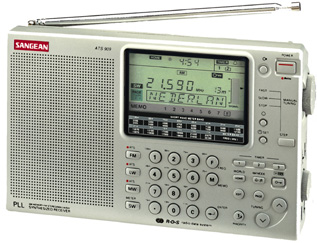

Based on reviews of the radio in publications like Passport to World Band Radio (sadly out of print, and badly missed), I picked up an ATS-909 just before heading back to Germany in 1998 for my second tour of duty there. At the time Central Europe was still a 'shortwave rich' environment, with powerhouse broadcasters like Voice of Russia (the old Radio Moscow), Deutsche Welle, and the BBC still pumping out content on shortwave. Additionally, I knew that many of the German FM broadcasters were switching to RDS, making the ATS-909's RDS decode capability a neat and useful feature.

While I can't say that the ATS-909 was a stellar performer on shortwave - most outlets rated its performance as just good to very good - the radio's build quality was outstanding and the ergonomics were excellent. Plus, it's performance on FM was considered best-in-class. That radio served me well in Germany, going along on a number of field exercises so my Soldiers could listen in on American Forces Network (AFN) broadcasts, local German stations, and the occasional radio show from the BBC. After the factory radio was stolen from our Volvo V70, the Sangean ended up doing service as an ersatz car radio. It slid perfectly into the gaping hole left in the center console where the Volvo radio used to be, and served well until I could get another radio installed. The ATS-909 eventually just gave up the ghost, too much time spent being rattled around in the car and sitting in the Georgia summer heat. I regretfully tossed it after the alkaline batteries belched up their contents in the battery compartment. I also kicked myself for not picking up one or two when Radio Shack closed them out a few years later.

For the past year or so I've been following the story of Sangean's replacement for the ATS-909, the ATS-909X and the 909X2. The ATS-909X was considered something of a disappointment - a bit deaf on shortwave reception when using the whip antenna (but a strong performer when using an external antenna), and some problems with AM sensitivity. The ATX-909X offered Sangean's usual excellent build quality and ergonomics, but with strong competition from lower cost mainland Chinese manufacturers like Tecsun, Sangean knew they needed to clean up the 909X's shortcomings (Sangean is a Taiwanese, not a Chinese manufacturer - there is a difference). So Sangean tweaked the ATS-909X's performance and renamed it the ATS-909X2 - just in time for chip shortages and COVID to hit. Talk about timing.
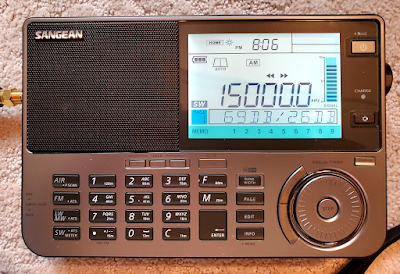

Reviewers really liked the improvements in the 909X2, but production was slow and prices for the radio, if you could find one, were high, with some retailers asking over $500. In the past six months production has increased, and the radio's price has settled down to about the $250 US level. Amazon now has regular stock of the radio and can deliver in a day or two.

But what about the lingering chip shortages? Some manufacturers like Icom have been very frank in their discussions about the impacts of the shortages. Production goes to the high demand/high volume customers like computer, military and commercial communications systems and automobile manufacturers. Low volume customers like ham radio and shortwave receiver manufacturers get low priority. This means the price and availability of the any radio - Sangean, Tecsun, Icom, Yaesu, Eton, Panasonc, etc. is in question. With this in mind I decided to go ahead and pull the trigger on the Sangean, and I placed an order with Amazon a few days ago.

A side-by-side comparison with the ATS-909X2's competition will have to wait. I've got several portable shortwave receivers to test against - the C. Crane Skywave, the Skywave SSB, the Tecsun PL-880, the Tecsun PL-310 and maybe one or two others hiding away. I'm particularly interested in seeing how well the Sangean performs on SSB compared to the PL-880 and the Skywave SSB, two radios that get high marks for sideband reception.
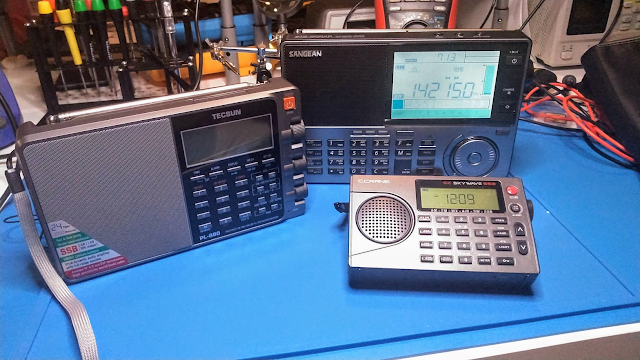

One thing became abundantly clear to me in the few hours I've used this radio so far - the ergonomics and build quality are outstanding. Anyone who's spent any time with a portable SW receiver will find the controls clearly marked and well laid out. You don't need a manual to get up and running with this radio (but if you do, the manual is excellent).
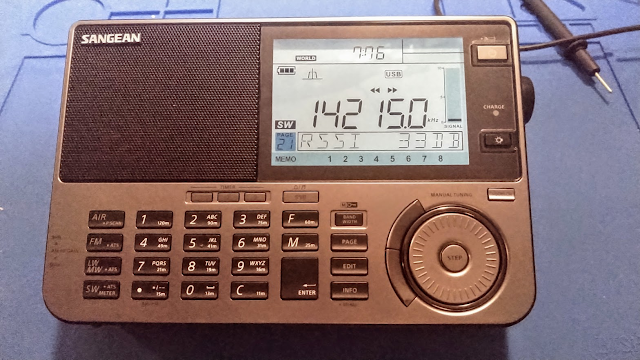

Sangean includes an external wire antenna, ear buds, and something few other manufacturers provide - a 'wall wart' power cube. The radio runs off of four AA batteries and can use alkaline, NiMH and NiCad chemistry types.
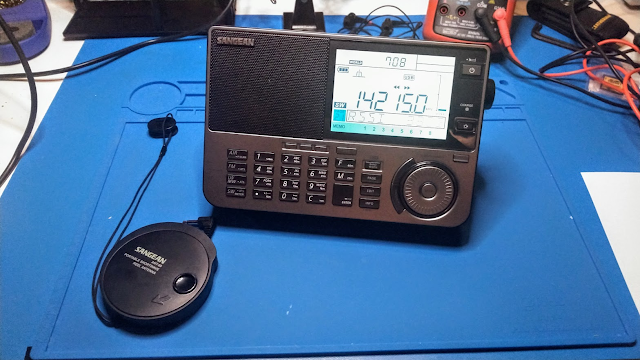

A word about external antennas. Many manufacturers, including Sangean, include an external antenna with their radios. Many folks feel that a portable radio shouldn't need an external antenna. For commercial FM and AM broadcast reception, I agree. But for shortwave and ham radio reception, an external long wire antenna is absolutely necessary. You wouldn't expect your expensive Amateur Radio HF rig to operate well on 80 meters using a 3' whip antenna. Why would you expect a consumer-grade receiver to do better?  Be realistic. If you buy a portable SW/HF receiver also pick up (or make) an external antenna to use with it.

OK, let's wrap this up. Over the next few seeks I'll be doing a side-by-side comparison of these radio on the Amateur Radio bands, focusing on 75 and 40 meter sideband reception. I'll be looking at overall performance, ergonomics and form factor. All the evaluations will be done using the factory supplied long wire antennas. Will a clear winner emerge? Stay tuned!

W8BYH out

01 December 2018

AM/FM Radio In The Shack?

Do you keep a consumer grade AM & FM radio in your shack?

Tecsun PL-310ET atop my Yaesu FT-991 - small but packed with features

Many of you will say, "Why bother? My all-mode rig does just fine."

True enough, but what happens in an emergency when you need to monitor both broadcast radio (say, for weather updates) and you are also working an HF disaster net? Some may say, "I'll just use my HT." OK, that may work. Lots of new(er) HTs  have the ability to pull in AM & FM broadcast bands. But what if you need to use the HT to monitor the local repeaters? Of course you could set up a scan memory group and roll the broadcast bands into a scan setup... at some point the issue over-complicates itself. The best approach? Get a good AM/FM receiver and incorporate it as part of your shack setup.

There are a lot of really good, and inexpensive, AM/FM/SW radios on the market. Sadly, many of the old-line makers of top-notch receivers like Sony, Panasonic, Grundig and Drake have either left the market, have been sold off to holding companies and are little more than badge names on second-tier electronics, or have gone under altogether. The good news is that several Chinese manufacturers have stepped into the market in a big way. You see, in most of the developing world (that would be what we call the 'third world') broadcast radio is still big, and it's a primary means of information and entertainment dissemination. Not everyone has gigabit internet service and a MacBook Pro. So Chinese manufacturers like Tecsun have moved into the portable AM/FM/SW receiver market in a big way, bringing great performing DSP-based radios to market at very low prices. Then there is a last holdout American firm, CC Crane, that still takes portable AM, FM & SW listening seriously, and makes an outstanding line of high performance, reasonably priced radios.

So what qualities does a good portable radio need to have to be considered for inclusion in a ham shack for emergency purposes? Well, for starters, good AM & FM reception. Next, the ability to run on common battery types (AAA, AA or D-cells). And last, the ability to accommodate an external long wire antenna, either a clip-on or plug-in design, for improved reception.

Down through the years I've collected (really, more like accumulated) a lot of portable AM/FM radios:

  • Several classic (and very fussy) GE SuperRadios - a very good design that was a favorite of AM DXers for decades. Too bad GE/RCA didn't give a damn about quality control
  • C Crane CC Radio EP - a product improved SuperRadio. Discontinued, but replaced by a better performing DSP model, the CC Radio EP Pro
  • A classic old Panasonic RF-505 - amazing FM sound quality. It shows what the old-line Japanese makers were capable of when they were at the top of their game
  • Tecsun PL-310ET  - a diminutive little radio (about the size of a large brick of sharp cheddar cheese) that probably offers the best bang-to-buck ratio
  • C Crane CC Solar Observer - a seemingly awkward mash-up of AM/FM radio, weather radio, an LED flashlight and a solar and hand-cranked dynamo charger. But guess what - it works, and works quite well!
  • Tecsun PL-880 - a simply amazing AM/FM/SW (USB/LSB) receiver that uses a hard-to-find battery
  • C Crane Skywave - another diminutive top performer, but a bit pricey. Proof that C Crane knows how to design & build radios. This radio was recently updated to a full USB/LSB version
  • Tecsun PL-365 - a revision of a design made for CountyComm by Tecsun for a US 'three letter agency' looking for  a small general coverage receiver that could fit in a bug-out bag. A remarkably good radio with an unusual (but very effective) external AM antenna. 
  • Freeplay FPR2 wind-up and solar powered AM/FM radio. This is the radio, along with some sort of goofy wind-up laptop running Linux, that was going to save the third world from itself. The thing is heavy, flimsy and makes a gawd-awful racket while the wind-up dynamo is running. But it has decent AM & FM reception, and is quirky enough to cause me to hang onto it as an example of the precursor to the current generation of 'wind-up' radios.

You can see a pattern here - I like Tecsun and C Crane radios.

But which one would I run in my shack during an emergency to monitor local broadcast stations? Remember, my criteria are good AM & FM reception, the ability to run on commonly available batteries and the ability to accept an external antenna to improve reception.

My first reaction is to reach, almost reflexively, for the Tecsun PL-880. It is an outstanding receiver in all respects. But it has one huge failure - it uses non-standard and hard to find lithium-ion 3.7 volt batteries that can only recharge via USB while in the radio. Sorry, but I have enough to worry about without wondering if I've got the right kind of batteries on hand for my radio.

Next I'd reach for the C Crane Skywave. Excellent AM & FM reception, and really nice stereo FM reception with earphones. But for normal listening the speaker is too small and 'tinny'. A great bug-out radio though.

So what does this selection really come down to? The plain-jane AM/FM only C Crane CC Radio EP. It offers excellent AM & FM performance (FM sounds really good out of the big main speaker), runs on D-cells, offers precise tuning with good selectivity, has a very effective FM whip antenna, a 'tunable' AM antenna and the ability to accept a simple long wire antenna to improve reception. This isn't just a good radio to have around for emergencies, it's an enjoyable radio to listen to at any time.


CC Radio EP  - a truly great AM/FM portable

So what do you have on-hand for AM/FM reception? Remember, the day before the ice storm is a lousy time to decide you need a broadcast band radio. And Amazon doesn't deliver on ice skates.

W8BYH out