Showing posts with label yaesu. Show all posts

04 July 2025

Hot Stuff

I had a chance to play around a bit with a new Yaesu FTX-1 rig during Field Day this year. One of our club members brought his and we hooked it up to an end-fed antenna just to monitor. Here's a few quick observations.
  • Audio is excellent. Yaesu really did a neat trick with the 'front firing' speakers, which really are not front firing, but downward firing, but into a resonance chamber below the radio that directs the audio forward. I found the audio was loud, clear and distortion free. Good job there, Yaesu
  • The screen is very good - clear, crisp and bright, and well laid out
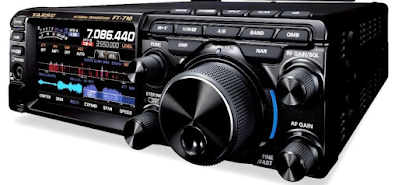
  • The configuration soft menu system appears to follow the FT-710 layout, which I thought was pretty good
  • The main VFO knob is too big - it gobbles up too much front panel real estate, space that could have been put to use for other purposes like a dedicated sub-VFO knob
  • The whole Field package seemed very sturdy. As many have commented, it's not light - it's very brick-like

But...

The radio was running just on receive, and it was running hot. I mean, HOT. There's a small area on the back of the radio just above where I think the PA board is located, and it was hot to the touch. The radio was on receive only because we didn't want to interfere with Field Day stations operating just a few yards away. I was astonished at how hot this thing was running. Compared to its #1 competitor, the IC-705, well, there is no comparison. Both operate at the same power levels (10 watts max), but even running heavy digital modes like JS8CALL the 705 never gets above moderately warm (less than half of the built-in heat indicator scale, and never near the danger level). One YouTuber reports that his FTX-1 gets up to 110 degrees F. when running FT8. Of course, Yaesu has always stated that the optional fan is necessary when running digital modes, and I don't really have an issue with that, but they should include the fan as a standard item with every radio sold.  


Heat management is an issue all radio manufacturers face. Some do it better than others, but more often manufacturers get it right with some models, wrong with others. Even Icom. The IC-705 and the IC-7300 are well known as 'cool-runners', but their higher end commercial HF rig, the F-8101, is infamous for its heat issues and the need to run its noisy clip-on cooling fan even when just working SSB. Elecraft's small KX3 and KX2 field radios are notorious hot runners on digital modes, which has spawned an active accessory market for heat sinks and clip-on fans.

Nobody I know of has yet to open up an FTX-1 to take a look at how the PA board is built, and what components Yaesu spec'd. It may be that the engineers knew heat would be an issue, and they over-built that part of the radio to handle the heat. Equally likely, we may see that Yaesu ends up replacing a lot of boards under warranty because they just couldn't handle the heat. Either way, we'll know in about a year. Stay tuned.

W8BYH out

27 May 2025

Fanboys Report!

It's been just a few weeks since the Yaesu FTX-1 Optima and Field models have started to ship. We've had the usual silly and pointless unboxing videos, and only a few in-the-field-making-contacts videos have come out. But there have been enough of those videos to show:

  • the firmware is still buggy
  • the field version with just the battery is pretty big and heavy; it ain't no Elecraft KX2
  • the radio addresses some of the issues that linger with the very good FT-710, such as waterfall display averaging
  • audio quality and volume are both good
  • the radio naturally 'sits' at a good viewing angle (something Icom blew with the IC-705)
  • something I never thought of, but Yaesu botched the placement of the two BNC connectors - the UHF/VHF connector should be at the top of the stack, making it easy to mount a whip antenna for local repeater work and still connect an HF antenna cable
  • like all field radios that have come before it in the Yaesu line, it's about as water resistant as a submarine with screen doors
There have been no reports on Bluetooth or GPS performance yet. And no discussion or evaluation of the performance of the 'snap-on' accessories like the external tuner or cooling fan.


For me there are few huge wait-and-see items, and this post is a request for someone to specifically address them.

First, does the radio have back-lit buttons? Internet chatter indicates that, yes, the radio does have some back-lit buttons, but I'd love someone to do a short video in low-light conditions to show just what buttons are back-lit, and show the menu item that controls the lighting level (assuming there is one).

Next, how well does this rig perform when running digital modes? In the recent past, Yaesu's digital mode configuration settings on their HF field radios were an unholy mess (FT-891, 991A and a few others of the same generation). My sense with the FT-710 is that Yaesu spent a lot of time cleaning up their menu structures, but I never got to work the radio on digital. Since this rig seems to borrow a lot from the 710 interface, I'd like to see someone do a video on configuring the rig for something like FT8, and then running an extended session outdoors to see just how cool the rig does, or doesn't, run.

Last, and most important, how well does the FTX-1 do when running digital modes over a USB-C cable? This is the Icom IC-705's biggest design flaw - Icom badly botched the RF shielding in the rig, and it's unusable on digital modes over USB. I want to know how well the FTX-1 works on digital when controlled by a USB cable. Did Yaesu get it right - did they incorporate proper RF shielding? If yes, this radio has the potential to grab the majority QRP radio market share from Icom.

So Yaesu YouTuber Fanboys, here's your mission - I want a comprehensive, focused video of the new FTX-1 covering all the things I list above. Get it posted by the end of the week. Move out.

W8BH out

10 May 2025

The Radio As A Box Of Legos

The new Yaesu FTX-1 started shipping this week and the ham radio world is all a-flutter. The Yaesu fanboys are squealing with delight, the Yaesu haters are harumphing, and folks in the middle, like me, are taking a 'let's wait and see' attitude. 

One of the FTX-1 issues I did gripe about on Facebook is the lack of built-in GPS and Bluetooth, and no wi-fi capability. In this day and age, and particularly at this radio's price point, leaving out these features seems kinda' dumb. 


However, someone responded to my post with a strong argument against GPS, Bluetooth and wi-fi integration, and his argument made sense. Now I'm not so sure stuffing all this technology into an HF ham radio is such a good idea.

Bluetooth and wi-fi are perishable standards. This means that the standards are always advancing, and backwards compatibility can be iffy. Over the course of a few years any radio with these features will become increasingly out of step with the latest standards. As the radio ages, it becomes harder and harder to sync it with Bluetooth devices like wireless headsets, or get the radio on a working and secure wi-fi network. I'll admit, it's more likely that the radio will fail for other reasons before the Bluetooth and wi-fi features become obsolete, but it does make me think about a radio with obsolescence engineered into the box.

GPS is a bit different. The GPS data standard is stable and has a lot backwards compatibility. There is an installed base of millions of GPS devices in critical applications (like aviation) that can't be messed with. This means GPS, by its nature, is pretty 'future proof'. But GPS integration by ham radio manufacturers has always been half-assed. I've written about this in the past. What this means is that owners who want GPS info for uses beyond DSTAR or C4FM integration will get only a fraction of the potential out of the GPS receivers built into the radios.

So let's look at what a modern HF radio must have to be relevant in today's world. The list is actually pretty short. It needs to be able to transmit on all bands from 10 meters through 80, and should be able to tune continuously from  1.5 mHz to 30 mHz. The radio has to do AM, SSB & CW, and do them all well. It must have good filtering and bandwidth adjustments. And of course, some sort of audio output (speaker), a physical control interface (knobs, buttons & switches) and a virtual control interface (CAT or CI-V) via serial or USB. 

Yes, Lego does make a radio! (OK, it's not a real radio, but it's still cool. Check it out!)😄

A radio with these features, and just these features, is a very viable and a very future-proof rig. It carries no technology that will cripple it due to obsolescence. Plus, by adding external components (that 'Box of Legos' thing), you can add relevant functionality without endangering the radio's basic resistance to obsolescence. The transceiver is the core of a system to which you add functionality by dipping into the metaphorical Box of Legos.

The IC-718 has been in production for a quarter century and lacks most bells and whistles
available on current rigs, But it's still a very viable HF rig that has survived 
precisely because it lacks technologies that could have aged-out, forcing the radio from the market.
Using the Box of Legos concept, it can be easily built out to match the
capabilities of more modern rigs 

The Yaesu FT-891 is a very good basic HF rig. It lacks a lot of modern features
such as a soundcard interface, antenna tuner and GPS. Its simplicity is a strength - there's
little with this radio that will 'age-out'.
Using the Box of Legos concept, it's easy to expand the rig's capabilities to
match more sophisticated units that are packed with technologies that
will age-out.

Want to be able to match a variety of antennas? Grab an external tuner. The beauty of an external tuner is that you can match it to the mission. Just want a basic 100 watt tuner for rag chewing or low power digital modes? There's plenty of them on the market. Need to run higher power level digital modes for SHARES or MARS nets? There's a few tuners available for that. Want a battery powered tuner you can run on a POTA activation? Those are available, too, in max wattage ranges from 20 to 100.

Want to run digital modes? Virtually every radio made in the past 30 years can support digital modes. If the feature isn't built into the radio, you can easily out-board the digital signals to an external soundcard device. There's lots of good options. Amazon will sell you a very nice external USB soundcard for under $20, or you can go for a more expensive but more capable dedicated unit like the SignaLink, or one of the manufacturer-specific soundcard interfaces. Any of these options will get you on digital modes with little fuss.

Think your rig is old? Here's a picture of N6CC's field setup, running Winlink using a 70's-vintage
military AN/PRC-174 radio. and a SignaLink as the digital interface

Is  your radio's volume output a bit weak? There are plenty of small, lightweight and cheap battery powered speakers on the market. 

Two small battery powered speakers designed for use with devices like smartphones with 3.5mm
audio output jacks. These work well with radios that need a bit of extra audio 'oomph'.
The small red one in the foreground (about $12 on Amazon) actually provides better sound,
but the battery only lasts an hour or two before it needs a recharge

Need access to GPS to time sync your FT8 session? Remember, the radio doesn't care a wit about a time sync for FT8, it's the WSJT-X application running on your computer that cares. For less than $20 you can buy a USB GPS receiver to plug into your computer and get highly precise location and timing information. There's free software available that will sync your computer's system clock to the GPS timing signal. This is a far more useful solution than a GPS signal that stays locked up inside of a radio.

Here's a nice looking GPS receiver that gets good reviews and uses the ubiquitous uBlox receiver chip.
Cheap and effective 

Just add one of several free GPS monitoring applications to your Windows device, and you'll be getting far more useful GPS info than you could ever hope to from a GPS receiver installed in a modern ham radio.

To sum things up, don't be afraid to buy into old or low(er) tech radio solutions, as long as you can bring the core transceiver up to snuff using add-ons that extend the radio's usefulness without endangering its resistance to obsolescence. Have that Box of Legos filled with useful add-ons that keep your radio running - and relevant - long after current Bluetooth and wi-fi standards are no longer supported. 

W8BYH out

20 September 2024

A Useless Appendage

That's what UHF/VHF is in a QRP rig. Useless. It's a marketing gimmick.

"Icom, why didn't you build a tuner into the IC-705?" Icom: "Hey look, it's got UHF & VHF!"

"Yaesu, why didn't you design your new FTX-1F field radio so it gets an IP rating?" Yaesu: "Hey look, it's got UHF & VHF!"

Building UHF & VHF bands into their QRP rig offerings reflects laziness on the part of the product design teams. Why? Because it gives the design teams the excuse to not get other, more important things right. Like an integrated tuner, like an IP rating for water resistance, like better RF shielding, like more power output, like a better form factor.

I don't care a damn about 70 centimeter or 2 meter capabilities in a QRP radio. If I want to talk on those bands at low power I've got HTs that do a much better job. If I want more UHF/VHF 'oomph' I've got a selection of 50 watt mobile rigs that do a better job. And it's not just me. Over the past few weeks I've talked to a number of IC-705 owners, and they all report that, other than using it to occasionally hit local repeaters, they never use the UHF/VHF side of their radios. 

Like I said, it's a gimmick. 

It looks like Yaesu is about to release a radio that, in form and function, is little more than an IC-705 clone. Icom got lazy with the design of the IC-705, and Yaesu is doubling down on laziness by copying the 705's capabilities, and little else. The FTX-1F's packaging may be a bit more clever, but at the end of the day it really won't do anything that the IC-705 already does.

"Let's just throw in the guts of an HT, toss it over to marketing
 and call it a day"

Think of what could have been. A highly refined HF-only portable field communications package that offers real performance under all conditions, and puts out enough wattage to make a difference. Yaesu is aiming at the wrong target with the FTX-1F. They're aiming at the IC-705. Instead they should have been aiming at the Elecraft KX2, and taken the opportunity to define a whole new class of radio.

Yeah I'm pissed. I'm almost 68, and it looks like I'll be dead before either of these two companies get it right.

 W8BYH out

13 September 2024

I Don't Care How Good Your Receiver Is

With Yaesu's recent announcement of their new FTX-1F QRP radio, lots of wish-casters are commenting about how this new radio just has to come out with top-of-the-heap receiver ratings. Otherwise the radio is a complete failure. Hmmm... Now, odds are this radio will exhibit excellent receiver performance; Yaesu long ago figured out how to make great communications receivers. But if that's what you are focusing on, you are focusing on the wrong thing.

Most of the major radio manufacturers - Yaesu, Icom, Kenwood, Elecraft, Flex, and others - know how to make radios with great receivers. Right now Yaesu, Flex, Icom and Elecraft are duking it out for top position on the Sherwood Engineering receiver ratings, and Yaesu has a surprising number of rigs in the top six slots. I think it's safe to say that the FTX-1F will have a pretty good receiver.

What Yaesu (and Icom) don't seem to understand are the requirements for a low power field radio - a rugged, battery powered radio that is easy to pack and carry long distances and is highly integrated - built-in sound card interface, wireless connectivity, tuner, modern power management - and provides transmit output beyond the conventionally defined QRP levels. But as far as receiver performance, that's not the most important thing. For a radio that's marketed as a low power field radio, receiver performance is less important than form factor, user interface, non-RF features, ruggedness and TX  output. Here's a few examples:

  • Yaesu's own FT-817 was never a top-notch receiver. In fact, among it's peers when it was first introduced in 2004, it was just middle-of-the-pack. But the radio became a phenomenon mainly because Yaesu nailed the non-RF features and form factor right out of the gate. Users were fine with merely OK receiver performance because the rest of the little rig was outstanding. It didn't just 'fit the QRP mission', it defined the mission, and it stayed in production for almost 20 years. It was that good
  • Elecraft's KX2 took the FT-817 example up a bunch of notches - improved receiver performance, an easy to view front panel, excellent internal battery performance, and an internal tuner that is truly world-class. The KX2 is still the only all-mode HF radio you can slip into the cargo pocket of your trousers and take to the field and effectively communicate for hours at a time. You can even use it as an HF walke-talkie. The KX2's receiver performance isn't first class, according to Sherwood (though it' is still very good), but Elecraft understood the QRP field radio requirements and nailed the features and form factor right out of the gate. That's why, eight years after its introduction, there's still a waiting list for newly manufactured units
  • Icom IC-705 is a high quality radio that packs a bewildering variety of features and capabilities into a small package, and it ranks higher on the Sherwood receiver test results than the KX2. Yet the IC-705's design reflects a lot of compromises that make it a less capable field radio than the KX2. Why? Because Elecraft paid more attention to the QRP field radio requirements than Icom did. All Icom wanted to do was get a QRP radio, any QRP radio, to market. They squished down the IC-7300 and tossed in a bit of ID-51. Although they did a great job of integrating all the technology, the resulting form factor is a chunky and awkward box that doesn't sit well at any useful angle, lacks an internal tuner, only offers one antenna connection (no separate HF / VHF & UHF connectors) and the stock battery performance is a bit anemic. This means the IC-705 field footprint will grow - an external battery, an external tuner, a transverter so you can run HF and VHF/UHF without antenna switching, and some sort of stand to hold the radio at a useful angle. When you lay it all out on the picnic table at your POTA location and ponder the footprint, you end up asking yourself why you didn't just bring your IC-7300. Again, Icom didn't understand or ignored the QRP field radio requirements when designing the 705
It's looking like Yaesu is following Icom's lead. The FTX-1F will be a mash-up of Yaesu's successful FT-710 HF rig, and their FT-5DR UHF/VHF handheld. Lots of technology in a small box. Yaesu seems to have addressed a few of the IC-705's shortcomings - dual HF & VHF/UHF antenna connectors, a snap-on tuner, a large capacity snap-on battery pack (the two of which, unfortunately, can't be used together). The fully functional footprint of the FTX-1F may well be smaller than the IC-705's. Good thing. But based on what we know right now, it's still just a run-of-the-mill QRP rig that's not optimized for field use. I may be wrong. I hope I'm wrong, but right now it looks like the FTX-1F will be little more than a warmed-over IC-705.

As a ham radio operator with money to spend, I've grown real tired of this QRP thing. QRP radios as Icom and Yaesu envision them are so dull, so unoriginal, and so unnecessary. Designing and building just another QRP rig reflects complacency and laziness on the manufacturer's part. Yaesu's had three years to study the IC-705 and its market performance. They could have focused tightly on the  QRP field radio requirements and included features that make the FTX-1 more compelling than the IC-705. Things like 20 watt TX capability with an integrated battery pack, an IPX and MILSTD rating, an integrated tuner, improved form factor and user ergonomics. That would have set them apart in the market space, taken  market share from Icom, and assured the long term success of the FTX-1. 

Instead, when the new Yaesu hits the market the only real discriminator will be the digital mode. If you are a C4FM guy or gal, you'll buy the Yaesu. If you are a DSTAR guy or gal, you'll buy the Icom. That's about it.

From a philosophical standpoint it's just a swing... and a miss

W8BYH out

29 August 2024

What To Do With An Old FT-818?

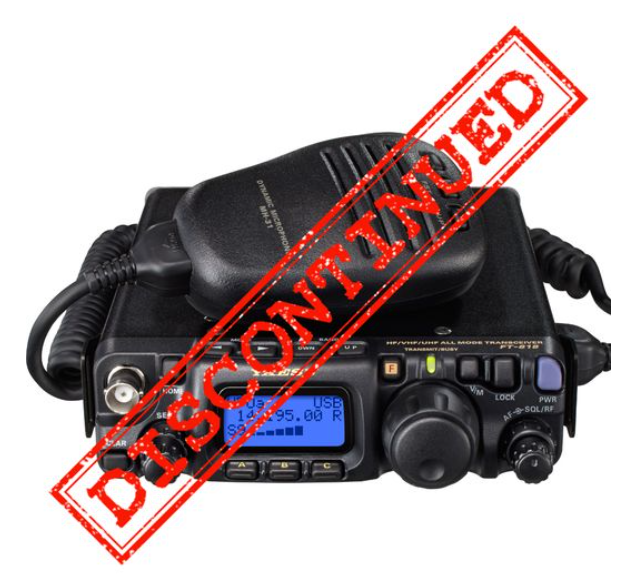
This past weekend's reveal at the annual Japanese Ham Fair may kill off the market for good used Yaesu FT-817s & 818s. Yaesu announced the pending release of their FT-818 replacement, the FTX-1F. 


From what we know so far, this new radio looks like it's got a pretty good feature set. There are some lingering questions about things like Bluetooth, Wi-Fi and GPS capability, but overall it looks like a worthy successor to the FT-818, and should give the Icom IC-705 some stiff competition. But we won't really know how 'stiff' until we start seeing some pricing information.

But if you are like me, and have one (or more) of the venerable old FT-818s sitting around, and are thinking hard about the FTX-1F, the question now becomes, what do I do with my old 818? Here's some options I've been pondering:
  • Put together a radio 'bug-out' kit with the FT-818 as a centerpiece and just leave it in my truck
  • Set it up in my ham shack as a back-up (to a back-up). The little rig does just dandy on VHF/UHF and with my exterior antenna I can hit our local repeater with ease. I may just designate it as an over-sized HT and call it a day
  • Hook it up to a SignaLink, park it on a single digital frequency, and turn it into something like a full-time JS8Call machine
  • Try to rig up some sort of manpack HF system
  • Sell it to help fund the possible purchase of an FTX-1F
  • Use it as a door stop


Like so many hams, I've got a soft spot in my head heart for the FT-817/818. It was a paradigm changer when it came out in 2004, and it's the radio that helped start the SOTA craze. It proved to be a rugged and versatile little beast that saw it used in some pretty unusual non-ham applications. How unusual? It was bought in large numbers by Central and South American revolutionaries and drug cartels (often one in the same) for short and long range jungle communications. While today it's a very outdated design, that's no reason to toss it. After all, every week we've got thousands of hams firing up even older tube-based gear to get on the air. Nobody today thinks of tossing a Collins S-line into the dumpster. 

OK, so I've talked myself into hanging on to my FT-818. But what to do with it? Other than the ideas I've outlined here, anyone have any suggestions?

W8BYH out

05 May 2024

Old Radios and Misplaced Nostalgia?

There's a style of radio that has fascinated me for decades. I love the concept of the manpack VHF and HF rigs, a design we first saw in WWII as the SCR-300, reached a design peak in the 1960s with the PRC-77, and culminates today in radios like the Harris PRC-160 HF/VHF manpack

SCR-300 in use during WWII


AN/PRC-25/77 as used in Vietnam


Current production Harris PRC-160. 
Twenty thousand dollars of glorious battle-ready manpack radio technology. And you can't have one.

For years I've idealized this style of radio, and pursued US and foreign models on the used market. But why a manpack? They really don't perform any better than table-top models. In fact, in the Amateur Radio realm they are more likely to perform worse - low TX power, poorer receiver performance, cooling issues, no internal tuner, too many accessory cables, and more. I look beyond all that to the unique and fascinating mash-up of technologies that are used in successful military and commercial manpack designs, designs that can overcome many of the limitations I've listed and provide good mid-range TX performance, good receiver performance, robust tuners, robust weatherproofing and long battery life. All in a package small and light enough to toss in a backpack, go for a walk, and make contacts. 

I've got a small collection of both military models (PRC-77, Czech RF-10) and commercial models (Vertex Standard VX-1210, Yaesu FT-70G), But I'm bumping up against some inevitable issues - most of his hardware is 50+ years old, no longer performs as it originally did, and is not really worth the expense to keeping running. That means when one of these radios dies, its next trip will be to a landfill or electronics recycling center.

Twenty five years ago manpack radios were less difficult to find. There were more of them on the market because there were more manufacturers in the market. Additionally, embedded encryption and military only waveforms were not in wide use like we see today. As encrypted systems became the norm, spurred on by America's conflicts in the Middle East and the rise of cyber warfare, the supply of surplus systems started to dry up. The available older systems were snapped up by collectors and reenactors, or sent for recycling. The newer systems could not be released to the surplus market. These encrypted systems, by law, can not be sold to the public. Instead, the radios had to be ground up or melted down to destroy the embedded encryption systems. 

This means that there's really no military manpack radios of recent manufacture available on the surplus market. Some manufacturers like Harris, Barrett and Codan do make civilianized versions of their high end rigs - radios that lack the sensitive embedded encryption. These are designed for sale to organizations like NGOs (UN relief agencies, Red Cross, etc.) and are legal for civilians to own. However, these radios are extremely rare on the used market, and when they do show up are too expensive to consider. As I write this one online vendor, Green Tip Surplus, offers a used Harris RF-7800 radio (civilian version of the PRC-160) starting at $8,500, with no batteries or accessories. And I have no doubt it will sell at that price.

Ouch

Codan Sentry manpack. Somewhat less ouchy than a Harris 7800, but still painful
at over $6,000 for a new stripped out model


Ham radio manufacturers have gone part way down this path with a few of their radios. I've already mentioned the Vertex Standard VX-1210 (originally made by Yaesu) and the Yaesu FT-70G. These were radios designed for commercial and military markets but bled over into the ham radio market. Other kinda' sorta' manpack rigs designed specifically for the ham radio market include the Icom IC-703, the Yaesu FT-817/818, the Elecraft KX2 and, of course, the current Icom IC-705. Of all of these, the IC-703 came closest to my idealized version of the manpack rig. Icom provided a whole host of manpack accessories, including an internal tuner, direct connect HF antennas, battery packs, and a very well designed backpack. Many hoped (expected?) the IC-705 would just build on the concept of the IC-703, but port over the outstanding digital HF performance of the IC-7300. Alas, while the IC-705 is a great radio, it's also a radio that reflects some missed opportunities, particularly in the awkward physical design and the lack of an internal tuner. Icom does make a well designed backpack for the IC-705 (the LC-192), but it's sized to fit a Japanese school girl and not much use as a serious manpack container.

When the dust settles, we're left with what many would consider a dark horse candidate. The Elecraft KX2. The dark horse perception is odd, because Elecraft actually advertises this rig as suitable for HF handheld operation. This is made possible, in large part, by the excellent internal tuner Elecraft makes for this little rig. 

From Elecraft's own website. This KX2 was designed
with handheld HF operations in mind

The KX2 isn't particularly rugged, and it's very vulnerable to water intrusion (the case is just a stamped metal box with lots of openings), but the performance is world class.

There may be some interesting developments in the manpack HF field just on the horizon. One effort that is beyond the vaporware stage is the Lab599 TX-500MP. This was teased out earlier last year, and one or two pre-production models have seen daylight. Lab599 is a Russian company, but it moved quickly to distance itself from Putin and his antics in Ukraine. The company moved its production to the UAE and seems to have found some stability. The TX-500 has developed something of a cult following, and the company responds well to input and puts out regular firmware updates, always a positive sign. 


There's not a whole lot of info out on the TX-500MP yet other than some basic specs, but Lab599 does keep the user community updated on its development status. The radio looks like a channelized version of the TX-500 with an integrated battery pack and antenna tuner. There has even been talk of a digital soundcard interface. In terms of a real product that may see the light of day in the next year or so, this looks like the best bet.

The other developments are merely speculative. Icom recently teased out that there's something new coming. They won't say what, but it likely won't be a new HT. It may be a new UHF/VHF mobile rig, since the ID-5100 is getting a bit long in the tooth (but is still one of the best dual band mobiles on the market). Or, it could be a new HF/VHF/UHF portable rig. Icom did something odd last year. They pulled the IC-7100 from production, then within literally a few months they put it back into production and acted like nothing every happened. It was a very odd sequence of events, and Icom never commented on what was going on behind the scenes. The IC-7100 is a very nice radio, and it was a strong seller for Icom, but it too is getting long in the tooth, and its DSTAR capabilities are a bit dated. The switcheroo Icom went through may well signal that Icom had the IC-7100's replacement about to enter the pipeline, but hit a snag and decided to keep the 7100 going just a bit longer. So, Icom may be poised to release information on this new radio at Hamvention in Xenia, OH in a few weeks. Fingers crossed that whatever they do release is a good manpack platform.

This last speculation is way out there. Yaesu killed off its FT-818 last year and there's been no discussion of a replacement. Yaesu simply can't let this gap in their product line continue. QRP activities like SOTA and POTA are sweeping the ham radio community, and in the US most of the spend to fill that demand has been on the Icom IC-705. Yaesu can't let Icom go unchallenged in this market. Or maybe they can. In the past decade or so, Yaesu seems to have gotten pretty good at snatching defeat from the jaws of victory, as reflected in some pretty clumsy hardware releases.

Some may be saying, "But Brian, what about the Chinese?" OK, I'll admit that the soon-to-be-released Xeigu 6200 looks pretty neat, but if you've read any of my posts over the past few years you'll know that I don't spend money on Chinese products. 

We'll check back on this subject after Hamvention. I'm hoping we'll have one or more really good manpack releases to talk about. Until then, 73!

W8BYH out

04 February 2024

So Close, Yet Still Oh So Far

I got bored yesterday and decided to put together yet another one of my ham radio transceiver evaluation spreadsheets. This time I wanted to evaluate QRP and 100 watt HF rigs against the same criteria, but not have them compete in the same space. So I decided to take a look at 100 watt rigs and QRP rigs separately.

My evaluation criteria change around the margins from year-to-year, but there are always a core set of requirements I'm looking for. These are MY requirements, the features and capabilities that matter to me. I also only evaluate rigs I've got personal experience with, or rigs that have caught my eye. For example, as kind of a toss-in to see where the market is today I decided to add the new(ish) Yaesu FT-710 to the evaluation. I have no personal experience with the rig, other than about a 15 minute test session at my local HRO showroom, but felt it deserved to be evaluated against some of its older siblings like the FT-897 and the FT-891.

Some of the radios I evaluate are out of production, so their scores really are not relevant to anyone other than me. But, since they are in my radio arsenal, I figured they would serve a useful purpose to highlight how far current rigs have (or have not) improved in terms of features and capabilities.

Let's talk briefly about the evaluation criteria. As I said, these are features that matter to ME. However, I know from talking to a lot of hams that like to operate outdoors that many of you are interested in these features, too. I also weight the evaluation criteria. For example, I consider the a built-in sound card interface to be critically important, so I give it an evaluation weight of 3, as opposed to having back-lit buttons, which only gets an evaluation weight of 1. While I think back-lit buttons are important, I consider a built-in sound card interface to be three times as important. 

Let's review some of the criteria:

  • Built in panadapter. This implies the radio has a real-time panadapter and waterfall display. Over the years I've found this a very useful feature, particularly when doing digital modes. A panadapter isn't absolutely critical; some high performing rigs on this evaluation, like the KX2, don't have them, but if the radio does have one that's a plus
  • Sound card interface. I've already discussed this above. My feeling is this - with a modern rig of any type, if you are a manufacturer and don't include a sound card interface, you are half-stepping it
  • Ease of digital mode configuration. It's one thing to have a built-in sound card. It's another to have a firmware set that makes it easy to configure for and run sound card digital modes. In my experience, Icom clearly excels at this. While no manufacturer's digital mode configuration settings are exactly 'easy', Icom's configurations are the least confusing and aggravating to set up and troubleshoot. 
  • Internal battery. It used to be only QRP rigs came with internal batteries (and not all of them, at that). I can understand 100 watt rigs not having internal batteries due to cost and technical complexity (although that excuse is becoming harder and harder to swallow, given recent improvements in battery chemistries and charging technologies), but there is NO reason today for a QRP rig to not have replaceable, rechargeable internal batteries or, in the case of rigs like the IC-705 and the Lab599 TX-500, a battery holder that securely attaches to and integrates with the main radio body
  • MARS mod. This is important to me, but likely not to many others. I'm a licensed MARS operator, so the ability to do a wide-band TX mod on any radio I own is important. The good news is that just about any radio can take a MARS modification. The challenge is the cost and difficulty. Most radios need some physical modification - either the removal of diodes or, in the case of some Yaesu rigs, adding a solder bridge across two open pads on a board. But the all-time winner is Elecraft. Their MARS mods are done via software - quick, easy, elegant and reversable
  • Tuners. Most tuners built into 100 watt rigs are anemic, handling (at best) a 4:1 antenna mis-match. They'll tweak up an 'almost resonant' antenna, but choke when the SWR crawls above 5:1. But what if you are dealing with some serious mis-matches under something like disaster response conditions? Spare me the talk about only using resonant antennas. I operate in the real world, where I've got one antenna up, and it's got to work on 10 - 40 meters and, if possible, at reduced power on 80 meters. This is why I want a more robust tuner in my radio. I'm OK with a tuner that can handle a 4:1 mis-match, but if you can give me one that'll handle 10:1, and build it into the radio, you get an extra point in my evaluation
  • IP and MILSTD ratings for water/dust resistance and ruggedness. Every rig fails at this, but I keep it as aspirational evaluation criteria. Both Yaesu and Icom know how to build IPX and MILSTD radios - they do it every day for the military, marine, aviation, commercial and land mobile markets the serve, and they also do it for some of the ham radio UHF/VHF handheld radios they currently make, like the Icom ID-52. There is no reason why they can't put just one HF radio in their lineup that meets these standards
  • Factory ruggedized. This is the most subjective evaluation criteria I have. It is different from IP and MILSTD ratings, but the end goal is the same - a radio that offers improved water and shock resistance for field use. There two radios on my list that manufacturers have either implied or outright stated as built to a higher standard - the Icom IC-7200 (now out of production) and the Lab599 TX-500. I've opened up my IC-7200 several times, and I can tell you that radio is about as water resistant as a submarine with screen hatches. It looks rugged, but it's really just a plastic shell surrounding a huge heat sink. A good radio, yes, but in no way water resistant. Icom should be ashamed of itself for implying in their product literature that the IC-7200 was in some way more water resistant than other radios on the market. The TX-500 is a different story. Lab599 proudly states that the radio is built to offer a higher level of water resistance. While the radio doesn't meet IPX or MILSTD ratings, reports from the field are that the radio really does offer serious water resistance in light rain and snow (it's a Russian design so, yeah, snow). The TX-500 is the only radio I give an extra point to for being truly rugged 

What's not in this evaluation criteria? UHF/VHF capability. Since I'm only interested in HF, I don't take into consideration any UHF/VHF capabilities the radio might have. Both the IC-7100 and the IC-705 offer UHF/VHF, but I simply don't care when it comes to what I'm looking at here. I also don't evaluate for CW capabilities. I'm not a CW operator. HF voice and digital only.

So, winners? Here's a few:

  • In the full-size 100 watt category, the IC-7300 is the winner. I've said this many times in the past - if you want an HF radio that works great in the widest number of scenarios, the IC-7300 is it. After over a decade in the market it really hasn't been beat. It's not a perfect radio by any means, but compared to all the others in it's market niche, it is still the best.
  • In the QRP rig category, the IC-705 is the clear winner. Like the IC-7300, it works best in the widest set of circumstances and offers those used to Icom's command and feature set a very similar menu structure. In fact, if you can operate a current Icom HF radio (7300, 7610) you can operate the 705 with ease. Performance on HF digital, with one exception, is a dream. It is hands down the easiest to configure and run digital QRP radio on the market. That one exception? RFI interference via the USB connection. This is a very serious issue, one that Icom has acknowledged, but not likely to address. The way around this is to run the radio on digital modes via wi-fi. There are several apps you can use for this, but I've had the most success with Icom's own RS-BA1 software 
There's no losers, per-se. Just several second place finishers, and a few radios that should have been spared this comparison (like the Yaesu FT-818 and the Xeigu G90). The #2 finisher in the 100 watt category is the Icom IC-7100. Even after 15 years of production, this is still a very viable design, with an excellent feature set and great digital mode performance. Icom kinda' sorta' killed it off in early 2023, then resurrected it for another production run (and with a corresponding price increase). Speculation is that the 7100's replacement has been delayed due to chip shortages (boy, that excuse is wearing thin), and Icom scraped up enough parts to do a final production run or two of the 7100 as a 'gap filler' until the new radio can make it to market. 

Some observations regarding other radios. The Yaesu FT-891 remains the radio that could have been. If  you look at the score it received, a respectable 9, and then consider where that radio would have placed if Yaesu had put a sound card interface in it (giving the rig 3 more points), that would have put the radio in a solid 2nd place, ahead of the IC-7100. But considering Yaesu has a long history of snatching defeat from the jaws of victory. Jeezus guys, just a simple sound card interface!

The Yaesu FT-710 looks like a solid performer, and I have to admit that I quite liked the interface when I played with it at HRO. Far, far better than the awful interface on the FT-991A. But I've also heard some of the same stories regarding digital mode configuration with the 710 that I heard with earlier models. Again, an overly and unnecessarily complex command set. I'll be doing more research on this rig before making a final assessment.

In the QRP category, while the Elecraft KX line remain strong contenders, their single biggest weakness is digital mode operations. The KX2 is a bugger to configure and run on digital modes, and the rig heats up very quickly. It just seems that digital operations were an afterthought with these rigs. On sideband they are unmatched in their class - even better than the IC-705. The venerable old FT-818 is such a simple rig that it's actually easy to configure for digital modes, and it'll run all day long on its 5 watt output. Sometimes simpler is better. Too bad the old girl isn't really competitive in any other category. But hey, it's almost a quarter century old design, so it can be forgiven.

OK, this is it for now. Remember, these are MY selections based on MY criteria. I'm sure many of you will disagree, so let me have your comments!

W8BYH out

29 December 2022

FT-818 QRT

Word dropped yesterday that the venerable FT-818 was taken out of production by Yaesu. As of this morning Gigaparts does not list the radio at all on their website, and HRO shows it either out-of-stock or low stock at all of its stores.

 
I've written extensively about this little radio on this blog and on various Facebook sites. I consider it the last of the 'good' generation of Yaesu radios, along with its sister rigs - the FT-897 and the FT-857. The FT-818 had a 20+ year production run, perhaps the longest of any Amateur Radio (although I think the Icom IC-718 may be giving it a run for its money). In the end it was killed off by the one thing no electronics system can escape - parts availability. According to Yaesu they couldn't source many of the components needed to build this radio. Of course they could have re-designed the rig to take advantage of components that are available in the market. A lot radio manufacturers have had to do this - including Icom and Elecraft. My guess is that Yaesu gave it some thought but realized that, given the age and design of the radio, it was just time to let the old girl go and work on bringing something new to market. At least I hope that's what Yaesu was thinking. Yaesu is being very cagey about what might be coming. I'll say this though - throughout the pandemic and chip shortages, Yaesu has been the one Amateur Radio manufacturer that hasn't been shy about bringing new products to market. Some have been minor refreshes like the FT-5DR handheld, some have been new development products like the FT-710. But while all the other manufacturers have been sitting on their hands waiting for things to shake out, Yaesu has pushed ahead. To me this indicates that Yaesu is likely to already have a replacement for the FT-818 waiting in the wings.

In an earlier post I mentioned that in 50 years there'll be more FT-817/818 rigs still on the air than  Icom IC-705s, and I truly believe that. Given the sheer number of 817/818 radios out there, and the fact that the 20 year old design is easier to maintain than an SDR, I'll wager that in 2101, the 100th anniversary of the FT-817s introduction, there'll be special event stations dedicated to firing up these great old rigs and getting them on the air. By that time the IC-705's will all be recycled electronic waste. 

So raise a glass to the old gal, the radio that defined the QRP shack-in-the-box concept and helped  launch the SOTA movement. And if you have one, make sure she gets on the air every now and then.

W8BYH out 

07 October 2022

What If Joe Stalin Designed A Radio?

For years I've been down on Yaesu radios, but just the current generation of Yaesus, particularly their lower-end HF models like the FT-891 and 991A, and their handheld radios. These aren't bad radios - in fact they are quite capable and very well made. But it's as though the radio interfaces are done by a high schooler with little understanding of  man-machine interface design. Additionally, it seems that too many Yaesu designs follow the rule of 'thou shalt not steal market share from existing products', so old radios linger too long in the lineup, and new products get stripped of features one-by-one as the marketing guys and bean counters hold sway.

However, I have a soft spot for Yaesu's early 21st century offerings. I'm talking about the FT-817 (still produced as the FT-818), the FT-857 and the FT-897. At the time of their release (between 2000 - 2005) they were considered groundbreaking - an entire suite of radios specifically designed for outdoor use, scaling up in size and capabilities from one to the next. I own an FT-818, I used to own an FT-857, but sold it to buy an FT-891 (big mistake), and I recently bought a good used FT-897D. The 818, the 857 and the 897 are what I call unpretentious radios - they just work, with a minimum of fuss. The diminutive 818 exudes 'cuteness' while still offering an amazing array of features and a very good design layout. The 857, very specifically designed for mobile operations, exhibited one of the best developed control layouts ever put on a radio of its size. The placing of control buttons concentrically around the VFO dial was a brilliant way to address the lack of front panel real-estate. Sadly, Yaesu didn't carry that design element into the later FT-891. I'm still scratching my head over that one. 

But the FT-897 is a radio that, while unshackled from the front panel space restrictions of the 818 and the 857, still exhibits some odd layout elements. Nothing bad, but it's as though it was designed by someone who attended the Moscow School Of Radio and Farm Tractor Design. A tuning knob sits almost square in the center of the front panel, like the snout of a pig. A low resolution/low contrast LCD laughs at the pretense of modern digital radio displays. Industrial grade buttons and lights are scattered across the panel. A squelch knob that works the reverse of every other squelch knob ever designed. Two 'Batt A' and 'Batt B' lights that let you know which under-capacity battery pack you have selected for a whopping one hour or so of portable operations. Stylized front panel protuberances that pretend to offer protection to various buttons. A 'sidecar' tuner design - none of this fancy internal integration stuff, let's just bolt that sucker to the side of the radio and pretend it belongs there. And the piece de resistance - a carrying handle so outlandishly robust that it could do double duty as a handle on a Russian heavy machine gun.

A screen capture from Tracy, VE3TWM's excellent short video on the 897

All of this oddity of design mashes together to present a radio that works great, is a hoot to use, and is uniquely designed for outdoor use. 

The early 2000s Yaesu command set is easy to figure out with just a cursory reading of the manual, the buttons are well labeled so there's no mistaking what they do, the display gives you all the key information you need to operate, and not a pixel's worth more, and the radio covers all the ham bands from 70 cm to 160 meters, in all modes. It's a good performer on SSB and FM, and I'm told it's very good on CW. The 897 is the Swiss Army knife of ham radio, if Swiss Army knives were made in a Russian tank factory.

One of Yaesu's design goals for the 897 was low power consumption for portable use. That's why we get the small display, no back-lit buttons, no IF digital signal processing and other power saving design features. The 897 sips power relative to more modern Yaesu rigs. It's receive power draw of 700 mA is about 400 mA lower than the FT-891, and is only one third that of the FT-991A. Even the much beloved Icom IC-706, a same-generation competitor to the 897, pulls a full 2 amps on receive.

The FT-897 does have some known issues, but the only one that gives me pause is the tendency of the  LCD display to develop vertical stripes - entire columns of dead pixels. This is a big problem with both the 897 and the 857. In fact, the first question knowledgeable buyers of either radio will ask is "Does the display have 'zebra stripes'?" Until a few years ago the fix was easy - ship the radio to Yaesu for a screen replacement, or order the part and have a knowledgeable repair shop do it. But I am told that Yaesu is now completely out of stock on these panels. So I watch my radio display like a hawk, praying I don't see any dreaded stripes developing.

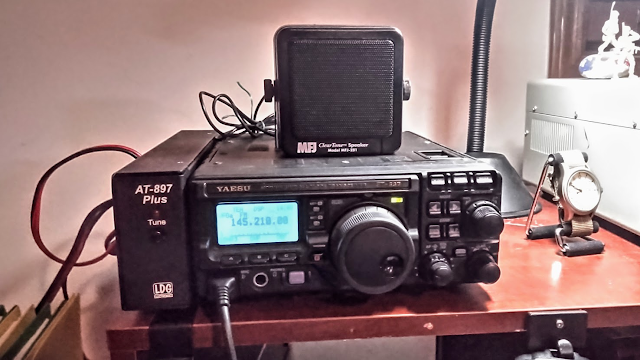
My 897, sporting an LDG 'sidecar' tuner

So how does it all work? Well, quite good, actually. I don't stress this radio out - it sits in my shack and works mainly 2 and 10 meters on just a few fixed frequencies. Its performance on VHF is not as good as my Icom ID-5100, and its HF performance is nowhere near as good as my IC-7300. But it doesn't have to near peer to anything else. No, my FT-897's job is to enjoy a comfortable retirement, work a little now and then, and remind me of a time when Yaesu built uncomplicated radios that worked without a lot of drama. And looked like they could be used as a chock block for a T-72.

W8BYH out

07 July 2022

Something Interesting From Yaesu

Everyone else is jumping on the prognostication bandwagon, so why not me?

Yesterday the word came out that Yaesu is releasing a new HF rig in August. Called the FT-710, it appears to be about the size of the Yaesu FT-991A, but it's HF only (no UHF/VHF capability). Now, the 991A is no diminutive little mobile rig, and the 710, based on the announced specs, is actually just a smidge bigger all around, so this isn't a SOTA rig by any measure. Some have observed that this is likely Yaesu's newest 'entry level' SDR rig, and is likely designed to go head to head with the Icom IC-7300. That sounds about right to me, because the radio incorporates Yaesu's newest SDR technology (which is getting great reviews). What little we know of the feature set so far looks good:

  • High resolution touchscreen interface
  • Build-in tuner
  • A DVI port on the back (for out-boarding the digital interface)
  • Two USB ports. 
  • SD card slot 

What's NOT been released yet is any mention of a built-in soundcard interface. However, Yaesu makes mention of a 'Preset' mode for things like FT8, and since you need a soundcard to run FT8 I'm guessing the soundcard interface is there.

The things I don't see but would like, beyond the soundcard interface, are:

  • Built-in GPS, and a GPS synched internal clock
  • Some level of industry standard environmental protection such as IPX5
  • A set of factory rack handles (a-la the IC-7200) would be nice, but if not I'm sure Portable Zero will be right along with a set
  • Yaesu traditionally 'gets it' when it comes to back-lit buttons (Icom? Icom? Icom?). Let's see if they continue the tradition
So far no power consumption numbers. I don't expect this thing to sip juice like the FT-817. After all there's a (relatively) power hungry digital interface in the mix. But Icom has proven with the IC-705 that digital interfaces and low power consumption are not incompatible concepts. Maybe Yaesu has incorporated some clever power management protocols and options into the radio. We'll have to wait and see.

The last thing I would ask for would be for Yaesu to please, for the love of God, clean up your awful configuration and settings interface. And please, don't make the dumbass mistake you made with the FT-891, and not provide an easy way to quickly switch between LSB and USB.

W8BYH out

10 December 2017

Snow!

In case you hadn't heard, the Atlanta area got a rare treat this weekend - snow! The VX-6 begged to go out and play.


It had a tough time making snow angels, though.

These radios are tough little buggers!

W8BYH out

02 December 2017

Testing the Yaesu VX-6R

Over the past few months I've become a huge fan of the Yaesu VX-6R handheld transceiver (HT). It is one of Yaesu's line of tough little handhelds designed for outdoor use. Yaesu's VX line has had a long run, and they are very popular. Sadly, the VX-6R seems to be the last survivor of that line - Yaesu recently killed off its sole surviving sibling, the VX-8DR. This has me wondering just what Yaesu intends to do with the line.

The VX-6R isn't a very sophisticated radio by today's standards, but the chunky little handheld (it's smaller than a pack of cigarettes, if anyone remembers how big those are) offers a lot of technology stuffed into a small package. It offers a tri-band transceiver (2 meters, 1.25 meters and 70 centimeters), wide band receive including FM, air band and shortwave (!), a full backlit keypad and a fairly large display for such a small radio. That's about where the bells and whistles stop - no digital modes, no GPS, no color display. It's an honest radio, one that would meet the needs of about 90% of American hams.

But the real reason I like the VX-6R is that it's a tough little bugger. In its advertising Yaesu seems to be targeting this radio at the outdoors crowd, with glossy shots of the radio being used by someone obviously too close to water to be holding an electronic device. In Yaesu's parlance the radio is 'submersible'. Heck, it's even printed on the face of the radio.


Not one to shy away from a challenge, I decided to put Yaesu's claim to the test. Back in October, Tropical Storm Nate paid a visit to the Atlanta area and dumped a few inches of rain on us. OK, more than a few. I figured this was the perfect test environment for the little radio.


After a few hours of sitting on the tailgate of my truck it was time to test. 


I have to admit I was half expecting the little radio to fail!

Since this test I acquired a second (used) VX-6R as a back-up and put it through the same test during a heavy rainstorm. This radio also passed the water resistance test with flying colors. It appears Yaesu's advertising isn't hype - these little buggers really can stand up to being dunked or left out in the rain.

The VX-6R has become my 'take everywhere' HT - on dog walks, on fishing trips, to the shooting range. Although I don't abuse my communications gear it's good to know this is a radio I don't have to baby. It can easily survive a tumble from the tailgate of my truck or shrug off being left out in a drizzle. It is convenient to carry and easy to operate. When paired up with a decent tri-band antenna like the Diamond SRH320A it makes a tough, capable little communications package.  

If you've been thinking about getting a VX-6R I recommend you pick one up soon. Yaesu may well kill it off in the upcoming year to make more market space for something more modern but less capable than this little winner.

Highly recommended.

W8BYH out