Showing posts with label antenna. Show all posts

20 September 2026

HT Antennas - A Quick, Non-Scientific Evaluation

 A few mornings ago I was walking my dogs around the neighborhood, carrying my Icom ID-52a. There were some storm clouds bubbling up, so I decided, just as a curiosity, to test out the NOAA Weather Radio reception on the HT. Like many HTs today, the ID-52 has the seven NOAA weather channels pre-programmed. All  you need to do is hit the MR button on the radio a few times to get to the weather radio channel menu and scroll through them until you get a signal.

For those of you unfamiliar with NOAA Weather Radio, it's a service of the National Weather Service that broadcasts continuous weather forecasts and emergency and severe weather warnings nationwide using a set of seven fixed FM frequencies. The chart below is taken from the ID-52 user manual, and it shows something interesting. The ID-52 has ten weather program channels, but NOAA only broadcasts on seven. What are the other three for? As you can see, WX08 & 09 are reserved for use by the Canadian Coast Guard, and #10 is an old NOAA radio beacon frequency. The manual also shows the frequencies used by Weatheradio Canada, a service that was shut down earlier this year. 

Sacre bleu Canada, no weather radio for you!

OK, back to the dog walk. I can normally receive Channel 1 (162.550) very clearly on my home weather radio. Channel 2 (162.400) can also be heard easily, but not as good as Channel 1. So I know at least one channel should be easily picked up by the ID-52. I was surprised to find that I wasn't hearing anything on any of the seven channels. At the time I figured I probably had a radio setting wrong, and maybe weather radio reception was turned off. This morning the dogs and I were back out on our walk and I decided to try weather radio reception again. Standing in the same spot as on the earlier walk, I tuned to the weather radio channels, and still nothing. Because I had not touched the radio since the previous walk, I still put it down to a setting in the radio. Then, as I moved the radio around trying to get the dog leashes shorted out, I got a brief reception blip on Channel 1, and recognized the automated NOAA weather 'voice'. A-ha! Weather channel reception was turned on! The dogs and I took a different path on this walk, to get us to one of the high points in the neighborhood. Sure enough, Channel 1 was coming through, but very weak. The issue wasn't the radio, it was the stock Icom antenna.

I live in Fayette County, GA, just south of Atlanta (about 20 miles to the city line). The NWS broadcasts on Channel 1 from atop Stone Mountain, east of Atlanta. As the crow flies, it's about 33 miles between the transmitter and my HT. There's also a lot of terrain between me and Stone Mountain, so I understand why reception using a relatively short rubber duck isn't great. But do I have an antenna that can do better?

Stone Mountain is 1,686' above sea level, my little HT antenna
 sits at about 860' 

I got home and grabbed a small handful of HT antennas from my shack and headed out to the deck to test:

  • A SignalStuff Signal Stick dual-band whip antenna
  • A Diamond SRH77CA dual-band antenna
  • A Diamond SRH320A tri-band antenna
  • A Kenwood dual-band HT antenna - the same one that comes stock with the new TH-D75
  • The Icom PA-S270 that comes stock with the ID-52


Left to right: Signal Stick whip, Diamond SRH77, Diamond SRH320, Kenwood & Icom

The results of the test were not surprising - the longer the resonant antenna, the better the reception. The winner was the Signal Stick, pulling in strong signals on channels 1, 2 and 4. The undisputed loser was the stock Icom 'rubber duck' that came with the radio. The Kenwood was only slightly better, maybe a reception bar or two on the marginal channels. Both of these antennas have been around for a long time and are well regarded, but they don't offer the receive capabilities of the longer antennas. The 'Goldilocks' antenna, and in my mind the overall winner, is the Comet SRH320. It's short and light enough that it doesn't interfere with the ID-52's mission of being easy to carry and it still offers very good performance. While the stock ID-52 antenna could only pull in a few bars, the Diamond was showing full strength receive performance. 

So there you have it - I've confirmed the obvious. What this test tells me is that if I'm going to rely on my ID-52 (or any other HT that can pull in the NOAA Weather Radio channels) I'm going to have to bring along a better antenna.

W8BYH out

09 April 2023

A View From The Bench - 09 April 2023

Happy Easter!

The way things are going, I'll be dead before I get all my ham radio projects out of the way. I'm guessing that's a that's a good thing? It means I'll be busy right up until the end.

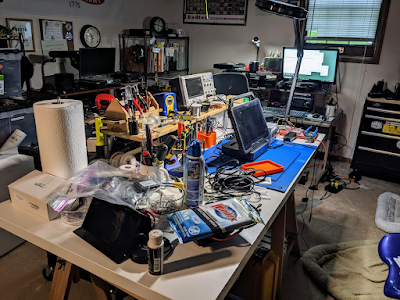
The view from the bench is... messy

I've already told my employer that I intend to retire around Christmas 2023. The retirement finances are lining up (as long as the current administration doesn't screw things up even more) and my wife and I have decided it's just the right time.  There's so much stuff we want to do while we are physically able to do it.

That includes more radio projects. The way these projects are stacking up, I'm beginning to think I should have retired a few years ago.

  • I've built a HobbyPCB HardRock50 amplifier for use with my Yaesu FT-818, KX2 and IC-705. The kit I bought from a seller on QRZ.com was new-in-the-box. It seems to work fine with the FT-818, but now I need to finish putting together the tuner. It's a project I've been putting off, and off. Time to finally get it done so I can test it with the Icom IC-705. That's a radio badly in need of a good 50 watt amplifier/tuner.
  • How about a TNC for the IC-705? I'm still trying to figure out how to get my Mobilinkd TNC3 working with the IC-705, so I can do VHF packet (and maybe APRS?) on it. Any ideas?
  • As for APRS, there's more to do be done. I'm increasingly curious about APRS and its potential use for emergency communications. Sadly, there are few good out-of-the-box solutions. The biggest issue is the difficulty of composing and managing messages. This is where the Yaesu FT-3DR (and, I suspect, the FT-5DR) fails. Spectacularly. To be fair, offerings from other manufacturers like the otherwise great Kenwood TH-72D and 74 had the same issue: lousy messaging interfaces. The best solutions I've seen so far are third party apps like APRSDroid for Android and APRS.fi for iOS, linked by Bluetooth to a TNC like a Mobilinkd TNC4
  • Speaking of Yaesu, Kenwood & Icom, things have been very quiet on the new announcement front. While not normally a bad thing, these are not normal times. Yaesu has done a good job of keeping interest going in their radio lineup with some new releases like the FT-5DR, the FT-DX10 and the FT-710, but there's been almost nothing out of Icom, and Kenwood has been silent on new releases since before the pandemic. With the announced demise of the IC-7100, Icom has a huge hole in their HF/VHF offerings. Specifically, Icom has no high power HF DSTAR offering, a significant market gap for a company that has hitched it's ham radio star to DSTAR (pun intended). All eyes are on Hamvention!
  • Web map development. The ARES Southeastern US Situational Awareness Map is slated to receive a major clean-up, where I'll be pulling selected data layers from the map to improve performance. Many of the more esoteric layers that get little, if any, use will be dropped in an attempt to improve map load and refresh times
  • I've about finished my hunt for the perfect laptop for use during outdoor activations, and I've got an upcoming post on the topic. After spending over a year testing and evaluating I've found my ideal. And it's not just good - as Tony the Tiger says, "It's great!"
  • I'm getting back to an earlier interest in HF-based off-grid emergency communications. I covered the topic in some depth a few years back, but the new player on the scene - VarAC (Vara Chat) - looks like it's lapped the previous HF chat application leader, JS8CALL. Back in October I did a short post on it, but since then the pace of development on VarAC has been almost frantic, as the author and his supporting developers rush to incorporate new features. As a result the application interface has gotten a bit messy. My feeling is that the developers now need to take a pause and work on the interface and do an overall look and feel improvement
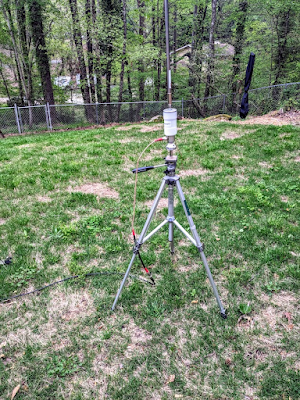
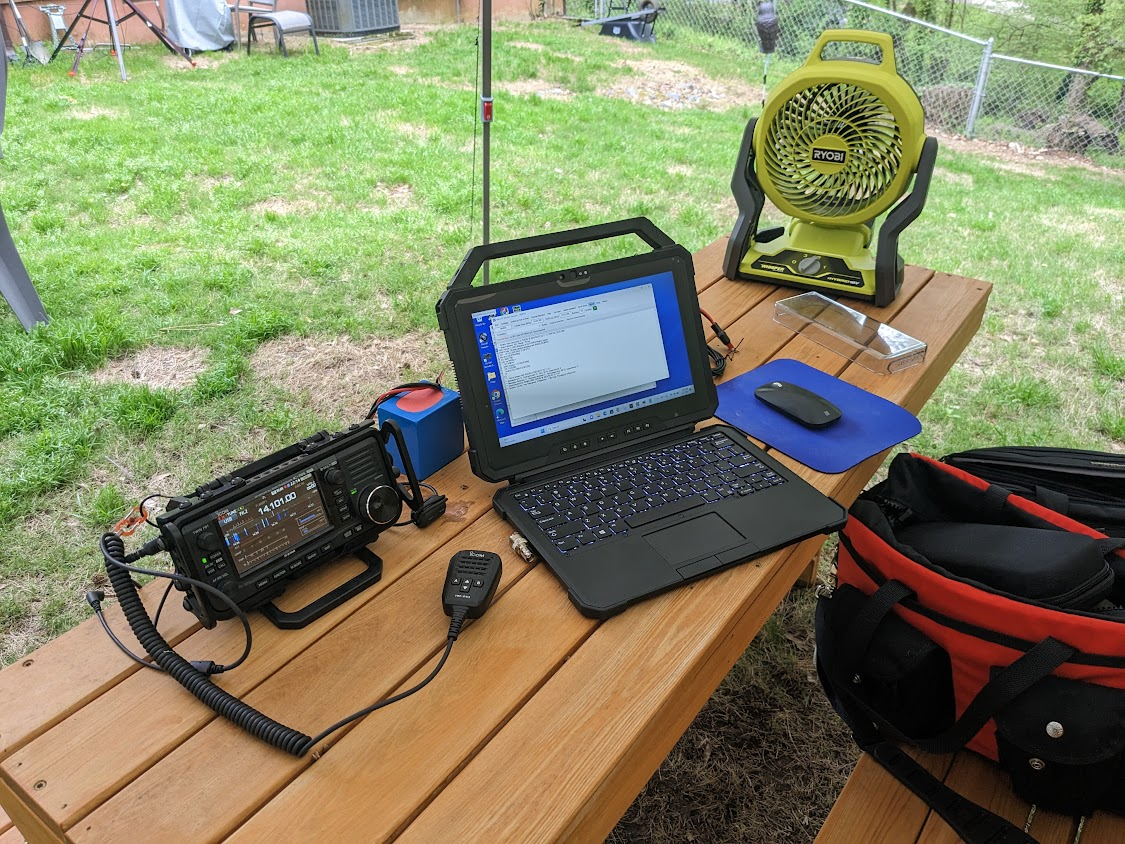
  • And last, sometimes the simplest works just fine. Yesterday I had a limited window of opportunity to 'play radio' in my back yard before a cold front with rain pushed through. I wanted to do some Winlink and if possible a few VarAC sessions, but I got caught up in some antenna issues. After fumbling with various configurations I just said 'screw it' and stuck a 17' Chameleon collapsible whip on a tripod with one counterpoise. I was surprised to find that combination worked just great on 10 - 40 meters (using a tuner, of course). I was hitting Winlink RMS nodes up to 400 miles away on 10 watts. I'll take that!
Chameleon 'mini' base with a 17' collapsible whip
and one counterpoise

The battery powered Ryobi fan does a great job of
keeping the little biting buggers away and the
operator cool. Runs almost all day on a
4 ah battery

Have a great day! W8BYH out.

06 August 2022

The View From The Bench - 06 August 2022

We're in what I'll call the 'post-Field Day, mid-summer ham radio doldrums', and for weeks now there's not been much ham radio stuff to report on. Down here in Gawga the weather has been hot, mostly dry, and buggy. Real buggy. So buggy that it's limited my outdoor operating activities. Then the XYL and I contracted COVID. While it didn't feel much worse than a mild cold, it did knock us back for almost two weeks, and we're still dealing with some lingering symptoms like congestion and coughing. Parallel to that, we launched on a major landscaping project to finally make our backyard habitable. What was supposed to be a little over a week job turned into a month-plus slog as the landscaper dealt with weather, material shortages and other demands on his time (he's a one-man show, so he works slow). Then a visit to the orthopedist for some nagging back issues threw me for a loop. What I hoped would be some simple muscle pain has turned out to be scoliosis, arthritis and a pinched nerve. That led to a canceled camping trip that we had both been looking forward to.

Slow progress, but progress


Getting old sucks.

So on to sunnier topics...

iPads 

Where I work (aka 'The World's Busiest Airport') senior management made a long overdue decision to go with a new maintenance management system. Part of this adoption will require provisioning the field crews with tablets that they'll use to respond to work orders and do inspections. The tablet of choice, and the one we steered them to, is the iPad. The software developer's apps just seem to work better on iOS devices. I'm not an Apple guy, but the XYL is. In fact, she's got a stack of old iPads sitting in a closet. Most of them were still perfectly serviceable, so I thought I'd grab one or two of the newest, update them, and use them to test and train on the new software. No such luck. The app requires at least iOS 15. The most current OS that could be loaded on any of these old iPads was iOS 14.x. The app wouldn't run. Damn. I needed to replicate exactly what the field crews were seeing on their devices so I could help train and troubleshoot, so an Android tablet wouldn't do. I needed an iPad, and I needed one fast. Double damn. After a few days of hunting around for the best deal, I settled on a new iPad Air. I found I could buy one on-line from the Army and Air Force Exchange System (AAFES) - one of the benefits of being an Army retiree - at a $200 discount and no sales tax.

Of course - of course! - the iPad got ham radio apps loaded on it. In fact, this is what the XYL suspected I really wanted it for. No honey, it's not. I had better uses for that money, plus I'm an Android and Windows guy (I love my Surface Pro). But I figure that as long as I've got the thing, why not try out some ham radio apps. My good friend Joe, KI4ASK, a long time Mac and iOS  addict/partisan/evangelist, has been singing the praises of a new iOS app for the Icom IC-705 (and IC-7610 and 9700) called SDR-Control for iOS. The app is written by Marcus Roskosch, who apparently designed the software interface for Flex radios, and a number of other highly regarded applications. I guess he knows what he's doing. I'm still in the learning stages with this app, but I have to agree with Joe, it's slick. While I can't say I'll ever use it for La-Z-Boy QSOs, I was sitting in said chair a few nights ago and just doing some SWL scanning while connected to my IC-705 via wi-fi . Lots of fun. I may have more on this at a later date, but for now I'll let Josh at Ham Radio Crash Course give you the rundown:


Antennas

I make no secret of the fact that I'm a Chameleon Antenna fanboy. What they make works, is rugged as hell, is well documented, and the company stands behind their products. A man has to have a vice, and since I don't smoke or drink (much), I decided my vice will be Chameleon antennas. Last  year Chameleon came out with their Tactical Delta Loop (TDL) and it caught my interest. The TDL was an immediate hit and Chameleon has had trouble keeping it in stock, but recently I found that the Atlanta HRO store had one available, so I grabbed it. I've used Chameleon's vertical antenna systems for years, but I was looking for a portable system that was quick to set up, didn't require ground radials, had more gain than a vertical, and could be rotated to take advantage of the improved gain. The TDL is an odd looking contraption - two 17' telescoping whip antennas set in a 'V' configuration (think giant TV rabbit ears) with a section of wire running between them. The antenna is fed at the base using one of Chameleon's standard matching transformers. The antenna kit comes with a ground spike to support it, but I've chosen to use my surveyor tripod, which gets the whole antenna setup further off the ground (improving the take-off angle a bit) and makes it easier to rotate. I've only tested it a few times, and only with my Elecraft KX2, but it seems to work quite well on 10 - 40 meters. The tuner in the KX2 easily finds matches on those bands, and can usually find a match on 75 meters, but it's a struggle. My real goal is to set this up with my IC-705 and test it with Winlink and JS8CALL. I think it has a lot of potential as an EMCOMM antenna.

Chameleon TDL set up for a local 10 meter net

Well that's it for now. I need to get back to my daily routine of fighting COVID, doing back stretches and praying for rain. I've been running the sprinklers so much on my new sod that I'm afraid to open my water bill. So c'mon Mother Nature, how's about a few days of light but steady rain? Pleeeze!

W8BYH out

18 June 2022

Decisions, Decisons

The XYL and I are beginning preparations for a week long camping trip later this summer. Of course radio will be part of the adventure. The question is, which radio(s)? If I look at the goals I have for this trip (beyond campsite setup and tear-down, meal prep, entertaining the XYL, walking the dogs, entertaining the dogs, feeding the dogs, general camper maintenance, shopping, talking with camper neighbors, sightseeing, etc, - those of you who camp know what's involved), the things I want to do with radio include:

  • chasing DX
  • POTA activations
  • Winlink
  • JS8CALL
  • MARS
  • SHARES
  • testing & playing with ALE (Ion2G)
Of course the IC-705 is in the mix. It's become my default camping radio. It can easily handle the DX, POTA, Winlink and JS8CALL duties, but at a low TX level (max 10 watts). 


But for MARS and ALE I'll need a different rig. I've got a number of MARS modded radios - IC-7300, Yaesu FT-991A, IC-7100, IC-7200, even my Elecraft KX2(!), but only two are suitable for ALE operations - the IC-7300 and the IC-7200. Both of these radios bypass the band relays when scanning in 'split' mode. This means as the radio scans from band-to-band while running ALE you don't hear the 'clack-clack-clack' of the mechanical band filters switching in and out. The 7300 does this out-of-the-box, and my 7200 has the 'quiet scan' mod which achieves the same result. 

IC-7300. The all-around champ in my radio stable

IC-7200. Not as capable as the 7300, but a good bit more rugged

Almost as important as the radio is the antenna selection. The campsite is a bit cramped, with 'neighbors' close-by. I won't have space to string a 120' end-fed, or even an 80' dipole. I always have a Chameleon end-fed EMCOMM II with me, just in case, but for high power HF I'm likely going go have to rely on a vertical. Problem is, most modern campsites are awash in RF hash generated by any number of consumer devices that campers bring along, from LED light strings to portable generators. A vertical is precisely the wrong type of antenna to use in that environment - they attract electronic noise and hash like a magnet attracts iron filings. I have a magnetic loop, which is electronically quiet - mainly because it's so narrow banded - but it's only good up to 25 watts on sideband, even less on digital.
 
Vertical HF - occupies relatively little real estate, but attracts interfering RF
like a magnet

Mag loop antenna - quiet and effective, but can only handle 25 watts

I guess I've got some testing and planning ahead of me. Oh dear, how will I manage? 

W8BYH out

11 December 2018

AT-984 Antenna

I love eBay. I buy a lot of stuff off of eBay. (Although strangely, I've never sold anything through eBay. Does that make me a hoarder?) I also often turn to eBay for some laughs. Lately the eBay thing that makes me laugh are the prices folks are asking - and sadly getting - for an AT-984 long wire antenna for the PRC-25 or 77.

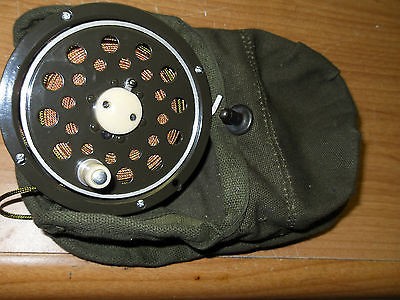
In the early 60's the Army recognized the need to extend the range of the PRC-25 beyond the (optimistic) five or six kilometers the radio was capable of when using the long (3 meter) whip antenna. The simplest way turned out to be the most effective - wrap some wire around the threads on the AB-591 long whip antenna base, screw it into the radio, pay out 150' or so of wire and you can easily double the range of the radio. The use of the AB-591 base was key, because there's an extra long 'nub' on the end of the base. As it screws into the radio that 'nub' contacts a switch deep in the antenna mount, indicating to the radio that a longer, more resonant antenna is in use. The Army wasn't content with telling RTOs to just carry an extra 150' or so of wire. Noooo - they needed to come up with an approved, type classified antenna system. Their solution was actually pretty neat (and cheap) - get some inexpensive commercial fishing reels (it looks like the Army selected the Pflueger Medalist fly fishing reel) and paint them olive drab, wind about 150' of thin but tough phosphor bronze wire on them, provide a crimped-on spade plug at one end of the wire to slip between the antenna mount and the antenna body, stick some simple user instructions on the reel, put it in a small canvas bag and name it the AT-984/G antenna. It worked great!


These things could not have cost Uncle Sam more than $15 each back in 1968. By all reports they were widely issued, so they were not rarities. But since they were not repairable I'm guessing a lot were broken or lost during combat and just written off. Surprisingly, I never saw one in the flesh in my 23 years in the Army (starting back in 1979), but I do remember seeing them in component listings for the PRC-77 radios. Our own field expedient manuals told us to just use a single 150' strand of WD-1 commo wire. A simple and effective substitution.

But I'm a military radio collector and dammit, I want a real, gen-u-ine AT-984 antenna for my collection! So this started me on the quest for a good example of an AT-984. I was surprised to find that there's usually one or two for sale on eBay. Great! But after a few weeks of tracking auctions (or buy-it-now sales) for these things it became apparent that everyone who owns an AT-984 thinks it's rare and valuable enough to contribute significantly to their retirement account. A hundred bucks seems to be the median value for these things right now, with the lower priced 'buy-it-now' ones moving quickly, the higher priced ones hanging around a bit longer but eventually selling for the asking price or racking up quite a few bids on auction. And condition is no impediment to a sale - I've seen beat-to-snot examples that were missing pieces and all bent up like they had been run over by a jeep sell for just as much as pristine, still in the wrapper examples.


Here's one currently on offer on eBay with a bent frame. It's in otherwise OK shape, and seems to be complete, but $104 plus $13.50 shipping for a damaged item? I guess because someone wrote 'B-1-135' (Bravo Company, 1st Battalion, 135th Infantry? Armor? Aviation? Who knows) on it in red paint it's collectible. But remember, this is not an unusual sale - and by comparison with some of the others recently sold on eBay this one is in pristine shape.

So I wait and watch, ready to pounce whenever someone financially solvent enough decides to put an AT-984 up for sale at a reasonable price. Or the current sellers come to their senses.

W8BYH out